Danielle had her cursor on the six months.
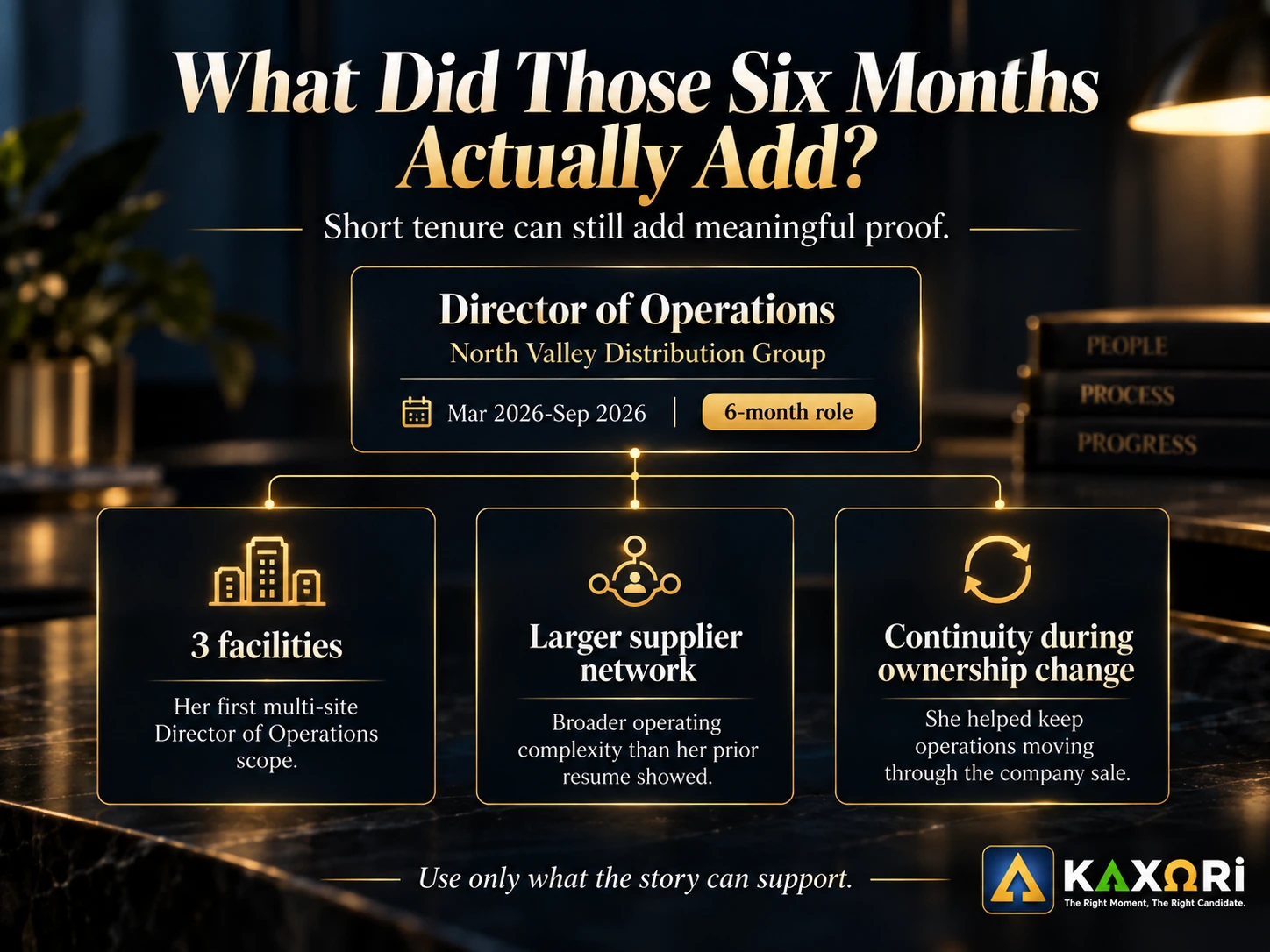
In March 2026, she took a Director of Operations role three weeks after a restructuring ended the job she had held for seven years. The new role gave her something her earlier resume did not: responsibility across three distribution facilities and a larger supplier network.
Then the company was sold. Six months in, her role ended.
Now that job sat at the top of her resume. Delete it, and the timeline looked cleaner. Delete it, and she also erased the strongest proof of the scope she had just earned.
At 47, Danielle was not only worried about looking like a job hopper. She was worried the timeline would make it look as though her career had stalled.
Should you leave a short-term job off your resume?
Sometimes. Keep a short-term job on your resume when it is recent, relevant, or proves scope you cannot show anywhere else. Leave it off when it adds little and removing it will not create a misleading gap.
A resume is selective, not a complete employment history. Harvard and UC Davis both recommend tailoring a resume around the experience that matters to the target role.12 If an application asks for a complete work history, answer that form as written.
What if the short job came right after a layoff?
That is exactly why Danielle's six-month role deserves a closer look. Her seven-year job ended in a restructuring, and the new role began three weeks later. Removing the short role would make the current gap look much longer and remove her only proof of three-site leadership.
A rebound job after a layoff is not automatically something to hide. Ask what it adds to the career story and what removing it would make harder to explain.
The real question is not, “Was the job too short?”
People often look for a simple cutoff. Three months. Six months. One year. That sounds useful because it turns a messy career decision into a rule.
But duration by itself does not tell you whether the job improves the resume.
That matters because a single short role is not the same thing as a pattern of job hopping. Purdue professor Michael Campion, a coauthor of recent job-hopping research, defines job hopping as a relatively high frequency of voluntary moves between organizations.5
Danielle had seven years with her previous employer before the six-month role. One short job after a long stretch of stability is a different career pattern from several voluntary moves in quick succession.
A recent six-month role may contain your strongest evidence for the next position. An eight-month role from 15 years ago may add nothing you still need.
Relevance, proof, recency and context are.
Is one short job the same as job hopping?
No. Job-hopping research looks at a pattern of repeated voluntary moves, not one isolated short role.5
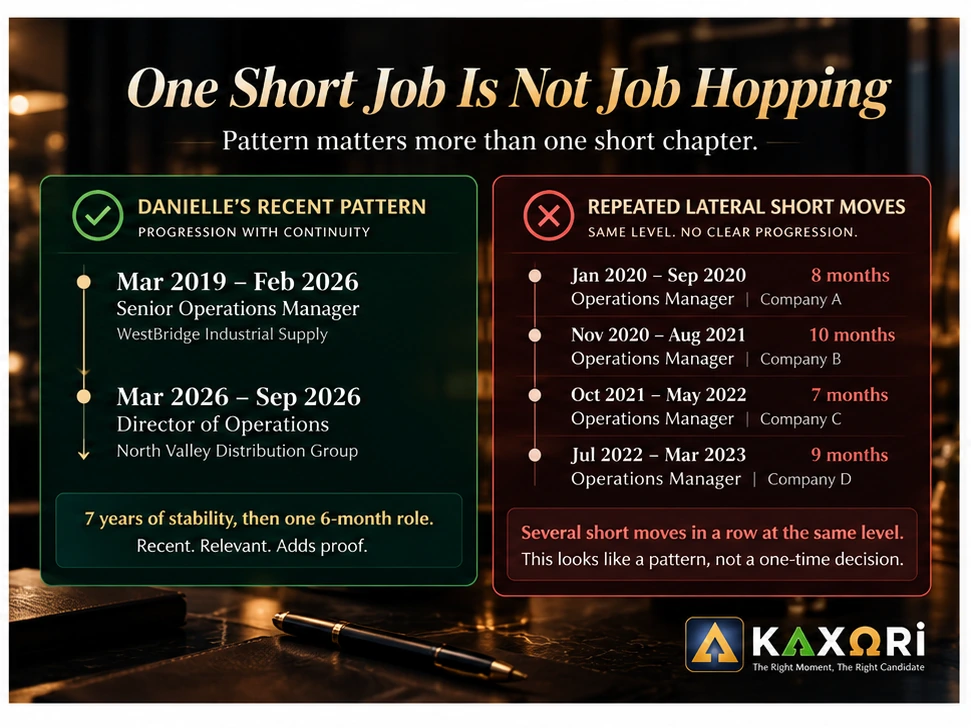
Danielle spent seven years at WestBridge before taking the six-month role. That matches the middle point in the U.S. Bureau of Labor Statistics' January 2026 data for workers ages 45 to 54. Half had been with their employer for less time, and half for more.10
The same study found that 12.2% of workers in that age group had been with their employer for a year or less.10 A short stretch with an employer isn't unusual, even in mid-career. These figures can't tell us how a recruiter will view Danielle, but they put her work history in context.
1. Keep the job when it adds evidence
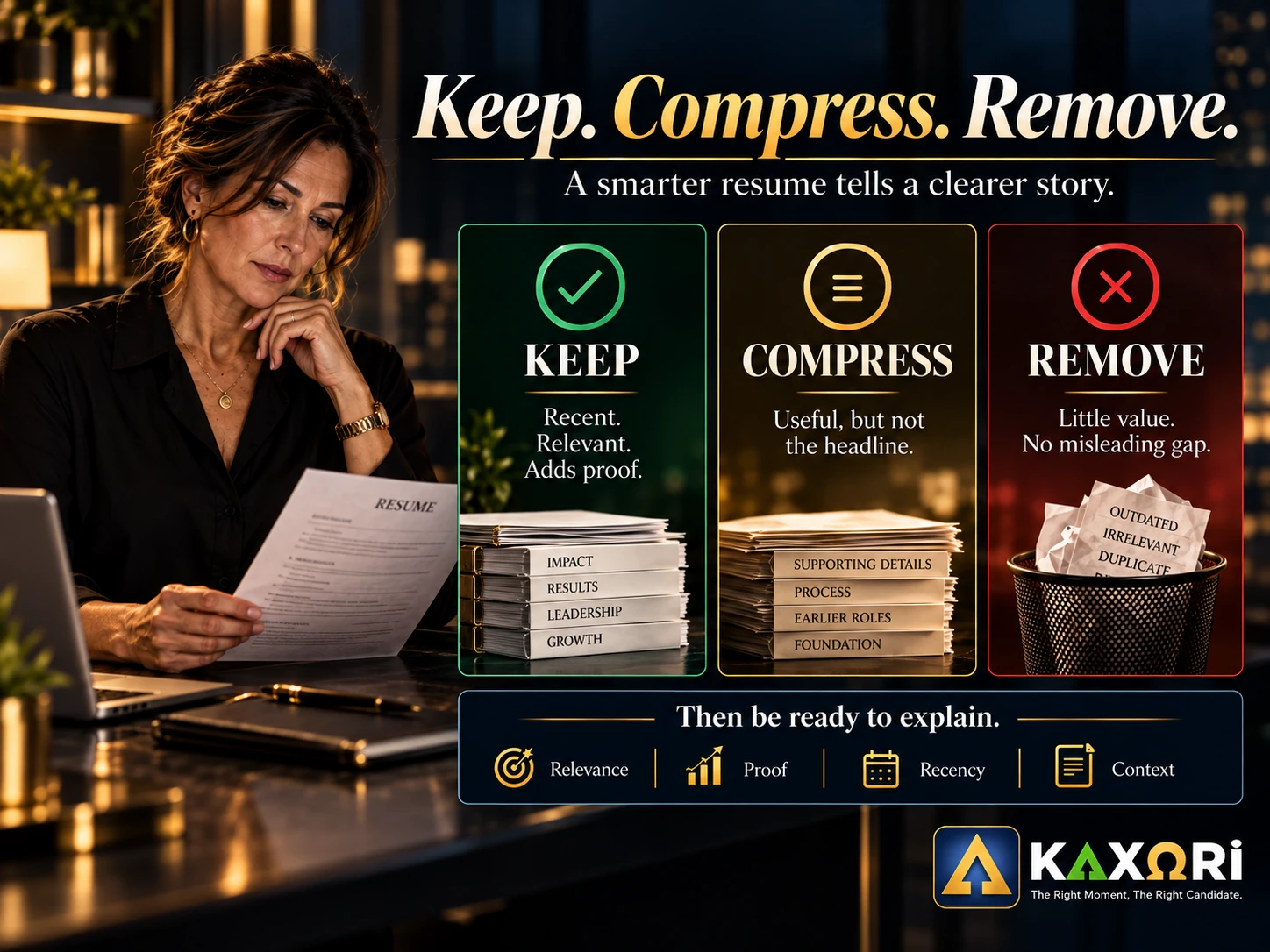
Danielle's recent six-month role gave her something important. She had managed a broader operation than she had before.
That mattered because the roles she wanted next called for wider operating scope.
She could ask five simple questions:
- Is this job recent?
- Is the experience relevant to the role I want?
- Did I accomplish something worth showing?
- Does it prove scope I cannot show elsewhere?
- Would removing it create an important unexplained period?
For Danielle, enough answers were yes. The job stayed.
That choice also fits an important finding from recent hiring research. In experimental hiring scenarios, visible career progression softened some of the negative reaction to job-hopping histories. Danielle's six-month role was not a sideways move. It was the first time she ran three facilities. The added scope is the evidence.6
2. Compress a short job when it matters, but should not dominate
A role can belong on the resume without earning five bullets and half a page.
Danielle could keep the employer, title, dates and one or two strong accomplishments. That gives the reader useful career context without making six months look more important than the rest of her career.
Short tenure does not require a long defense.
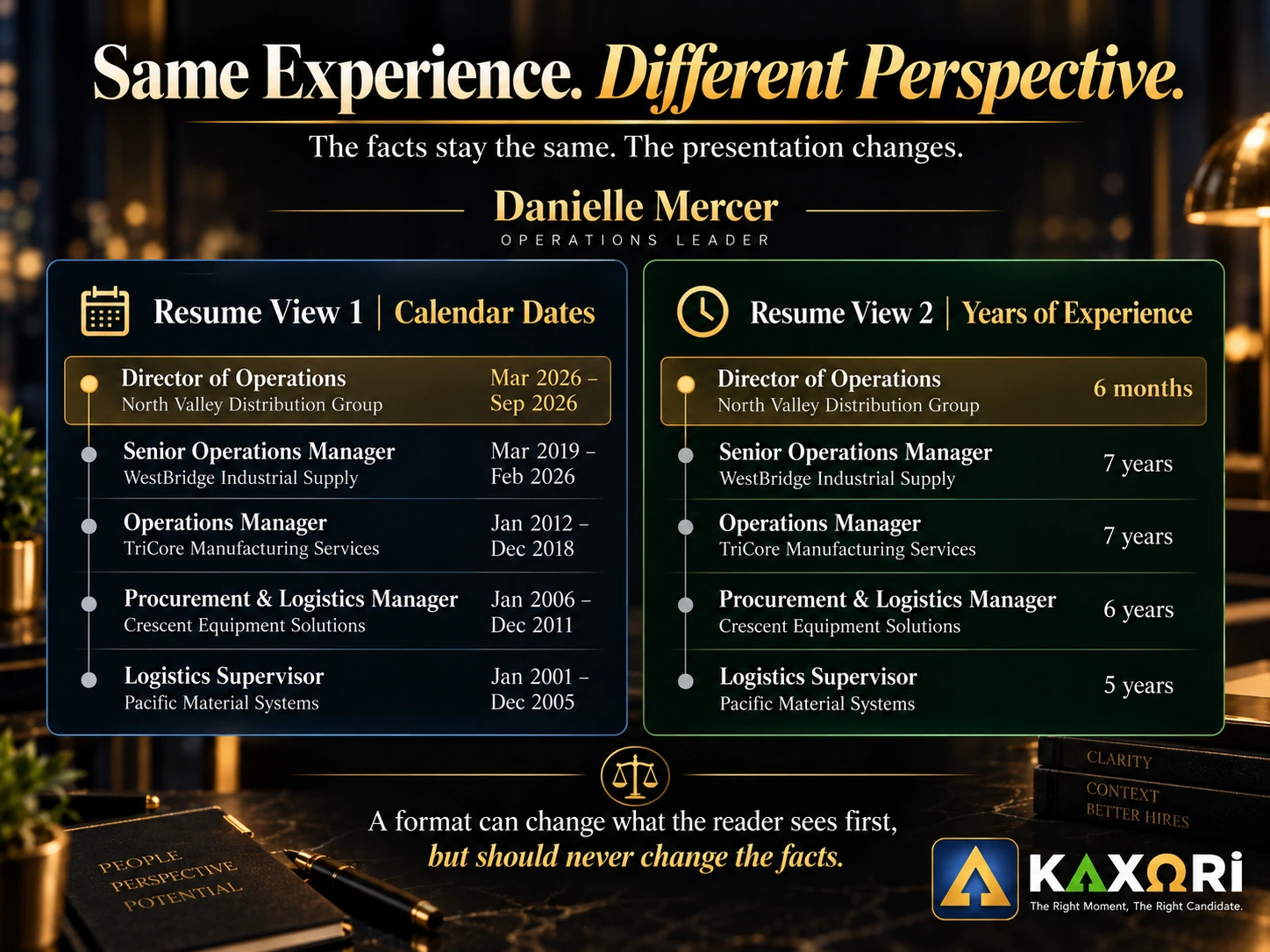
Same experience. Two ways to show time.
The jobs, titles and proof stay the same. Only the way time is presented changes.
Traditional chronological format
- Led operations across three distribution facilities and an expanded supplier network.
- Maintained operating continuity through an ownership transition.
- Managed regional warehouse and fulfillment operations.
- Strengthened vendor coordination and service consistency.
- Oversaw plant, distribution and workflow execution.
Experience-duration format
- Led operations across three distribution facilities and an expanded supplier network.
- Maintained operating continuity through an ownership transition.
- Managed regional warehouse and fulfillment operations.
- Strengthened vendor coordination and service consistency.
- Oversaw plant, distribution and workflow execution.
What changed, and what did not
Both examples use the same jobs, responsibilities and career history.
- Changed: how time is displayed and what the reader notices first.
- Did not change: employers, job titles, responsibilities or Danielle's actual experience.
The second example mirrors the experience-duration approach tested in the Nature Human Behaviour study. That research is useful evidence about presentation, not a universal rule for every resume. Follow the employer's instructions and never alter the underlying dates when they are requested.4
This is the kind of decision Kaxori is built to support: compare the target job with your career evidence, then show the experience that actually strengthens the case.
3. Remove a short job when it no longer earns the space
Some short jobs no longer earn space. An older role may be unrelated to the target job, add no unique proof and disappear from the resume without creating a misleading timeline.
For example, an unrelated eight-month role from 15 years ago may add less value than the stronger work that came after it. The point is not to hide short tenure. The point is to use limited resume space on the experience that best supports the job you want now.
Does it matter how long ago the short job happened?
Yes, but recency is a judgment factor, not a fixed rule. SHRM's recruiting guidance recommends evaluating gaps case by case and quotes talent leaders drawing a sharp distinction between an older gap and a current multiyear gap. That supports treating recent chronology as more consequential than a distant interruption.3
Career centers also tell job seekers to lead with the most recent and relevant experience. Harvard, Georgetown and UC Davis all emphasize reverse chronology while still tailoring the document around what matters to the target role.127
The same six-month tenure may therefore deserve different treatment depending on whether it ended six months ago or 12 years ago.
Be careful about creating a new gap just to remove a short job
Employment gaps can affect early screening, but the evidence is more nuanced than “gaps are bad.” A preregistered U.K. field experiment sent 9,022 applications across eight sectors, including software engineering, HR, call centers, warehouse operations, finance, manufacturing production management, administrative work and social care. The researchers tested several ways of presenting prior experience.4
when prior jobs were shown as years of experience rather than calendar dates, compared with resumes that displayed an employment gap.4
The same format also produced about 8% more callbacks than the study's no-gap resume condition. The field experiment used a fictitious mother with nine years of experience, while follow-up lab studies replicated the effect with male and female applicants and people with both less and more experience.4
How do you explain a short job in an interview?
The resume usually does not need the full story. An interview might.
For Danielle, the explanation can be simple:
“The company was acquired shortly after I joined, and the new ownership consolidated leadership. While I was there, I ran three facilities, which is the scope I am looking to build on now.”
Notice what the answer does. It explains the exit, then turns back to the evidence.
More broadly, SHRM's recruiting guidance recommends gathering the facts and using a straightforward explanation rather than assuming a gap or transition proves disloyalty or instability.3 Georgetown's career center adds an equally important rule for the candidate: do not lie, exaggerate or include something you would not want to discuss in an interview.7
“The organization restructured shortly after I joined, and my position was eliminated. I am focused now on roles where my operations background fits the longer-term needs of the business.”
“The scope changed considerably after I joined, and it became clear the position was not the right long-term fit. It helped clarify the kind of operating responsibility I am looking for next.”
“The company decided to make a change. I took the feedback seriously, and there are things I would handle differently today. I am happy to talk about what I learned from it.”
“I stepped away because of a family situation that needed my attention. That situation has been resolved, and I am ready to return to the kind of work I have been doing successfully.”
These are models, not scripts to copy when they are not true.
What if the job is on LinkedIn but not on your resume?
Your resume and LinkedIn profile do not have to contain the same amount of detail. Kaxori's recommendation is consistency, not identical length.
That matters because employers may ask about employment history, review public social media or use a background-reporting company during hiring. The EEOC and FTC both describe employment history and public social media as information employers may consider, subject to applicable law.8
So an older job can appear on LinkedIn and be absent from a focused resume. But the underlying dates, titles and employers should not contradict each other.
Selective is fine. Contradictory is not.
Should you use years only to hide a short job?
The 2023 Nature Human Behaviour field experiment found that an experience-duration format, showing years worked rather than calendar employment dates, improved callbacks in that study.4 That does not make years-only formatting a universal rule.
Some hiring systems parse employment dates as structured data. Greenhouse says its Talent Matching feature extracts years of experience plus employment start and end dates, and Workday notes that resume-parsing results can vary with formatting and word order.1112
Kaxori's practical rule: follow the employer's instructions, keep a dated version ready, and review every field the application parses before you submit it.
Federal resumes are different
Do not apply private-sector omission advice blindly to federal applications. The U.S. Department of Labor says federal resumes should include detailed work-history information, including starting and ending dates with month and year, and advises applicants to list positions chronologically. Always follow the specific job announcement.9
The bigger idea: career evidence versus career chronology
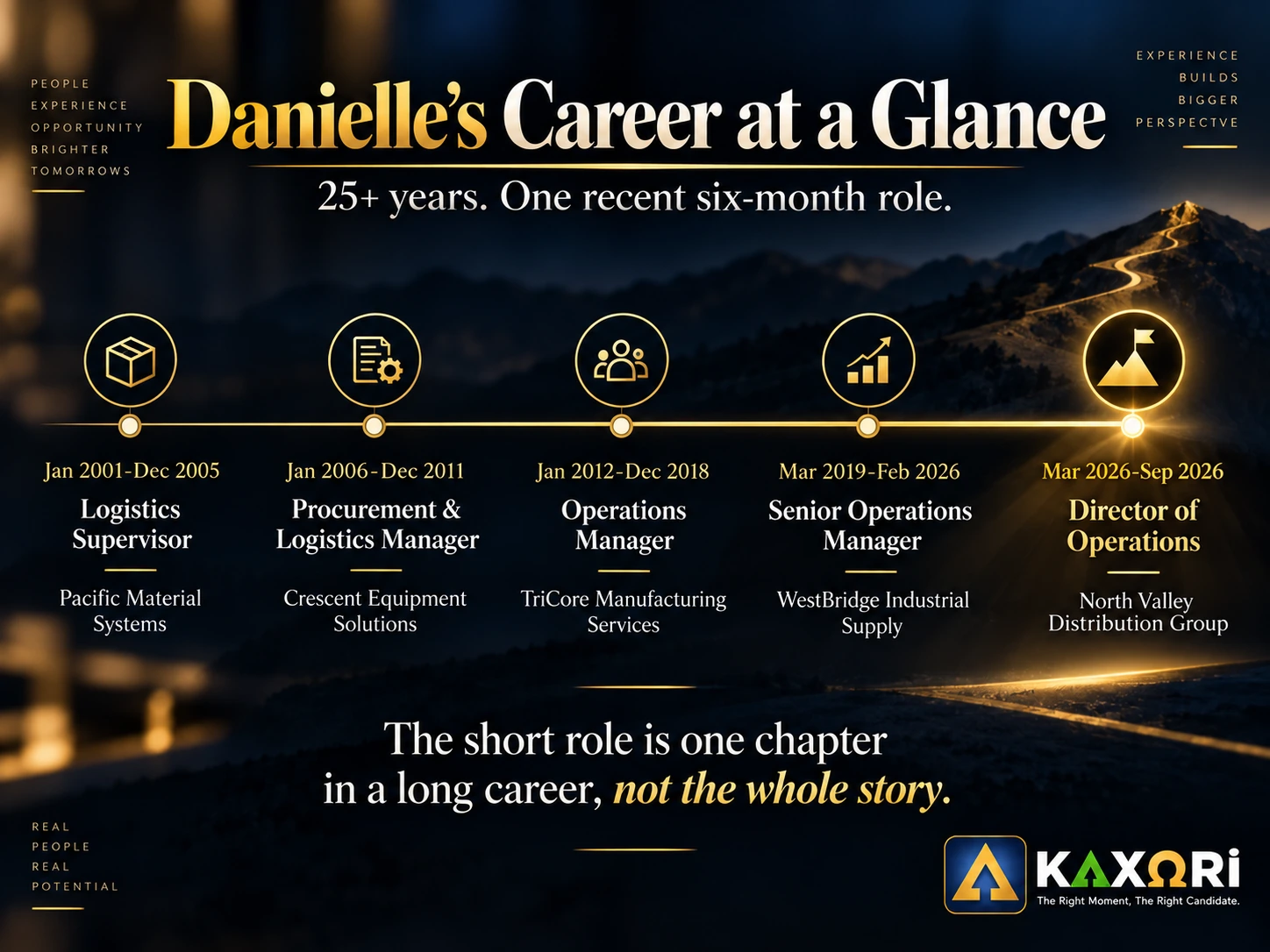
Danielle had 25+ years of career evidence.
Her resume did not need to function as a complete biography. It needed to show the experience that best supported the job she wanted next.
That is the distinction experienced professionals often miss. More history does not automatically create a stronger resume. Better evidence does.
The job lasted six months. That fact did not disappear. It simply stopped being the headline.
Keep the experience that answers that question.
Frequently asked questions
Should you put a six-month job on your resume?
Sometimes. Keep it when it is recent, relevant, or proves scope you cannot show anywhere else. Leave it off when it adds little and removing it will not create a misleading gap.
Can you leave a short-term job off your resume?
Yes, in many private-sector resumes. A resume is selective. But follow the application instructions, and do not omit a role when doing so would make the timeline misleading.
What if the short job came right after a layoff?
Look at what the short role adds and what removing it would change. If it fills the post-layoff timeline or adds important new scope, keeping or compressing it may tell a clearer story than deleting it.
Is one short job the same as job hopping?
No. Job-hopping research looks at patterns of repeated moves. One six-month role after years of stable employment is a different career pattern.
How short is too short for a job on a resume?
There is no universal month cutoff. Relevance, proof, recency, career context and the gap created by removing the job matter more than a fixed number of months.
How do you explain a short job in an interview?
Keep the explanation brief, truthful and forward-looking. State what happened, avoid attacking the former employer, then return to what you accomplished and what you are looking for next.
Should I use years instead of dates on my resume?
Not automatically. Research has tested experience-duration formats, but some hiring systems parse start and end dates. Follow the employer's instructions, keep a dated version ready and review parsed application fields before submitting.
What if a job is on LinkedIn but not on my resume?
The two do not need the same amount of detail, but the underlying facts should stay consistent. Different levels of detail are fine. Contradictory dates or titles are not.
Research and sources
We prioritized government workforce data, peer-reviewed hiring research, HR professional guidance and university career centers. Where a study covers only certain jobs or applicant groups, we say so rather than treating it as universal.
- University career guidance
Harvard FAS Mignone Center for Career Success, “Harvard College Guide to Creating a Strong Resume.” - University career guidance
UC Davis Career Center, “Resumes.” - HR professional organization
Society for Human Resource Management, “How to Evaluate Resume Employment Gaps.” - Peer-reviewed multi-sector field research
Kristal, Nicks, Gloor and Hauser, “Reducing discrimination against job seekers with and without employment gaps,” Nature Human Behaviour 7 (2023). - University research explanation
Purdue University Daniels School of Business, Michael A. Campion, “The Pros and Cons of Job-Hopping” (2026). - Peer-reviewed hiring research
Harrison, Campion, Van Iddekinge, Campion, Gibson and Barsa, “Is the job-hopping penalty merited?” Journal of Applied Psychology (2026). - University career guidance
Georgetown University Cawley Career Education Center, “Resume Content & Formatting.” - Government hiring guidance
U.S. Equal Employment Opportunity Commission and Federal Trade Commission, “Background Checks: What Job Applicants and Employees Should Know.” - Government resume guidance
U.S. Department of Labor, “Tips for Writing a Federal Resume.” - Broad U.S. workforce data
U.S. Bureau of Labor Statistics, “Employee Tenure in 2026,” including Tables 1, 3 and 6. - ATS product documentation
Greenhouse Support, “Talent Matching - Data Processing FAQ.” - ATS product documentation
Workday Administrator Guide, “Resume Parsing.”