
In this story
The week my final unemployment check arrived, my 13-year-old car broke down.
It needed a new transmission. To fix it, I would have to take more money from my shrinking retirement account and maybe ask my mother for a loan. I was already living in the small bedroom where I had grown up.
I had lost my job. I had sold my home for far less than I believed it was worth. My 20-year marriage had ended. I was trying to rebuild my career while sharing custody of my three sons and holding on to the life they knew.
That night, my youngest son turned 11.
I covered a chocolate cake with the two cans of frosting he loved, lit the candles and carried it into the backyard. He seemed unaware of how much our lives had changed. I wanted to keep it that way. I did not want his birthday to carry the fear I was carrying.
That was the hardest part. My children still needed their dad, even when I was not sure how I was going to hold everything together.
At the time, I told the Orange County Register, “This is not a great recession in my house. This is a great depression in my house.”
The newspaper documented that part of my life in a July 1, 2010, story called “Now what? Dad's unemployment runs out.”
The story appeared almost 21 months after my layoff. It captured me near the bottom. Later that month, I began the part-time marketing work that opened the next chapter of my recovery.
I did not know it then, but that season would stay with me. Years later, it helped shape why I built Kaxori.
Read this first
Key takeaways
- A layoff changes your circumstances. It does not erase your ability or your career.
- A bridge role can restore income, routine and current proof without becoming your final destination.
- Employers need to see a clear connection between the role and experience you can defend.
- Recovery rarely follows a straight line. Each honest step can create the next opportunity.
Direct answer
Why I built Kaxori
I built Kaxori because capable people can become difficult to see during a long job search. Experience does not disappear after a layoff, but it can be buried inside a résumé that does not clearly connect with the role. Kaxori helps job seekers compare what an employer needs with truthful evidence from their own careers, then build a clearer and more relevant application.
Experience did not make the search easy
I had a bachelor's degree from the University of Utah and an MBA from Pepperdine University. I had owned a plumbing company. I had worked in sales and marketing, managed a region and built a career around growth and business development.
None of that made me immune to a collapsing market.
The mortgage crisis pulled new construction down with it. I lost one position in 2007. I returned to work in 2008, only to be laid off again that October.
For 21 months, I searched online, contacted people I knew, attended a weekly job-search workshop and kept applying. I did not earn a paycheck during that time.
I knew I could contribute. The hard part was getting that value across in a process that often reduced a career to a résumé and a few fields on a screen.
That gap can get inside your head.
It can make you question your experience. It can make you wonder whether anyone sees the work behind the résumé. It can make every unanswered application feel like a judgment about your worth.
It is not.
How do you connect a job description to your real experience?
I eventually understood that experience alone does not make a strong application.
The employer must be able to see how that experience connects with the work it needs done.
A job description may ask for profit-and-loss responsibility. An executive résumé may say the candidate managed a region. The person may have owned revenue, pricing, budgets and performance across that region, but nobody connected those facts for the reader.
An employer may ask for organizational design. The résumé may list a restructuring project without showing the size of the team, what the candidate changed or how the new structure supported growth.
That does not mean applicants should copy a job description or stuff a résumé with keywords. It means they need to translate their real experience into clear evidence that relates to the role.
That is one reason I built Kaxori.
Kaxori helps a job seeker compare a résumé with a specific job description, identify relevant language, find possible gaps and organize a more focused application.
The applicant still owns every fact. Titles, dates, tools, numbers, qualifications and results must be true and defensible.
If you want to see how employer language can connect with real experience, read Your Résumé Needs the Right Keywords, Not More Keywords.
Use the role-to-proof method
You do not need to reinvent your professional identity for every application. You need a disciplined way to connect the role with evidence you already own.
1. Read the job description as a request
Do not begin by asking whether you are good enough.
Ask what the employer needs someone to do. Identify the five most important responsibilities, problems or outcomes in the posting.
2. Match each need to real evidence
Find one example for each priority. It may come from paid employment, consulting, contract work, volunteer leadership, military service or another relevant setting.
Record what you did, the setting, the people involved and the result you can support.
3. Separate evidence from assumptions
Mark each requirement as:
- Supported by direct experience
- Supported by related or transferable experience
- Not yet supported
Do not turn a gap into a claim. A truthful gap is safer than an impressive sentence you cannot defend.
4. Translate without copying
Use the employer's language when it accurately describes your work. Then support that language with a concrete example.
A keyword can create alignment. Evidence gives the word meaning.
5. Build one clear application
Revise the résumé so the most relevant evidence is easy to find. Use a cover letter when it can explain a transition, connect experience across industries or show why this particular role makes sense.
Then read every line as if an interviewer asked, “Tell me more about that.”
If you cannot answer honestly, revise it.

Should you take a lower-paying job during a long search?
Later in July 2010, I took part-time marketing work with a five-person company for $18 an hour. The job came with no benefits.
I was happy to be productive again. I was earning some money, rebuilding a routine and doing useful work. I also knew I was underpaid and that the job could not support the life I needed to rebuild.
So I treated it for what it was: a bridge.
I kept working, and I kept looking for a full-time role. The part-time job did not erase the previous 21 months. It gave me somewhere to stand while I worked toward something better.
That distinction matters. A bridge job is not an admission that your best work is behind you. Part-time, contract, consulting or project work can restore momentum, create current experience and give you new proof to discuss. It can help you move forward without pretending you have reached the destination.
Today, that bridge might be a three-month cloud migration contract, a freelance design project, fractional leadership work or part-time consulting. The work may look different from mine, but the purpose is the same. It gives you a place to stand while you work toward what comes next.
If you take a bridge role, tell the truth about it. Show the work you owned, the problems you helped solve and what you learned. You do not need to inflate the title or apologize for the choice.
That bridge work belongs when it helps explain your fit. What Counts as Work Experience? Turn Overlooked Work Into Résumé Proof explains how to use part-time, contract, volunteer and project work honestly. If the next role looks smaller on paper, Overqualified for a Job? How to Show Why the Role Still Makes Sense shows how to explain why the move still makes sense.

The tools changed. The human problem did not.
My long search happened in 2010. Job searching looks different today. Candidates can use AI to produce applications faster, and employers use software to collect and manage the response.
What has not changed is the person behind the résumé. A capable candidate can still be overlooked when real experience is buried or does not connect clearly with the role.
This is not only a story from the Great Recession. In August 2026, the U.S. Bureau of Labor Statistics reported that 1.9 million Americans had been unemployed for at least 27 weeks. They represented 27% of all unemployed people.
Long job searches are not a relic of 2010. Whether your experience comes from plumbing, cloud infrastructure, product design, engineering, health care or another field, the challenge is familiar. You still need to help another person see what you know, what you have done and how it connects with the work ahead.
What an ATS score can and cannot tell you
An applicant tracking system, often called an ATS, helps employers collect and manage applications. These systems do not all work the same way.
No public résumé tool can promise that an employer's private system will rank, advance or accept an application. An ATS score is not an interview prediction.
A comparison can still help you find missing language, unclear evidence and parts of the résumé that deserve another look.
For a plain-language explanation of the limits, read What an ATS Resume Score Means Before You Apply.
Kaxori helps you improve the part you control: the clarity, relevance and truthfulness of your application.
That is the thinking behind our promise: Stop getting filtered out. Start getting called. It is the outcome we are working toward, not a guarantee that software can make for an employer.

The offer was a step down and a way forward
The full-time offer came in December 2010, 26 months after my October 2008 layoff. The salary was about $40,000 less than what I had earned before my first layoff in 2007, as the Great Recession began.
I took it.
I was a divorced father sharing custody of three boys. Living on $40,000 less than my pre-2007 salary was not easy, even in 2010. Living with my mother had helped me keep the shared-custody arrangement while I searched. The new job restored health insurance, benefits, stability and a place to begin rebuilding.
It also took me back into the world of plumbing, water, contractors and distribution. I had spent most of my career in that market. I understood the people, the work and the problems.
I joined an international tankless-water-heater and boiler manufacturer that was building its North American brand. I led its marketing function, including branding, advertising, distributor programs, contractor training, trade shows, public relations and product launches.
I did not accomplish that work alone. I led the marketing effort as part of a larger team. The role let me take what I already knew and prove that I could build again.
By early 2014, the bridge had led somewhere bigger. I became director of marketing for an established North American water-heating brand, with responsibility across tankless water heaters, boilers and traditional gas water heaters. I had gone from accepting $18-an-hour part-time work to leading marketing for an established brand in an industry I knew.
Recovery did not happen all at once. It happened one decision, one role and one opportunity at a time.
The market I returned to was plumbing and water. Yours may be cloud infrastructure, product design, engineering, health care or something else. The mechanism is the same: reconnect with work you understand, make your contribution visible and use it to build the next step.
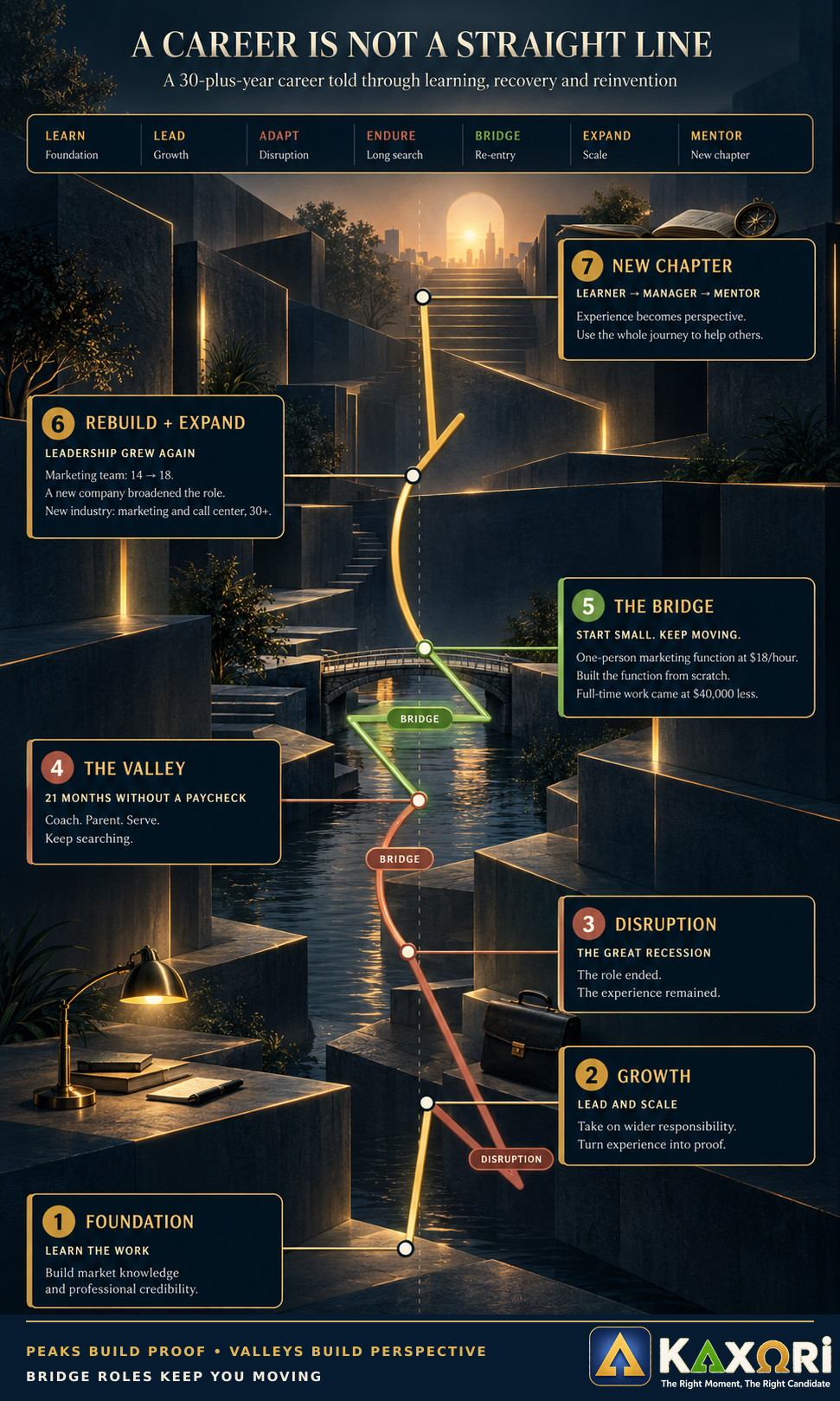

Those 26 months were not empty
I would never pretend those 26 months were easy. They carried financial pressure, rejection, uncertainty and loss.
They also gave me time with my three sons that I would not trade away.
During that time, I returned to the high school I had attended and coached the sophomore basketball team. My oldest son was on that team.
Coaching got me out of the house, gave me a team to lead and let me share something meaningful with my son while I continued looking for work.
Coaching reminded me that losing my job had not taken away my ability to lead, teach, prepare and show up for people. Not everything valuable from that season belonged on a résumé. But it all mattered.
I also stayed involved in scouting. I had the chance to be present as a father while my sons watched me work through a difficult season.
Today, they are adults with careers and dreams of their own. Our relationships are strong. I believe part of that comes from the time we had together and the resilience they saw while I kept moving forward.

A difficult season can take a great deal from you without taking everything. You may still be building relationships, learning, caring for someone, volunteering, consulting or becoming clearer about the work you want next.
That part of your life counts, too.

Keep a record of the work and lessons you may need later. Your Résumé Isn't Your Career Memory. Here's What to Save Instead. explains how to preserve proof without keeping company secrets.
Help has always traveled through my family
During the Great Depression, my grandmother fed people from her back porch. Years later, my mother raised two sons on a teacher's salary.
In 2010, I became the person who needed help. My mother opened her home to me. Living there gave me the stability I needed to share custody, be present for my sons and keep searching for work.
Receiving help after spending much of your life providing it can humble you. It also stays with you. When you get back on your feet, you remember who gave you room to stand, and you look for a way to do that for someone else.
Kaxori is part of how I carry that forward.

The lesson I carried forward
The newspaper story captured one difficult season of my life. The bridge job, the lower-paying full-time role and the career growth that followed taught me something the story could not yet show.
People do not stop being capable when they lose a job.
They may lose momentum, confidence, income and control. They may have to explain a layoff, a career break or a move into a different industry. They may be doing all of that while trying to protect their families from the weight they carry.
I have always tried to look at the glass as half full. Even then, I believed being out of work was a temporary place in my life. It was a stop, not my destination. Things had turned around before, and I believed they would turn around again.
That belief did not pay the bills or remove the fear. It did give me a reason to keep showing up, coaching, applying and looking for the next opening.
Your employment status is a circumstance. It is not your identity. A hard season can change where you are without deciding where you will end up.
What people need is not another empty promise.
They need practical help seeing what is still there: experience, judgment, skills, relationships and proof of work.
Kaxori cannot do the interview for you. It cannot create experience you do not have. It cannot promise that an employer will call.
It can help you slow down, study the role, find the evidence and present your real value more clearly.
I wish I had that kind of structure when I was sitting at my mother's kitchen table, searching for the next opportunity.
Today, I can help build it for someone else.
The right opportunity depends on the right person being seen clearly. The Right Moment, The Right Candidate.
One useful action today
Choose one job you genuinely want. Identify its five most important needs. Put one truthful example from your experience next to each one.
Do that before changing a single résumé bullet.
Frequently asked questions
1. How can long-term unemployment affect a career?
Long-term unemployment can reduce income, routine, confidence and current work experience. It does not erase a person's earlier accomplishments or ability. In my case, I went 21 months without a paycheck and returned to full-time work 26 months after my October 2008 layoff.
2. What is a bridge job, and how can it help during a long job search?
A bridge job provides income, routine, current experience or momentum while someone continues moving toward a longer-term role. It may be part-time, contract, consulting, project or full-time work. It can provide a place to rebuild without becoming the final destination.
3. Should I take part-time work while looking for a full-time job?
Part-time work can be a useful choice when it restores income, structure or relevant experience without stopping the larger search. I accepted part-time marketing work for $18 an hour after 21 months without a paycheck. I treated it as a bridge and kept looking for full-time work.
4. Should you accept a lower-paying job after a layoff?
A lower-paying job can make sense when it restores benefits, stability, relevant experience or access to a market you understand. My new full-time salary was about $40,000 below what I earned before my first layoff in 2007. The role was a deliberate step back into full-time work, not the end of my career.
5. How do you rebuild a career after long-term unemployment?
Start by identifying what an employer needs and connecting each priority with truthful evidence from your experience. Bridge work can restore recency and create new proof. Within four years, I moved from $18-an-hour part-time work to leading marketing for an established North American water-heating brand.
6. Can coaching or volunteer work help explain a career gap?
Yes, when the experience is relevant and described honestly. Coaching, volunteering, caregiving and community leadership can show skills such as planning, communication, leadership and follow-through. They should not be presented as paid employment when they were not.
7. Why did I build Kaxori?
I built Kaxori because capable people can become difficult to see during a long job search. Experience does not disappear after a layoff, but it can be buried inside a résumé that does not clearly connect with the role. Kaxori helps job seekers compare what an employer needs with truthful evidence from their careers, then build a clearer and more relevant application.
About the source
The Orange County Register published “Now what? Dad's unemployment runs out” by Peggy Lowe on July 1, 2010. Michael Goulding photographed the accompanying story. Kaxori is not affiliated with or endorsed by the Orange County Register.