Your experience needs proof, not another duty list
Most experienced resumes sound responsible but not memorable.
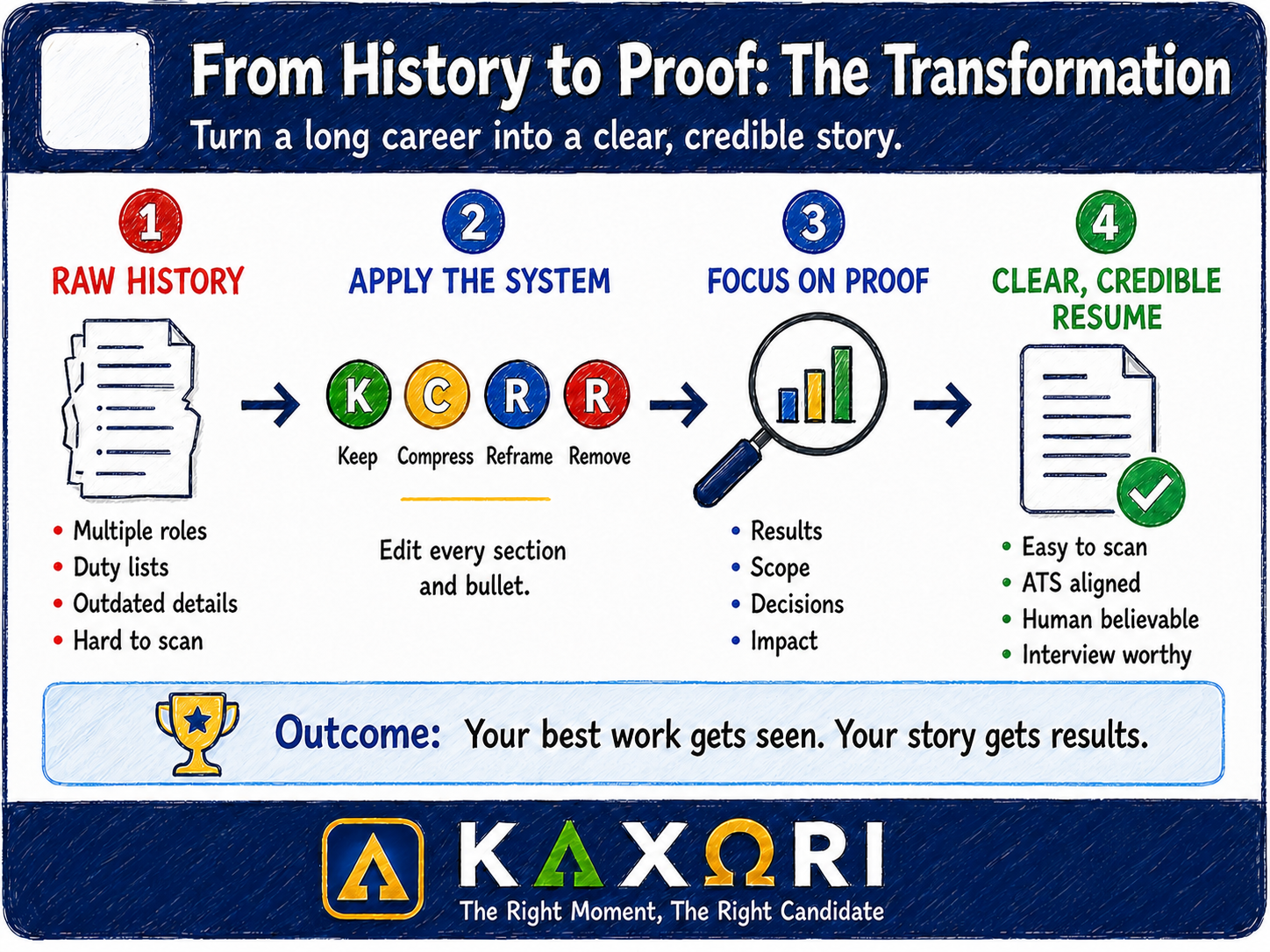
They managed strategy. They led teams. They oversaw operations. They ran budgets. All of that can be true, and it still leaves the reader asking one question: What actually changed because you were there?
Strong bullets make the proof visible.
- Show the money. Revenue you grew, costs you reduced, or budgets you managed.
- Show the scale. People you led, sites you supported, customers you reached, or systems you launched.
- Show the change. Time saved, quality improved, risk lowered, or growth accelerated.
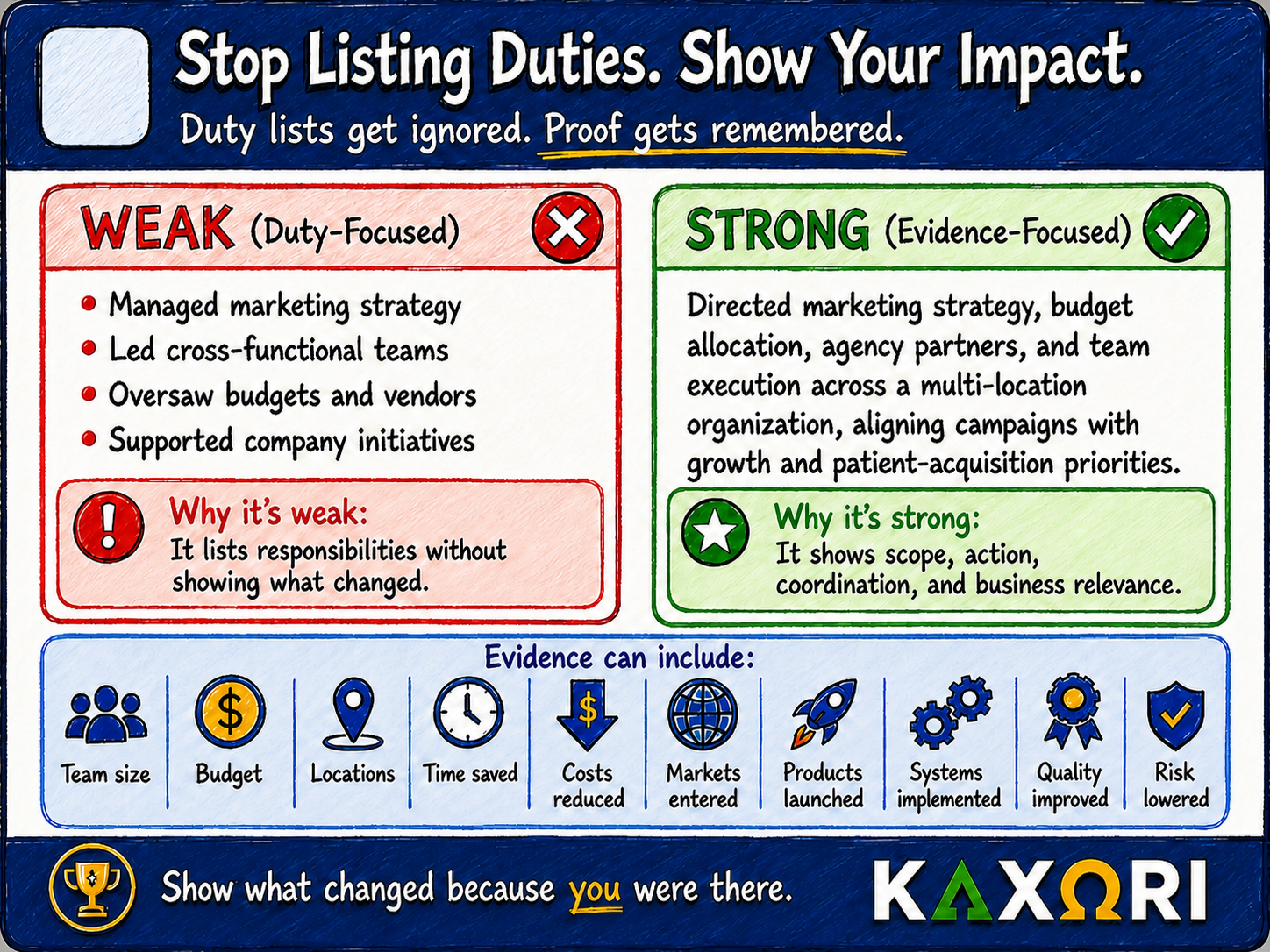
Here is the same work written two ways.
- Duty version
- Led cross-functional teams and supported company growth across multiple locations.
- Proof version
- Led a 42-person team across marketing, sales, and operations during growth from 12 to 17 sites, helping revenue climb from $68 million to $84 million in two years.
Nothing was invented. The facts were already there. The second version simply makes them visible.
Teaching example: This is a teaching example, not a Kaxori customer result. On a real resume, every number must come from your actual work.
This isn't only our opinion. USAJOBS tells applicants to write concise, results-focused bullets and use numbers, percentages, dollars, or other clear measures. Harvard's career center says resume language should be specific, fact-based, and “written to express not impress.” UC Berkeley advises candidates to connect accomplishments to skills the employer is seeking.
Don't force a number into every line. Some work is better shown through scale, risk, complexity, or the importance of the decision. And don't guess. Use facts you can explain in an interview.
Keep, Compress, Reframe, Remove
This is the Kaxori framework. Run every section and every bullet through it.
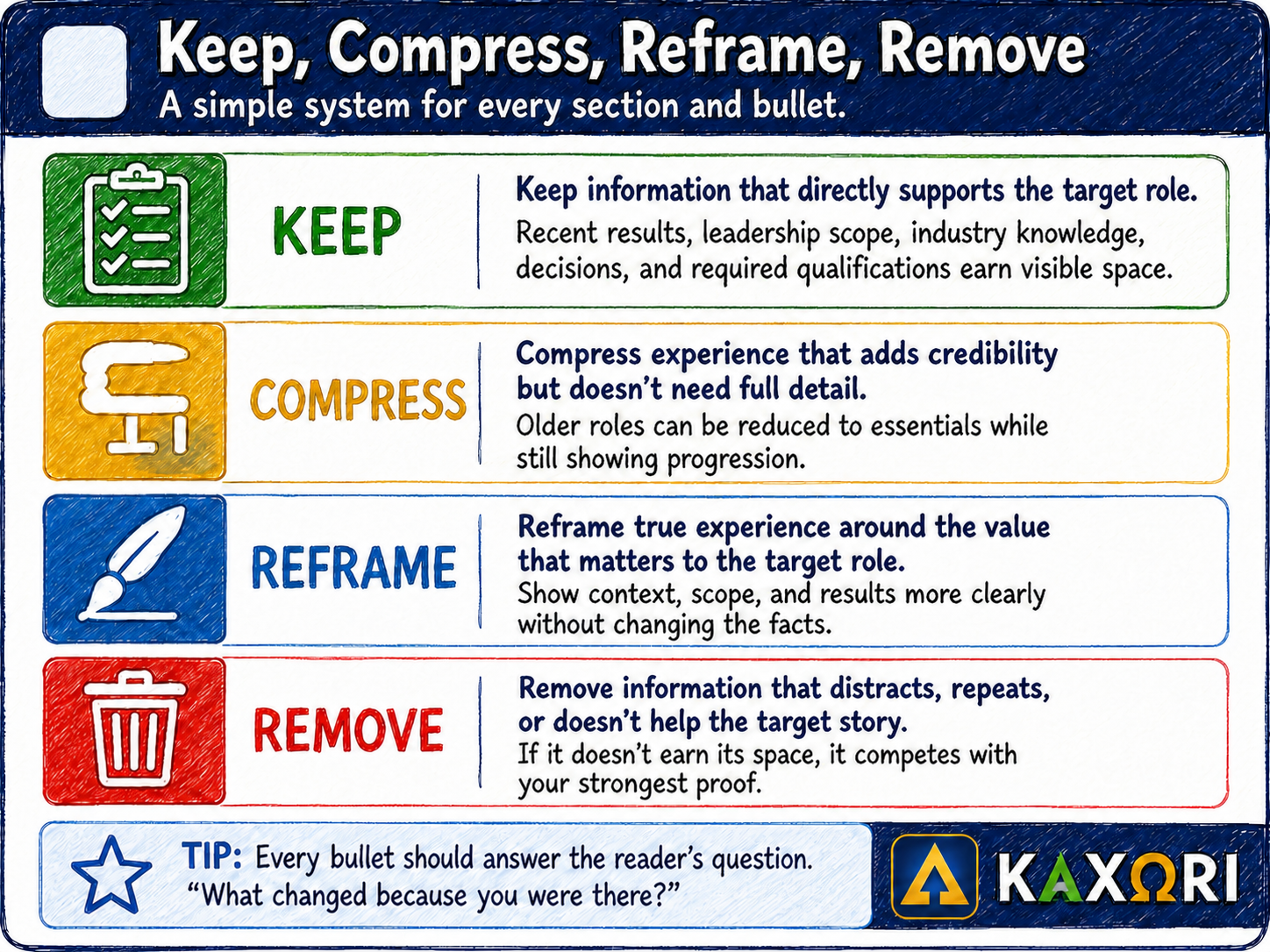
Keep
Keep what directly supports the job you want. Recent results, leadership scope, required credentials, and specialized tools earn their space when they match the posting.
Keep doesn't mean leave the wording alone. It means the information belongs in this version.
Compress
Compress work that adds credibility but doesn't need full detail.
An older role can still show your growth, your industry depth, or how your leadership expanded. Often it only needs the company, title, dates, one line of context, and one relevant win.
Compressing an older job keeps the story without letting it take over.
Reframe
Reframe true experience around what this role cares about.
A marketing position may pull forward revenue growth, customer acquisition, and campaign results. An operations position can use the same career history and pull forward process improvement, cost control, and cross-team execution.
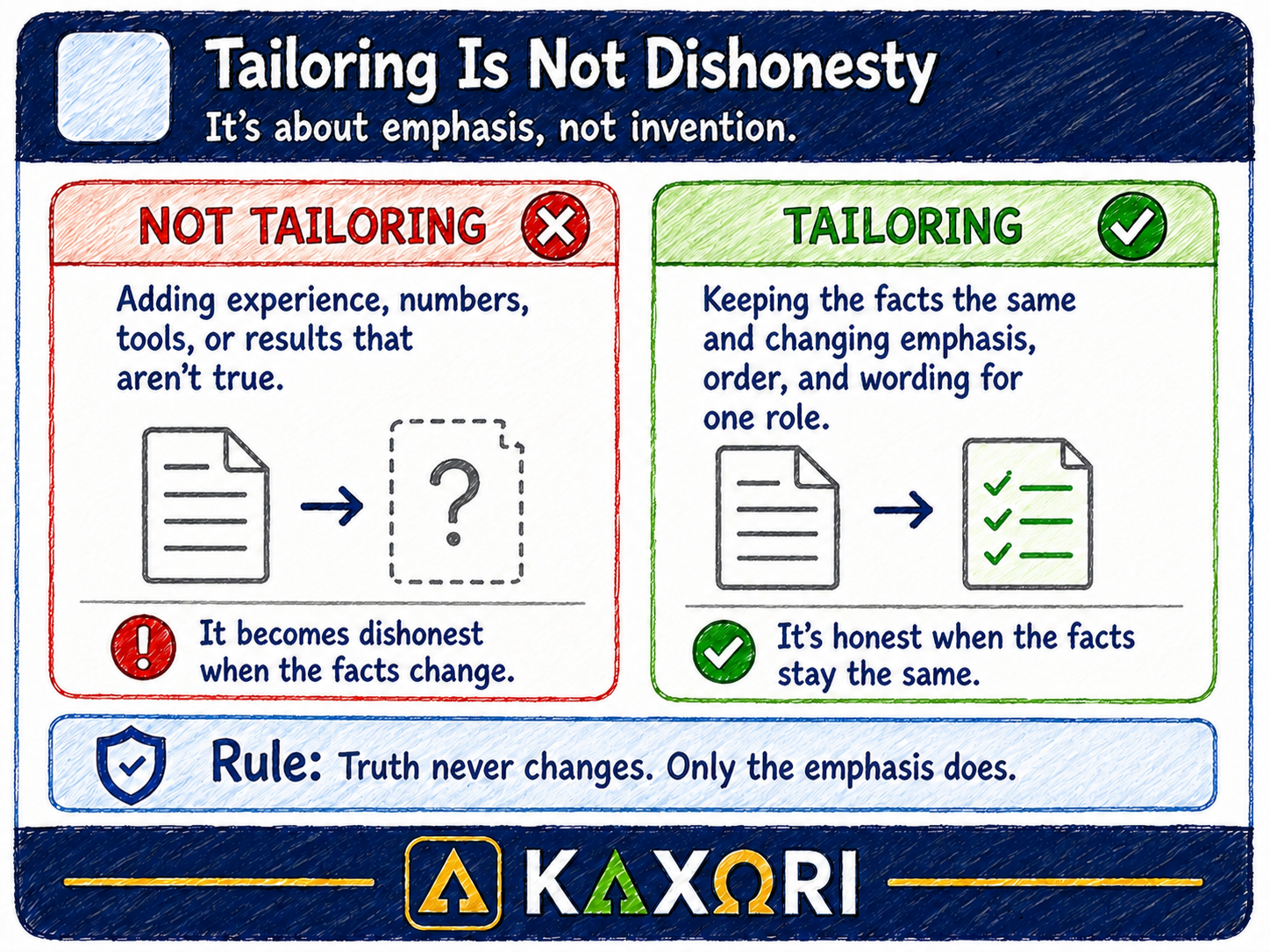
The facts don't move. The emphasis does. That's honest tailoring.
It becomes fabrication the moment you add a tool, title, number, responsibility, or result that isn't real.
Remove
Remove what distracts, repeats, or doesn't support the story.
That usually includes repeated duties, outdated tools, early-career tasks below your current level, and large accomplishments that have little to do with this job.
Taking something off the resume doesn't erase it from your career. It means it isn't earning space in this application.
Put your strongest proof in the top third
A busy reader shouldn't have to reach page two to understand why you're worth a conversation.
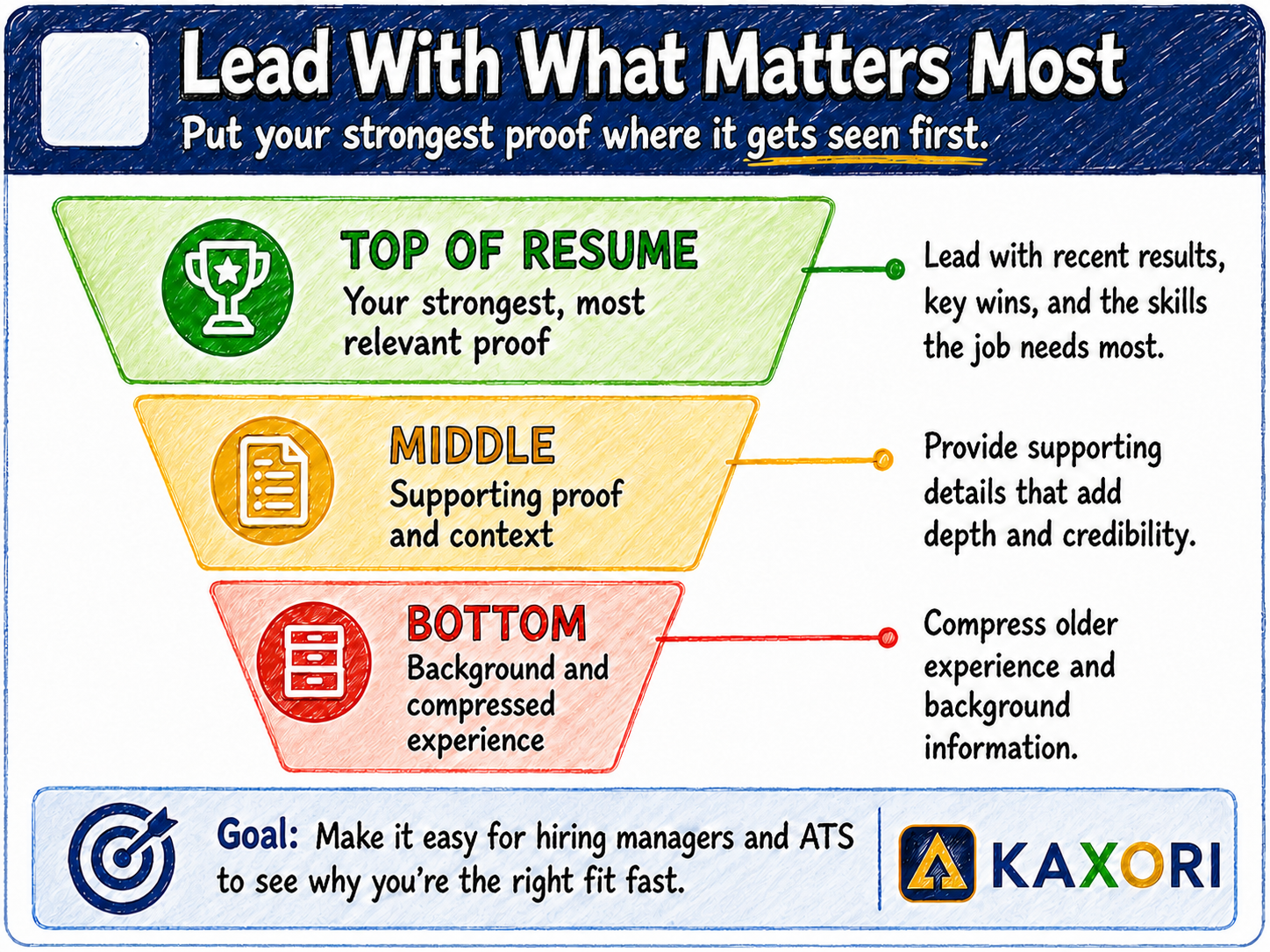
The top third should quickly show your target role, your level, the problems you solve, and the proof behind the claim.
USAJOBS asks candidates whether a hiring manager can spot their main credentials within 10 to 15 seconds and whether the top quarter of the first page is doing real work. Federal and private-sector resumes aren't identical, but the visibility test applies to both.
Skip the opening paragraph stuffed with words such as strategic, innovative, accomplished, and results-driven unless the next few lines prove them.
“Strategic leader” is an opinion.
“Led a 42-person team across 17 sites and helped grow revenue by $16 million” is proof.
Older experience isn't automatically irrelevant
There's no universal rule that says work past a certain age has to disappear.
Older experience still earns space when it shows required industry knowledge, regulated or technical depth, a clear climb in responsibility, a major win, or a pattern that explains why you fit now.
So the question isn't, “How old is this?”
The question is, “Does this help explain why I fit this role today?”
If yes, keep it or compress it. If no, shrink it or remove it.
Career changers need a bridge, not a leap
Career changers face a different problem. Their previous titles may not match the new role even when the underlying work does.
The resume has to build the bridge.
Show what carries over. Point to outcomes that matter in the new field. Name the tools and processes that overlap. Explain why the move makes business sense. Be honest about any real gap.
And drop the empty phrases. Adaptable leader. Strategic thinker. Quick learner. Those are claims, not proof.
If adaptability is the point, name the time you entered a new market, learned a new system, integrated two teams, or solved something unfamiliar. Add the scale and result when you have them.
Transferable skills need receipts.
Keep one master source and send focused versions
One large resume for every job creates two problems. The document becomes too broad, and every application turns into a rushed rewrite.
A better system is simple. Keep one complete master resume or career evidence library. Build a focused version for each target role. Save the exact file you submit.
The master source holds the full career. The tailored resume brings forward the proof that matters for one opportunity.
That last step helps more than people expect. When an interview comes, you can pull up the exact version the employer reviewed.
The U.S. Office of Personnel Management uses an accomplishment record method that asks people to describe the situation, what they did, and what resulted. OPM also notes that those claims can be verified. That's a useful discipline for any candidate, not just federal applicants.
Check your resume against the role you want.
Use Kaxori to see what the job needs, where your strongest proof appears, and what deserves a closer review.
Five questions before you apply
Put your resume beside the actual job posting and ask:
- Can someone tell what role I'm pursuing within a few seconds?
- Does the top third show my most relevant numbers, scope, and proof?
- Are my strongest results buried under duties or old detail?
- Does each major claim connect to something this employer needs?
- Can I explain and defend every title, number, tool, and outcome in an interview?
When one answer is no, don't just add more content. Add proof, improve relevance, or run the section through Keep, Compress, Reframe, Remove.
There is no single formula that works for everyone. A study in Business and Professional Communication Quarterly examined resume decisions involving 63 students, 20 advisors, and 24 employers. The groups used different reasons, including relevance, recency, value, and fit, rather than one fixed rule. Read the study.
How Kaxori helps with this review
Kaxori compares your resume with one specific job description, then shows your ATS match score, keyword gaps, and the areas of your resume to review next.
The score is a review signal, not a hiring prediction. A high number doesn't prove that your resume is believable, truthful, or ready for a human conversation. For a full explanation, read what an ATS resume score means before you apply.
Kaxori is built to help you say true things more clearly. It should never be used to add a qualification, responsibility, number, or outcome you can't support.
The real advantage of a long career
Experience becomes an advantage when the reader can see the pattern and the proof.
What problems have you solved? What decisions have you made? How large was the work? What can you prove? Which part of that history matters most for this job?
Your resume doesn't have to tell every story from your career.
It has to tell the right one clearly enough that somebody wants the next conversation.
Your next step
Take one resume and one target job.
Highlight what the posting needs most. Find the numbers, scope, decisions, tools, and outcomes that prove your fit. Run every section through Keep, Compress, Reframe, Remove. Move your strongest proof toward the top.
Then run an ATS Check and use the result as a guide for what to review next. Check every suggestion before you send anything.
Make your strongest proof easier to find.
Check your resume against one real job, review the gaps, and keep every change grounded in experience you can support.
Frequently asked questions
Does every resume bullet need a number?
No. Use numbers when they add real context, scale, or impact. Strong qualitative proof can show judgment, complexity, risk, or why a decision mattered. Don't force a number where it doesn't help.
What numbers can I use if I never owned revenue?
Think about team size, budget, locations, customers, users, volume, time saved, costs avoided, turnaround time, adoption, quality, risk reduction, projects finished, systems launched, or processes standardized.
What if I don't remember the exact number?
Don't guess. Check old performance reviews, project reports, budget files, presentations, awards, calendars, emails, and past resumes. Use an approximate number only when it's accurate, clearly marked as approximate, and safe to share.
How many years of experience should I include?
There's no universal number. Include what supports this job. Compress older work that adds credibility but doesn't need full detail.
Should an executive resume run longer than two pages?
Two pages is a useful working target, but clarity matters more than length. A longer resume isn't automatically stronger. Every section has to earn its space.
Is tailoring a resume dishonest?
No. Honest tailoring keeps the facts the same and changes emphasis, order, and supported wording for one role. It becomes dishonest when you add experience, credentials, tools, numbers, or results that aren't true.
Can an ATS score tell me whether my resume is good?
It can flag alignment signals, keyword gaps, and formatting concerns worth reviewing. It can't guarantee an interview or represent every employer's screening process. Read more about what an ATS score means.
Sources
- USAJOBS, What to Include in Your Resume. Accessed July 30, 2026.
- U.S. Office of Personnel Management, Accomplishment Records. Accessed July 30, 2026.
- Harvard Mignone Center for Career Success, Create a Strong Resume. Accessed July 30, 2026.
- UC Berkeley Career Engagement, Resumes. Accessed July 30, 2026.
- University of Pennsylvania Career Services, Write a Resume or CV. Accessed July 30, 2026.
- Society for Human Resource Management, How to Write a Powerful and Memorable HR Resume. Accessed July 30, 2026.
- Randazzo, C. (2020), A Framework for Resume Decisions: Comparing Applicants' and Employers' Reasons. Business and Professional Communication Quarterly. Accessed July 30, 2026.