At 8:42 p.m., the application was ready except for one question: Which résumé should go with the job?
The candidate had five versions open. Each used a different headline. Each moved a few skills. None made the strongest proof for this role easier to find. A relevant project still sat on page two beneath work the employer had not asked about.
The deadline created pressure to keep editing. More keywords went into the summary. A few bullets grew longer. The résumé looked busier, but the hiring story remained the same.
Keywords help employers recognize your experience. Tailoring decides which evidence they see first, what supports it, and what no longer deserves the space. Good tailoring does not create a new career for each application. The Prioritize, Move, Prove, Trim method changes the reader's path through true evidence without changing the facts.
Five versions. One hidden match.

Why one general résumé struggles to serve every job
A career can support more than one direction. A marketing leader may know brand strategy, demand generation, and product launches. The same career may also include team building and operations. One résumé cannot give every part equal weight and still feel focused.
A general résumé often asks the reader to find the connection. A tailored résumé makes the connection visible. It brings the right work forward. It gives less space to work that matters less for this role.
Tailoring should change the reader's path through the evidence, not the truth of the evidence.
This guide is the next step after keyword translation. Your Résumé Needs the Right Keywords, Not More Keywords helps you decide which employer terms are truthful. This guide helps you arrange the résumé so the strongest supported evidence appears where the reader needs it.
The four architecture changes good tailoring makes
Prioritize. Move. Prove. Trim.
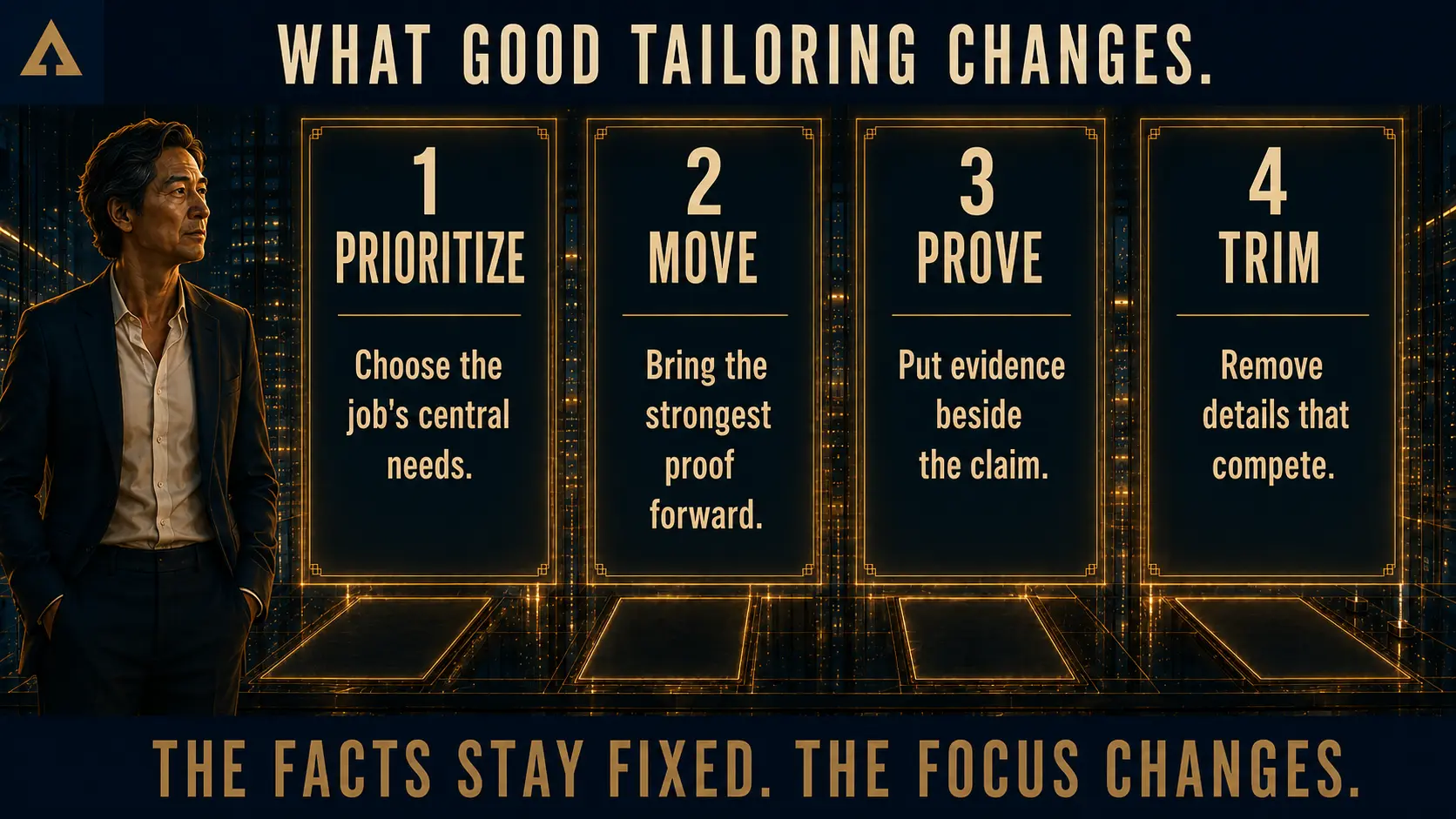
Prioritize the employer's real needs
Start with the work, not a word count. Read the role title, opening summary, responsibilities, qualifications, tools, customers, and outcomes. Identify three to five priorities that appear central to the job.
Do not chase every phrase. Some language is broad, repeated for legal reasons, or unrelated to the main work. Your first job is to decide what matters.
Move the strongest proof forward
Find the strongest supported evidence for each priority. Move that proof higher in the summary and within the relevant role. The career facts stay fixed. The order and emphasis change so the reader does not have to search for the connection.
Keyword translation is a separate decision. Your Résumé Needs the Right Keywords, Not More Keywords explains Match, Translate, and Gap. Use that method when the employer's language differs from yours. This article focuses on the architecture around that language.
Relevant proof moves up. The facts stay put.

Prove the fit where the claim appears
A tailored résumé should not make the reader hunt for proof. If the summary calls you a lifecycle marketing leader, show a recent program or decision. Add the process or outcome that supports the claim.
Important language belongs beside evidence. A skills list may help with scanning, but the work history must carry the claim.
Trim what competes with the target
Tailoring is partly subtraction. Older, unrelated, or repeated details can take attention away from stronger proof. Compress them. Remove them when they no longer help the target story.
Trimming does not erase a career. It protects the reader's limited attention and gives the right evidence room to breathe.
Less noise. More signal.

A before-and-after example
Marketing executive with broad experience leading strategy, campaigns, teams, partnerships, digital programs, and business growth across several industries.
Marketing leader who turns product strategy into coordinated launch plans across sales, operations, and channel teams. Built decision rhythms, clarified ownership, and adapted launch messaging for distinct customer groups.
The second version is not stronger because it sounds larger. It selects evidence that matters to the target and names the work more clearly.
Tailoring section by section
Headline and summary
Name the target direction and the strongest relevant proof. Do not copy the employer's title when your background does not support it. Keep your real level and function clear.
Skills
Keep skills that matter to the role and that your work history can support. Remove broad lists that make the candidate look less focused.
Work history
Move the most relevant bullet within each role closer to the top. Expand the proof that matters. Compress work that is less connected to the target.
Older experience
Keep enough context to show career depth. Reduce detail that repeats newer proof or pulls the reader toward a different role.
What tailoring should never change
- Your real job titles and employers.
- Employment dates and career chronology.
- Tools, markets, credentials, and responsibilities you actually held.
- Numbers, results, and the part you personally owned.
- The difference between leading, supporting, advising, and participating.
Artificial intelligence can help compare, organize, translate, and revise. It cannot verify a fact it was never given. The NIST Generative AI Profile emphasizes human oversight and the risk of confident but unsupported output. You remain responsible for every claim.
The 15-minute one-job tailoring review
- Write the target role at the top of a working copy.
- Mark three to five employer priorities.
- Find one source of career evidence for each priority.
- Move the strongest supported proof closer to the top.
- Add proof beside every important claim. If the employer uses different language, use the Match, Translate, Gap method from Your Résumé Needs the Right Keywords, Not More Keywords as a separate language check.
- Trim details that compete with the target.
- Read the revised résumé aloud and verify every change.
How Kaxori supports the review
Kaxori is designed to compare one résumé with one job description. The useful output is not a pile of replacement words. It is a clearer view of alignment, missing proof, and real gaps. It also shows where the résumé may need stronger evidence.
Kaxori cannot know whether a private career claim is true unless the user provides accurate information. It cannot reproduce every employer's private screening process or guarantee an interview.
Compare before you apply
A useful comparison should do more than return a number or a list of repeated terms. Use it to answer five practical questions:
- What are the job's three to five central needs?
- Where does the résumé already provide credible evidence?
- Which strong evidence is buried too low or placed in the wrong section?
- Which important claim still lacks proof beside it?
- Which details compete with the target and can be compressed or removed?
Make one supported change at a time. Compare again, then read the résumé as a person would. The goal is a clearer path through real evidence, not a perfect score or a rewritten identity.
One honest comparison.

Make your strongest relevant evidence easier to see.
Use Prioritize, Move, Prove, and Trim. Then compare the revised résumé with the job description in Kaxori and review every suggestion before you apply.
Frequently asked questions
Do I need a different résumé for every job?
You need a résumé focused on the target role. Closely related jobs may use the same strong base with smaller changes. A different career direction may require a more meaningful shift in emphasis.
How much of my résumé should change?
There is no universal percentage. Change only what improves truthful relevance, evidence, order, and clarity.
Should I change my job title to match the posting?
Do not replace an official title with a title you never held. You may add clear context when an internal title would confuse an outside reader, but keep the facts visible.
Can I remove older jobs?
You can compress or remove older detail when it no longer helps the target story. Preserve an honest chronology and any information needed to understand the career.
Does a tailored résumé guarantee an interview?
No. It can make relevant experience easier to recognize, but it cannot control screening, recruiter interest, interviews, or hiring decisions.
Can Kaxori tailor the résumé for me?
Kaxori can help compare the résumé with a job and support revision. You must verify every title, date, tool, number, result, qualification, and level of ownership.