The job description and the résumé describe the same career in two different languages.
The employer asks for customer segmentation, lifecycle marketing, and cross-functional leadership. The candidate has done that work, but the résumé calls it audience planning, retention programs, and coordination across sales and operations. The experience is there. The match is hidden.
Then comes the overcorrection. The candidate copies the employer's phrases into the summary, skills section, and work history. The résumé gains keywords but loses the person. Important terms now appear everywhere, while the proof remains difficult to find.
The goal is not to add more keywords. It is to translate real experience into language an employer can recognize without changing the facts. The Match, Translate, Gap method helps decide which terms to keep, which to translate, and which to leave out.
Same experience. Different language.

What résumé keywords are actually for
A job description gives you clues about how an employer describes the role. It names priorities, skills, tools, responsibilities, problems, and expected outcomes. Your résumé should use that language when it accurately describes your experience.
This is not a game of copying as many words as possible. It is a translation task. The employer has one vocabulary. Your career history may use another. The job seeker's responsibility is to connect the two without changing the facts.
A useful keyword does at least one of three jobs. It names a skill you actually used. It helps describe the context in which you used it. Or it connects your evidence to a priority in the target role.
The three situations people confuse
You use the same term and can prove it.
You did the work under different language.
You do not have the qualification.
Match. Translate. Gap.

1. You already use the same language
Sometimes the match is direct. The employer asks for customer segmentation, and your résumé already shows how you created or used customer segments. Keep the term, confirm the context, and make the evidence visible.
Do not repeat the phrase in the summary, skills section, and every bullet just to increase frequency. One clear use with supporting evidence is stronger than several empty repetitions.
2. You have the experience, but you use different language
This is the most common opportunity. One company may call the work lifecycle marketing. Another may call it customer journey management. One team may say demand generation. Another may divide the same work into acquisition, nurture, and pipeline development.
If the employer's term accurately describes what you did, you can translate your wording. Then add enough context to prove the translation is legitimate.
3. You do not have the experience
A missing keyword can reveal a real qualification gap. If the job requires a platform, certification, market, responsibility, or technical skill you have never used, adding the term would not improve the résumé. It would make the résumé less trustworthy.
You can show adjacent experience, transferable knowledge, or active learning when those statements are true. You cannot convert familiarity into hands-on experience by changing the wording.
A keyword is not proof
The Five-Second Résumé Credibility Test still applies. If a keyword cannot survive a follow-up question, it does not belong in the résumé as a claimed qualification.
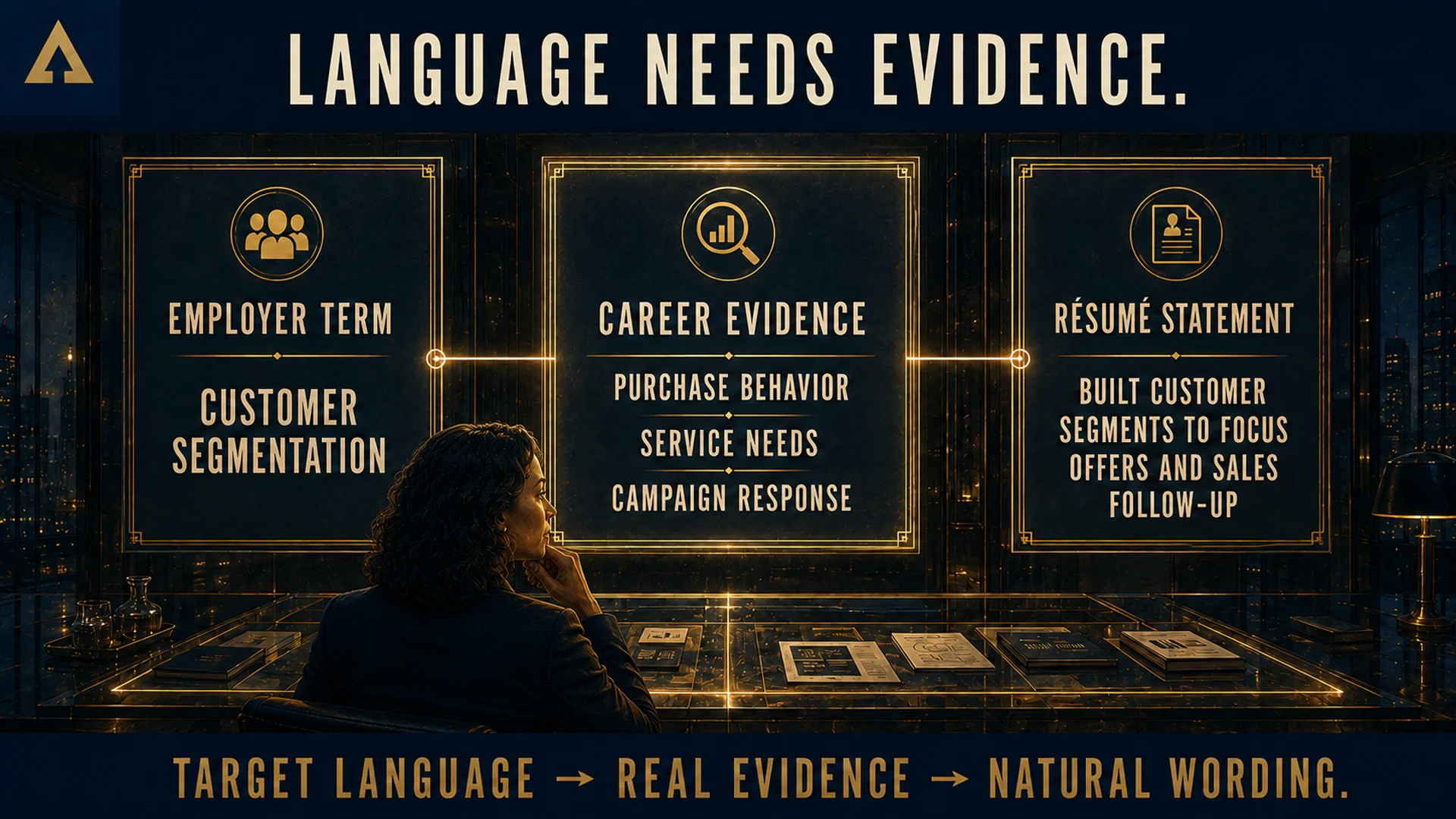
Suppose the target role emphasizes customer segmentation. Simply adding “customer segmentation” to a skills list does not show what the candidate did. A stronger version connects the language to real work.
Customer segmentation leader with expertise in customer segmentation and targeted customer segmentation strategies.
Built customer segments from purchase behavior and service needs to focus email offers and sales follow-up.
Illustrative example. Use only language and evidence supported by your actual experience.
How to translate a keyword without stuffing it
Use a simple evidence bridge: target language, source evidence, and natural résumé wording.
The term the employer uses.
The real work, tool, decision, scope, or result that supports it.
One clear statement connecting the term to the evidence.
Language needs evidence.
Identify the employer's priority language
Read the job description for repeated ideas, not just repeated words. Look at the role title, opening summary, responsibilities, qualifications, tools, customer types, and outcomes.
Prioritize terms that appear central to the work. Ignore legal boilerplate, broad personality language, and phrases that do not help explain fit.
Find the evidence in your career history
Before editing the résumé, locate the experience that supports the term. Use prior résumés, performance reviews, project notes, work samples, recommendations, promotion records, or your own detailed career inventory.
Ask what you did, where you did it, what you used, what constraint existed, what decision you made, and what outcome or scope you can defend.
Use the term where a reader expects to find it
Place important language in the section where it makes sense. A role-defining term may belong in the summary. A tool may belong in skills and in one supporting bullet. A responsibility should appear inside the experience that proves it.
Do not force every term into the summary. Do not create a keyword warehouse at the bottom of the page. The résumé should remain readable as a career story.
Write for meaning, not frequency
Use the phrase once where it is strongest, then use normal language around it. A reader should understand the action and evidence without noticing that the résumé was optimized around a phrase.
If the wording feels awkward when read aloud, revise it. A truthful match should sound like the candidate, not like the job description pasted into a sentence.
What keyword stuffing looks like
Keyword stuffing is not only repeating one phrase many times. It also includes loading the résumé with loosely related terms, copying requirements into a skills section, hiding lists in the document, or assigning yourself expertise that the career history does not support.
It creates two problems. First, it can make the résumé harder for a person to read. Second, it creates claims the candidate may be unable to explain in an interview.
More words. Less person.

Five warning signs
- The same phrase appears in several sections without new evidence.
- The skills list is much broader than the work history.
- A bullet sounds like a requirement copied from the job description.
- The candidate cannot explain when or how a listed tool was used.
- The résumé becomes less natural after optimization.
If any of these appear, remove the excess language and rebuild the claim from the evidence.
How to review one job description in 15 minutes
- Mark five to 10 terms that appear central to the role.
- Label each one Match, Translate, or Gap.
- Find one source of evidence for every Match or Translate term.
- Place each term where the supporting experience belongs.
- Read the revised language aloud and remove anything you cannot defend.
What good alignment changes
Good alignment does not rewrite your career. It changes what the résumé emphasizes.
The most relevant experience moves closer to the top. The employer's truthful terminology replaces internal company language. Supporting proof appears beside important claims. Unrelated material becomes shorter. Real gaps remain visible instead of being disguised.
That is how a résumé becomes easier to recognize without becoming less believable.
Be seen. Stay believable.

How Kaxori approaches keywords
Kaxori is designed to compare one résumé with one job description and help the user examine language, evidence, and fit together.
The useful question is not simply, “Which words are missing?” The better sequence is: Does this term matter to the role? Does the candidate have the experience? Where is the evidence? How can the résumé express that evidence naturally?
Run the keyword test now
Choose one real job description and one version of your résumé. Find five terms that appear central to the role.
For each term, label it Match, Translate, or Gap. Keep the direct matches. Translate only the experience you can prove. Leave real gaps alone or describe adjacent experience honestly.
Then read the revised sections out loud. If they sound natural and you can explain the proof behind every important term, you have improved alignment without erasing the person.
Make your real experience easier to see.
Compare your résumé with the job description. Find the important gaps, connect the right language to real proof, and review every change before you apply.
Frequently asked questions
How many keywords should a résumé include?
There is no universal number. Focus on the terms that define the specific role and that your experience can support. Relevance and evidence matter more than frequency.
Should I copy exact phrases from the job description?
Use an exact phrase when it is standard language and truthfully describes your experience. Do not copy whole responsibility statements or claim qualifications you do not have.
Where should important keywords appear?
Put them where a reader expects to find proof: the summary for role positioning, skills for genuine capabilities, and work history for actions, context, and outcomes.
Can I add a skill if I am currently learning it?
You may describe active learning accurately, but do not present training or familiarity as completed professional experience.
Does keyword matching guarantee an interview?
No. It can improve clarity and alignment, but it cannot guarantee screening, recruiter interest, an interview, or a hiring decision.
What if the employer uses language that feels unnatural?
Use the standard term once if it accurately describes your work, then explain the evidence in natural language. If the term does not fit your experience, leave it out.