Why “let me know if you hear of anything” rarely works

The text message was friendly, sincere, and almost impossible to act on: “I am looking for something new. Let me know if you hear of anything.”
The person receiving it wanted to help. But what kind of role? Which industry? What level? Remote or local? What could the candidate prove? The message handed every decision back to the helper.
That is the hidden problem in many job-search networks. People may care about you and still have no practical way to help. A stronger approach gives them a clear target, a short piece of evidence, and one request they can answer without taking responsibility for your search.
Networking is not asking 25 people to find you a job. It is creating 25 appropriate conversations around information, feedback, introductions, and support.
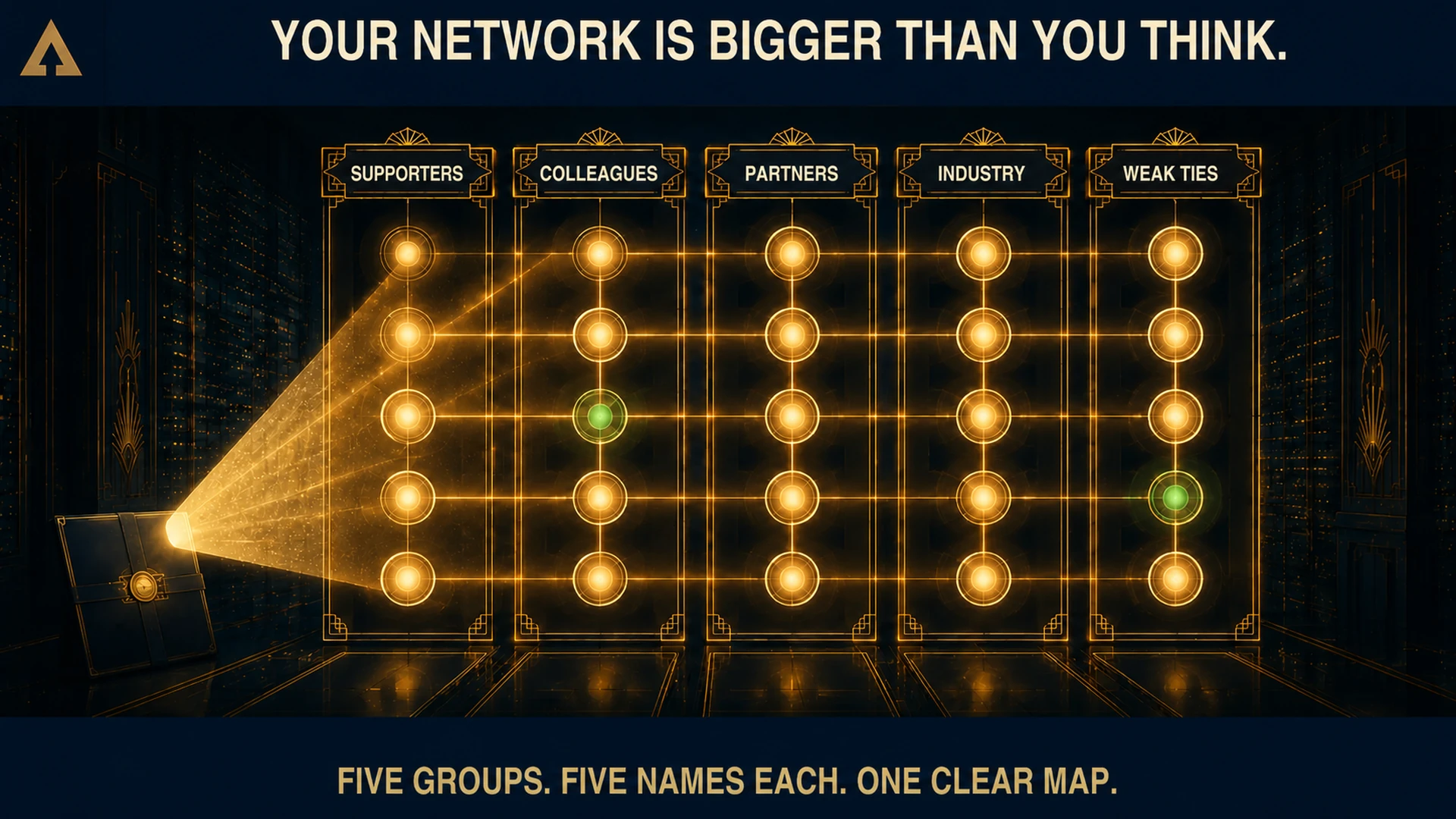
The five groups already in your network
1. Close supporters
These may be family members, close friends, mentors, or trusted peers. They may not know your industry, but they can help you stay focused, practice your explanation, notice opportunities, and manage the emotional load of a search.
2. Former colleagues and managers
These people have seen your work. They may help identify strengths, clarify accomplishments, provide perspective, or make an introduction when the relationship supports it.
3. Clients, vendors, and professional partners
People outside your former employer may understand your reputation, judgment, follow-through, or industry reach. Respect confidentiality and any contractual boundaries.
4. Recruiters, industry peers, and association contacts
These contacts may know hiring patterns, role language, company needs, or people working near your target. Ask for information or a relevant connection, not control over an employer’s decision.
5. Weak ties, alumni, neighbors, and community contacts
Do not ignore people you know less often. A large randomized study of LinkedIn connections found that moderately weak ties could increase job mobility, although the effect varied by tie strength and industry. The result does not mean every acquaintance will help. It supports looking beyond the people already closest to your daily circle. Read the peer-reviewed Science paper and Stanford’s accessible research summary.
Build the 5 × 5 support map
Write five names under each relationship group. Twenty-five is a working exercise, not a magic number. If one group has three strong names and another has seven, keep the list honest.
- Name and relationship
- What the person may know
- What the person has seen you do
- One appropriate request
- Next respectful action
Do not begin by sending the same message to everyone. First decide which names fit your current target and which request makes sense for that relationship.
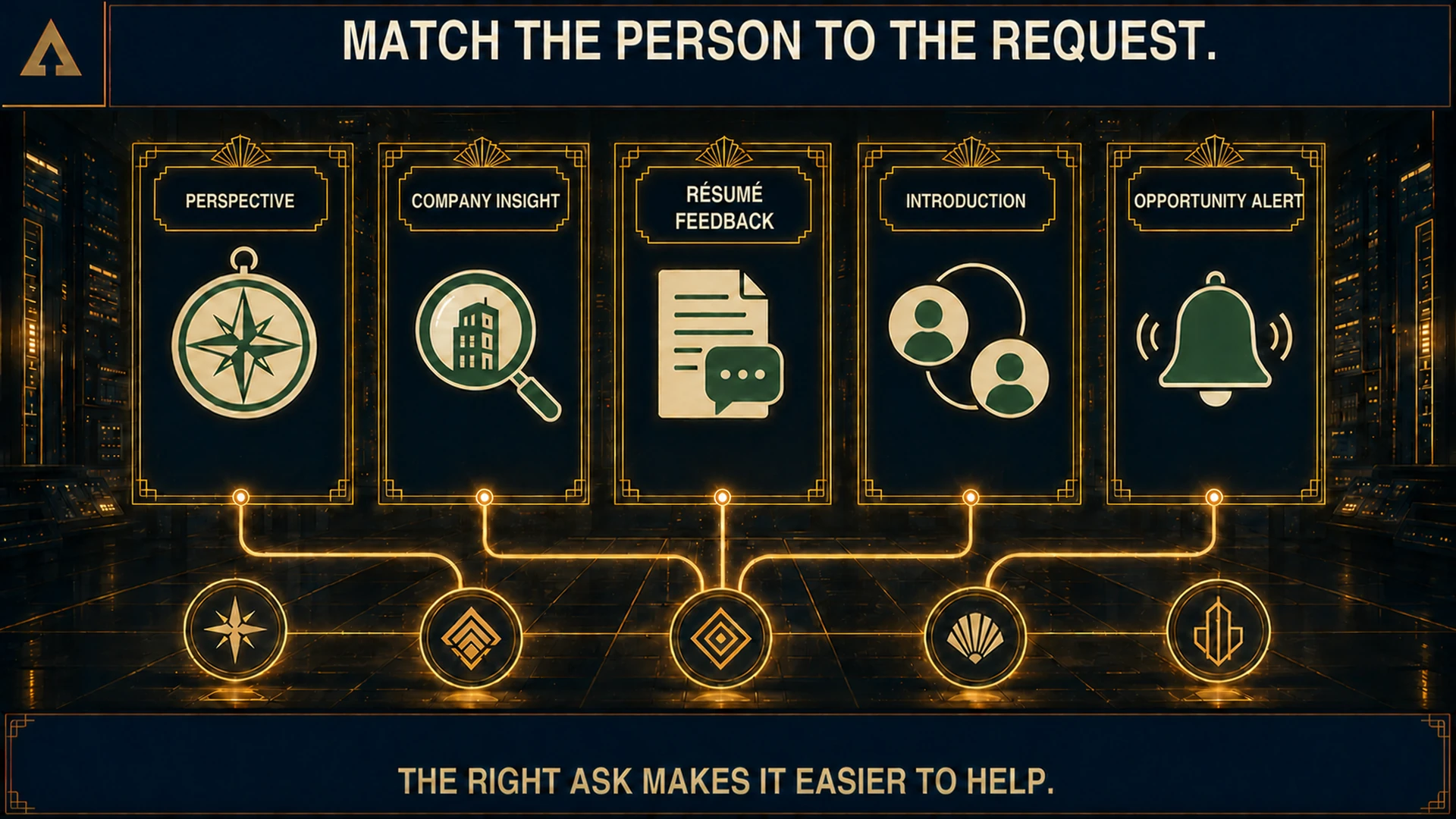
Match the person to the request
| Request | Best fit | What it sounds like |
|---|---|---|
| Perspective | Trusted former colleague | “Does this target make sense based on the work you saw me do?” |
| Company insight | Employee, vendor, or industry contact | “What should I understand about this team before I apply?” |
| Résumé feedback | Manager, peer, mentor, or recruiter | “Is the experience most relevant to this role easy to see?” |
| Introduction | Someone with a real relationship to both people | “Would you feel comfortable introducing us for a short conversation?” |
| Opportunity alert | Broad professional network | “If you see a senior marketing role in a multi-location organization, would you send it my way?” |
A referral is not the default request. Sometimes the most useful help is a correction, a name, a warning, or a clearer view of the role.
Give people something useful to forward

If someone offers to introduce you, do not make that person rebuild your career story from scratch. Provide a short, accurate package:
- The target role or role family
- Preferred company types, industries, locations, or work model
- Three proof points connected to the target
- A current résumé
- A two- or three-sentence forwardable introduction
- Your preferred contact information
Every item should be easy to verify and safe to share. Remove private company information, confidential client details, unsupported numbers, and claims that require explanation.
Example: from a vague broadcast to a useful request
Illustrative example
This example is illustrative and is not a real Kaxori user message, result, or outcome. The second message does not ask the person to produce a job. It gives context, reminds the person of real work, and asks for one manageable form of help. Adapt the language to the real relationship and your actual experience.
Protect the relationship
- Reconnect before asking when the relationship has been quiet.
- Acknowledge the shared context instead of pretending the relationship is closer than it is.
- Make it easy to decline.
- Thank the person even when the answer is no.
- Do not send repeated follow-ups after silence.
- Return help when you can.
A network is not a list of favors owed to you. It is a set of relationships that deserve care before, during, and after the job search.
A seven-day network activation plan
- Day 1: Write the target role and three supporting proof points.
- Day 2: List five close supporters and five former colleagues or managers.
- Day 3: Add clients, vendors, peers, recruiters, weak ties, alumni, and community contacts.
- Day 4: Assign one appropriate request to each priority name.
- Day 5: Prepare the résumé and short forwardable introduction.
- Day 6: Send three personal messages.
- Day 7: Record replies, thank people, and choose the next three contacts.
The plan is intentionally small. Three thoughtful messages are easier to learn from than 25 generic messages sent at once.
What a network cannot guarantee
A larger or more active network cannot guarantee a referral, interview, offer, or better hiring decision. Some people will not respond. Some will not feel comfortable making an introduction. A referral may still lead nowhere.
The method improves clarity and makes support easier. It does not create an obligation or control the employer’s process.
How Kaxori supports this work
Kaxori does not manage your relationships, send referral requests, or promise introductions. It can help compare one résumé with one job description, identify relevant language and evidence, and prepare a clearer application document before someone shares it.
You remain responsible for every claim and every message sent in your name.
Build the map, then prepare what people will see

Start with 25 names. Choose three appropriate conversations. Before asking someone to forward your résumé, make sure the target and strongest proof are easy to understand.
Build the map, then review the résumé you plan to share.
Complete the 25-person map. Choose three respectful conversations. Then use Kaxori to compare your résumé with the role and confirm that every claim is accurate.
Review my résumé with KaxoriFrequently asked questions
Do I really need 25 people?
No. Twenty-five creates a broad starting exercise. A smaller, thoughtful list is better than a larger list of people you barely know.
Should I ask everyone for a referral?
No. Match the request to the relationship. Information, feedback, or an introduction may be more appropriate.
Can I contact someone I have not spoken with in years?
Yes, when you reconnect honestly and acknowledge the gap. Do not open by pretending the relationship stayed close.
What if I do not have a large professional network?
Begin with work, education, volunteer, association, customer, vendor, neighborhood, and community relationships. Focus on real shared context.
How often should I follow up?
There is no universal schedule. Consider the relationship, urgency, and prior response. One respectful follow-up may be reasonable. Repeated messages after silence are not.
Does networking replace applying online?
No. Networking can add information and human context. It does not replace a well-targeted application or guarantee access to a decision-maker.