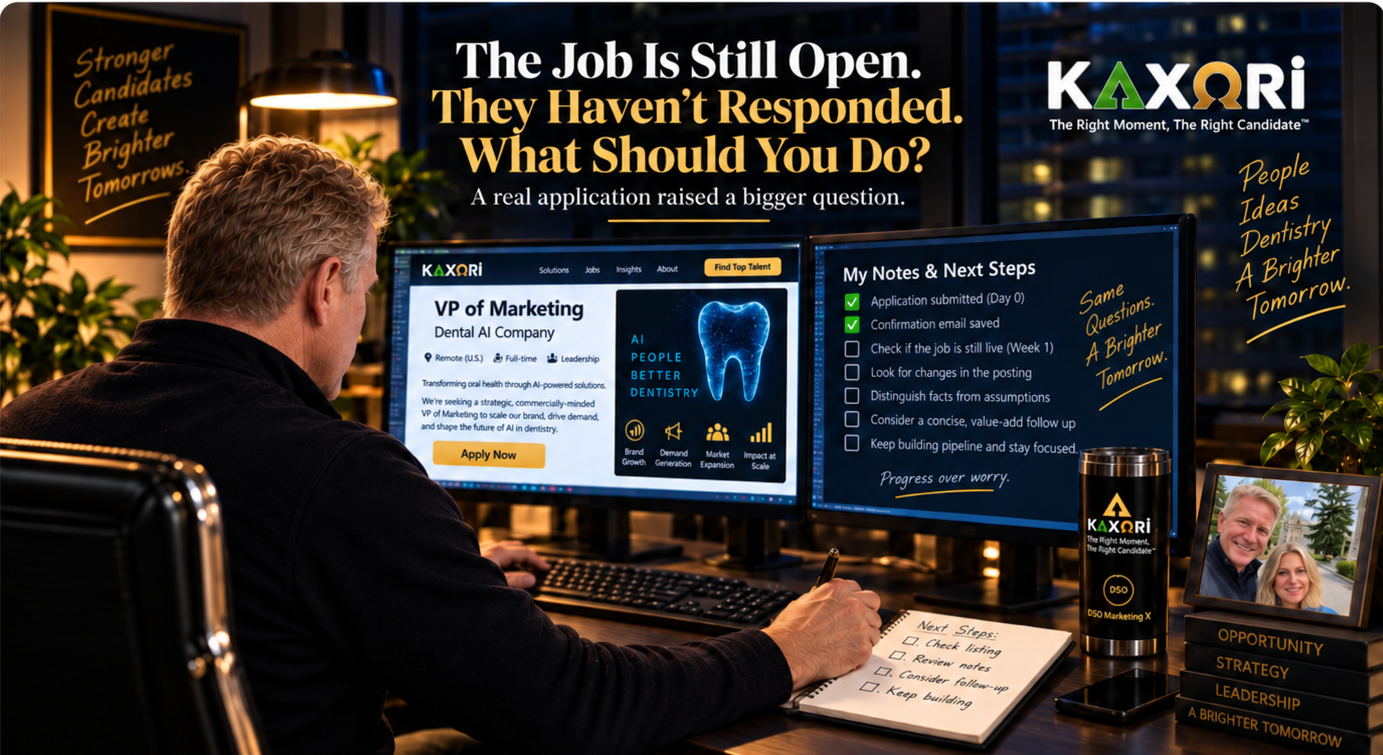
I knew the Videa job was different before I'd even finished reading it.
Videa builds AI tools for dentistry. It was looking for a VP of Marketing who could build a strong marketing team, bring in business from large dental groups and smaller practices, shape the market, and tie marketing to growth. That's a lot in one role. But it brought together several parts of my career: dental and DSO marketing, product strategy, demand generation, analytics, and leading teams. 1
So I applied.
As I write this, it's been four weeks since I applied. I haven't heard a thing. No interview request. No rejection. Not even a quick update. But the same VP Marketing job is still on Videa's careers page. I don't know what's happening inside the company. And that's the part that got me thinking about something a lot of job seekers face:
When a job is still posted after you applied, what does that actually mean?
What does it mean when a job is still posted after you apply?
If a job is still posted after you apply, all you really know is that the company still has it online. It doesn't tell you if anyone read your application, if interviews are happening, if you've been passed over, or if it's an evergreen role. So check the company's careers page, the job ID, any changes to the description, and the hiring timeline. Then decide whether a follow-up makes sense.
Why This Role Looked Like a Fit

This one caught my attention because it was such a close fit. Videa wasn't looking for someone to market just any software. The job focused on dentists, dental support organizations, large-account marketing, partnerships, product messaging, and growth. It even mentioned more than 500 mid-market DSOs where the company said it had little presence. That's a pretty specific group of customers and a set of problems I know well. 1
When you've worked across several industries, your resume can look a bit all over the place. The right experience may be there, but it's easy to miss. This job brought several parts of my background together. I wanted Videa to see that connection clearly, without adding skills or experience I couldn't back up.
That same idea shaped Kaxori. It looks at a real job and checks what your resume can actually prove. It shows what already fits, what needs clearer wording, and where you still need proof. But even a strong resume can't see a recruiter's notes. It can't tell you why an employer hasn't answered, either.
Strong fit explains the application. It does not explain employer silence.
Separate Facts From Assumptions
It's easy to take the silence personally. I caught myself asking the same thing: If the job is still open, why haven't they called? But no reply doesn't tell the whole story. It leaves you with a question, not an answer.

Maybe your resume is still being reviewed. Maybe interviews started with other candidates. The manager might still be comparing people, the budget could have changed, or the search might be on hold. Any of those things could be true. But unless someone at the company tells you, they're just guesses. Don't turn a guess into a fact about any employer.
This isn't just something I've noticed. Greenhouse's 2024 Candidate Experience Report found that 52% of the candidates it surveyed said they'd been ghosted during hiring. That's a real finding about what people experienced. It doesn't prove that Videa, or any other company, ghosted one specific applicant. 6
And it's not just one group of job seekers. Greenhouse's 2025 Workforce & Hiring Report surveyed 2,200 people who were actively looking for work in the U.S., U.K., and Ireland. Those job markets aren't all the same. Still, the research shows why waiting without an answer is a real concern for people looking for work. 7
Before I decide what Videa's listing means, I need a way to check the facts, not just go with what I feel.
Five checks: LIVE, SAME, CHANGED, CLOCK, ACTION
Here's the five-step check I use when a job stays online after you've applied. It's a practical Kaxori guide for making your next move. It's not a way to see inside a hiring team's system, and it can't tell you what they think of your application.
1. LIVE: Is the posting on the employer's own site?
Start on the company's own careers page. Old listings on job boards can hang around after the original changes or disappears. If the company is still showing the job in its own hiring system, that's more useful to know. But it still doesn't mean a hiring manager is looking at resumes today.
With Videa, I go back to its official VP Marketing listing on Ashby, the system it uses for applications. I don't rely on an old copy on another job board. Even if that link closes later, the advice stays the same: start with the company's current job page, not an outdated copy. 1
2. SAME: Is it the same requisition?
The title might look the same, but the job may not be. A company could have similar openings on different teams, in other cities, or with different budgets. It might also start a new search with a new ID. Save that job ID when you apply so you can compare it later. For Videa, I can use the unique Ashby link as my starting point.
The same link doesn't mean the company wants exactly the same things. And a new link doesn't mean you were rejected the first time. Think of the job ID as a clue. It isn't an answer on its own.
3. CHANGED: Has the actual job changed?
Put your saved job description next to the one that's online now. Start with the basics: title, level, pay, location, who the person reports to, required experience, and what the role owns. Then look for what the company is stressing now. Is it enterprise sales, product marketing, a technical skill, or industry knowledge? Those changes may point to a shift in the search. But only the employer can explain why.
Save the full description, not just the link. Companies can change the words on a page without changing its address. Save the exact resume you sent, too. If you've edited it since then, that newer version isn't what the recruiter saw when you applied.
There's another reason this matters, especially if you've had a long career. You can check whether your resume still shows the parts of your experience that fit this job. If the posting has changed, don't just copy new keywords into your resume. Only use words you can support with real work.
4. CLOCK: What does the hiring timeline actually measure?
Here's where a lot of online advice misses the mark. You've probably seen someone say, 'Don't apply after seven days.' It sounds like a firm rule. But it skips over how long companies may need to make a hiring decision.
SHRM's 2026 Recruiting Executives Benchmarking, covering more than 4,600 organizations, reported a 39-calendar-day median time-to-fill for nonexecutive positions. Its 2025 report found an executive median of about 45 calendar days. For extra-large organizations, the executive median was 60 days. 23
Time-to-fill isn't the same as time-to-first-email. SHRM starts counting when the job opens and stops when someone accepts an offer. Those numbers won't tell you if you'll hear back tomorrow, or whether one company is still actively interviewing. They do help explain why a job that's been up for 30 days may not be old at all.
Is a job posted for 30 days too old?
Not necessarily. A job that's been up for 30 days may still be within a normal hiring cycle. See if it's still on the employer's site, whether the work fits your background, and whether the listing has changed. Hiring data gives you context. It doesn't promise the role is active or that anyone has reviewed your application.
5. ACTION: What is the next useful thing you can do?
Start by following the employer's directions. If it says not to contact the team, don't. If it gives you a timeline, use that. Otherwise, a short note to a recruiter or someone you already know at the company may be worth sending. Say why you're still interested and add one useful detail about your fit. And don't confuse that one application follow-up with making new professional contacts. Building relationships is a separate, longer-term part of the search.
Yale's Office of Career Strategy recommends keeping track of your outreach and considering a follow-up after 7 to 10 business days. That's good general advice, not a promise you'll hear back. And it won't fit every executive search, so use the company's timeline when it gives you one. 5
One good follow-up is often enough. Applying again to the same job ID or sending message after message usually doesn't tell the employer anything new. After that, keep looking at other jobs that fit. Don't put your whole search on hold for one opening, no matter how good it looks.
Don't just wait. Get to know people at the company.
There's another part of the Videa story I don't want to miss. I applied for a job that looked like a strong fit, then waited for an answer. But I can do more than check the listing and watch my inbox. I can get to know people who work there, learn how they think, and let them see what I bring to the table.
Start with the people closest to the work
For a VP Marketing role at Videa, I'd look for people in marketing, dental sales, partnerships, customer success, and leadership. I'd first check whether we share a connection who could introduce us. If not, a short LinkedIn message can still make sense. I wouldn't ask someone I've never met to push my resume. I'd ask a real question about their work or the market and see if they're open to a conversation.
Harvard's career guidance says informational conversations can help you learn about a company, make new contacts, and find people who may be willing to introduce you to others. It also says to be curious, give back, and ask for advice before asking for a job. 8
Don't overlook the people you barely know
You might think only your close friends can help. But a 2022 study published in Science tested LinkedIn connection recommendations across more than 20 million people. It found that weaker professional ties could help people move into new jobs, though the effect depended on the kind of connection and industry. That's a good reason to look beyond your closest circle, not a reason to send random requests to everyone. 9
Let your work start the conversation
I'd also write and share more of what I know. For this kind of role, that could mean a short LinkedIn post about how dental groups evaluate AI tools, or a useful blog article about marketing to DSOs. Maybe it's a lesson from building a go-to-market plan or a question dental leaders should ask before they adopt new technology.
That gives people something real to read before they ever meet me. LinkedIn's own guidance encourages members to share useful experiences and professional ideas to build their voice and connections. But posting isn't a shortcut into an interview, and it doesn't mean a recruiter will see your article. Share because you've got something worth saying, not because you want to tag a hiring manager ten times. 10
Keep the application and the relationships on separate tracks
One track is the job itself: save the application, check the role, and follow up once when it makes sense. The other is your professional network: meet the right people, listen, share useful work, and stay in touch. Someone who gets to know you may offer to introduce you to a recruiter or refer you later. That's their call, not something you can demand.
For me, the lesson is simple. Don't just hope the right person finds your resume. Give people a reason to get to know your work, without turning every new connection into a job request.
Five-Step Reality Check When a Job Is Still Posted
This is a guide worth saving or sharing with a friend who's wondering whether to follow up, apply again, or move on. The five steps are Kaxori's way of sorting through the question. The three hiring-time numbers come from SHRM, and the 7–10 business-day follow-up tip comes from Yale. They're useful guideposts, not hard rules for every employer. 2 3 5
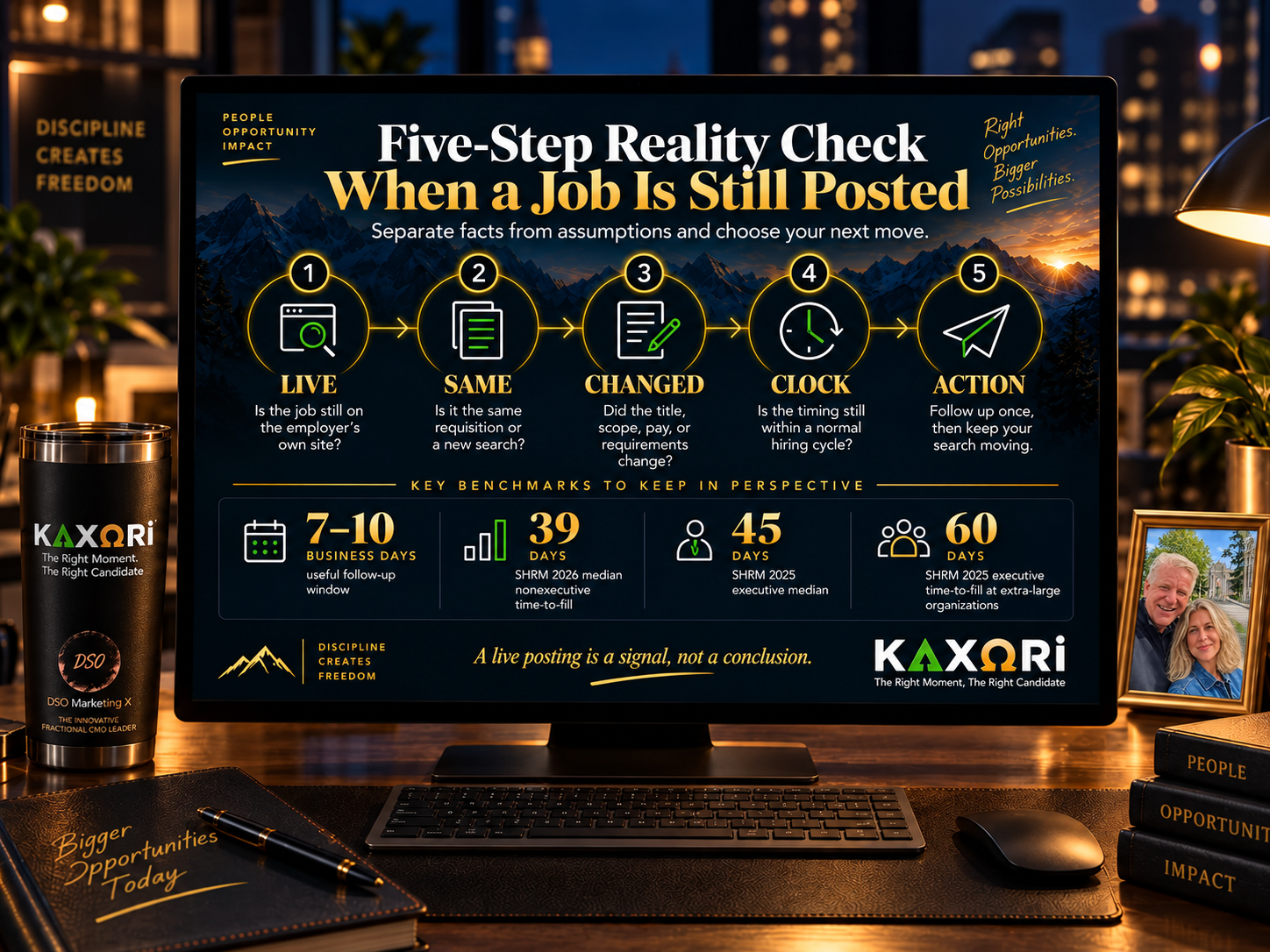
You'll find the same five steps written out above the infographic. That's on purpose. The smaller words in a graphic can be hard to read on a phone. I want you to get the advice and see the sources even if you skip the picture.
Is the job evergreen, reposted, or simply hard to fill?
Evergreen has a specific meaning in hiring. Workday says an evergreen job stays open so a company can keep meeting possible candidates, often for roles that are filled again and again or are hard to fill. When there's a specific opening, someone from that pool may be moved into a regular job listing. 4
A VP Marketing job that's been up a long time isn't automatically an evergreen opening. Maybe the company is having trouble finding the right person. It could be updating the job, waiting for approval, reopening a search, or already interviewing people. We can't see all that from outside. So I can't tell you which reason applies to Videa.
Here's what a few common signs can tell you, and what they can't:
| What you observe | What it supports | What it does not prove |
|---|---|---|
| Employer-hosted job is still live | The company continues to display it | That hiring is moving today |
| Same requisition identifier | It is the same public job record | That your application is still active |
| New job ID with similar title | A different recruiting record exists | That the earlier search rejected you |
| Requirements changed | The public description has evolved | Why the employer changed it |
| No response after a few weeks | You lack an update | Rejection, acceptance, or recruiter intent |
This table may not give you a catchy 'secret hiring trick.' That's fine. It's much more useful to know what's real, what's only possible, and what you can do next without guessing at someone else's decision.
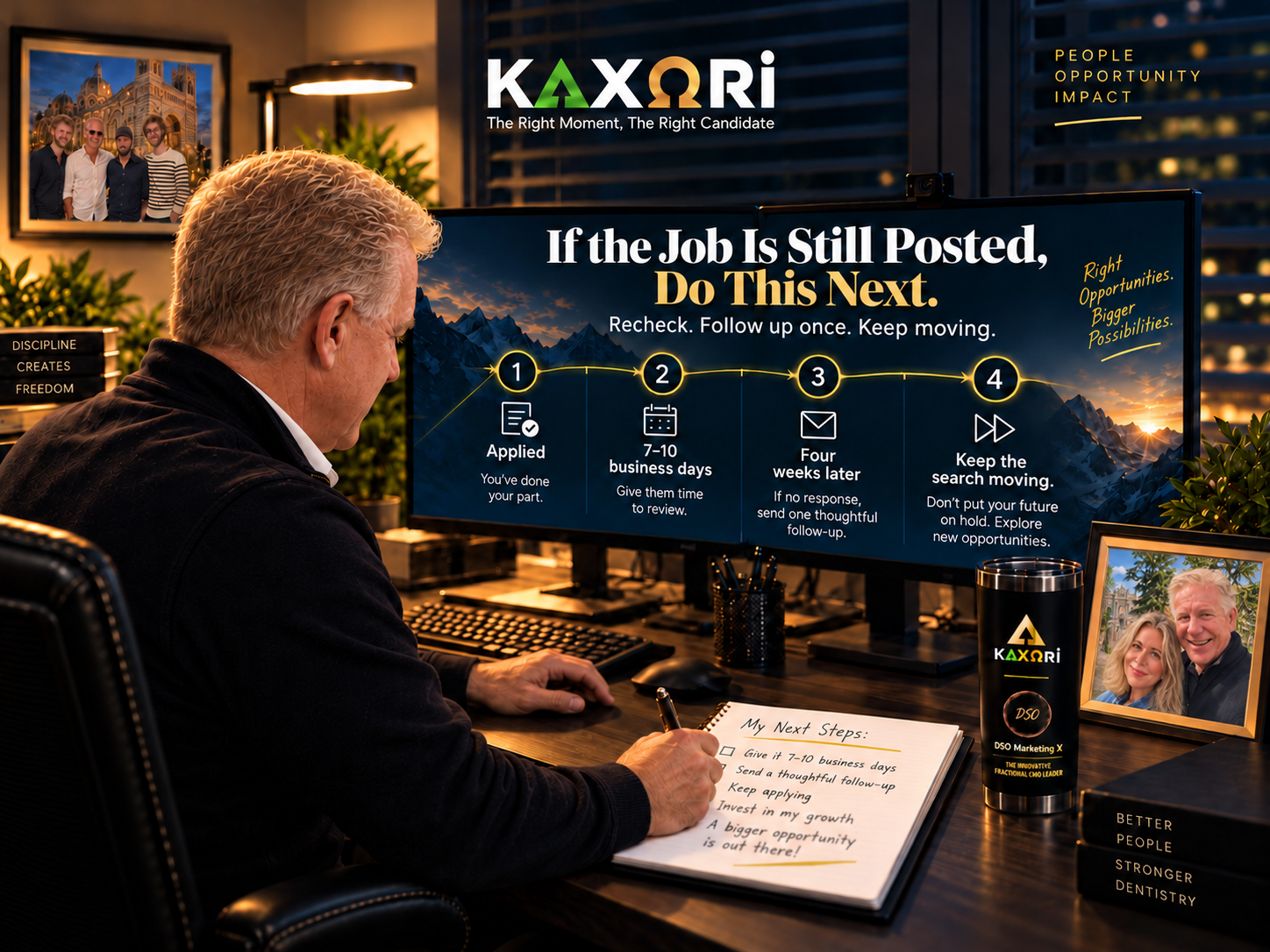
If the Job Is Still Posted, Do This Next
Before you apply: Save the company name, job link, job ID, description, the resume you're sending, and any cover letter. Write down why you think you're a good fit. That gives you something real to compare with if the posting changes later.
Day 0: Send the application and save the confirmation email or message in the hiring portal. If the employer tells you when to expect an update, write that down too. It'll save you from trying to remember it weeks later.
Early in the search: Find one or two people at the company whose work connects with yours. Check LinkedIn for shared contacts, read what they publish, and make a personal introduction if it feels appropriate. You're trying to learn, not ask a stranger to do you a favor.
After roughly 7–10 business days: If the employer didn't give a timeline and you know the right person to contact, think about sending one short follow-up. That's based on Yale's advice. It isn't a deadline that every employer has to follow. 5
Weeks 2–4: Go back to the company's careers page and check the job ID. Has the title, pay, location, or description changed? Is there a new message in your application portal? If nothing has changed and nobody has replied, keep the result marked unknown.
Beyond a month: Look at the hiring-time data, but don't treat those numbers as a deadline for getting an email. Ask yourself what would make the best use of your time now. A better introduction? A fresh note with real proof? Or more effort on other jobs that fit just as well?
Throughout: Keep meeting people and applying for jobs that make sense. Pay attention to what gets a response, and protect your time. You need more than one chance in play. One promising opening shouldn't become your entire job search. You can also share useful LinkedIn posts or articles from your field so new contacts can see how you think. Keep it genuine and give people something worth reading.
What does a good follow-up message actually say?
You don't need to write a long letter. Make one clear connection to the job, share one example that shows your fit, and ask one polite question. That's it. Here's the kind of message a VP candidate could send:
Hi [recruiter name], I applied for the VP Marketing role and wanted to follow up. I've led growth and marketing work with dental groups and multi-location health care businesses, so the markets in this job caught my attention. Do you have an updated timeline for the search? Thanks for your time.
That note doesn't demand an answer or act like you know someone you haven't met. If you've done something new that's relevant since applying, add a quick sentence. If you don't have the right contact, or the company says not to follow up, don't go looking for someone's private email address to force a reply.
The application record worth saving
If you take one thing away from this article, make it this simple application record. You can keep it in a spreadsheet, a notes app, or a private tracker. Having the right details in one place is often more useful than checking the same job board over and over.
| Field | What to record |
|---|---|
| Opportunity | Employer, job title, employer-hosted URL, requisition ID |
| Baseline | Saved description, role requirements, compensation and location |
| Submission | Resume version, cover letter version, submission date, confirmation |
| People | Recruiter or employee name, relationship, consent-appropriate contact |
| Changes | New posting wording, dates observed, different IDs and portal status |
| Next action | Follow-up window, message sent, response, or decision to move on |
| Connections and useful content | People you met, introductions, LinkedIn conversations, articles shared, and whether a follow-up is welcome |
You're not saving all this so you can worry about it every day. You're saving it so you can tell what changed, what you actually sent, and what needs a response. It also keeps you from sending the wrong resume version if another opportunity comes along.
A Serious Job Search Needs Both
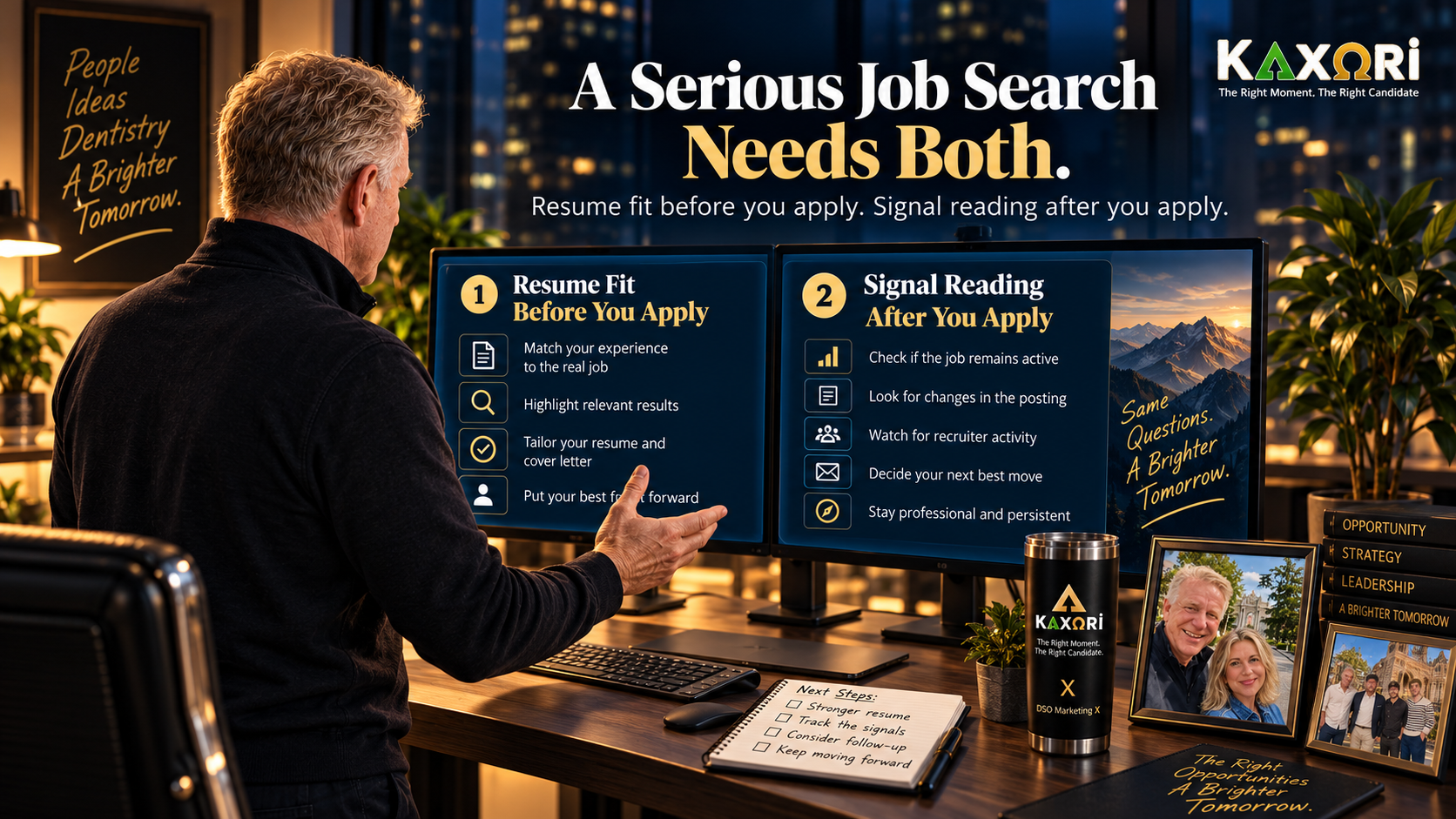
My first question was pretty simple: Does my background fit this job, and does my resume make that clear? That's the problem that led me to build Kaxori. I wanted people with real experience to tell their story better without making things up or sounding like someone else.
Then I applied for the Videa job. It looked like such a good fit, but the inbox stayed quiet while the listing stayed online. And I couldn't read the company's mind from either one. It reminded me that getting your resume right is only one part of finding the next job.
First, make sure your application shows the fit. Then pay attention to what happens after you send it. Save your records, check what actually changed, try to reach the right person, and decide what makes sense next. You don't need to know everything. You do need to be careful about what you assume.
My Videa application is one real experience. It doesn't tell us what Videa plans to do or how its search will end. But it does make a bigger point: a job that's still posted gives you a signal. It doesn't give you an answer. And I can do more to let people inside a target company see my ideas and experience, not just my application.
Frequently asked questions
What does it mean if a job is still posted after I applied?
It means the employer still has the job online. It doesn't tell you if someone read your application, if interviews started, or if the job is evergreen. Check the company's own careers page, compare the job ID and description with what you saved, and then decide whether a polite follow-up makes sense.
Should I apply to a job posted 30 days ago?
Yes, if the job is still on the employer's site and your experience fits. SHRM reported a 39-day median time-to-fill for nonexecutive jobs in 2026. That's not a deadline for getting an email. It just shows why a 30-day-old listing isn't always stale.
Why is the same job reposted after I applied?
The company may have refreshed the post, opened the search again, changed the role, or tried to reach more people. A similar title doesn't mean it's the same job ID. Compare the current listing with the one you saved before you decide whether to apply again.
Does no response after a job application mean rejection?
No. When you don't hear back, you still don't know the result. But silence doesn't mean your application is moving ahead, either. Check your portal and any timeline the company gave you. Then send one professional follow-up if it makes sense, and keep your search going.
How long should I wait to follow up after applying?
Follow the employer's timeline first. If it didn't give one, Yale's Office of Career Strategy suggests checking in after 7 to 10 business days. That's helpful career advice, not a deadline every company has to meet.
What is an evergreen job posting?
An evergreen job stays open so a company can keep finding candidates over time. Workday says employers use these listings for high-volume, high-turnover, or hard-to-fill roles. You can't tell for sure that a job is evergreen just because it's been posted for a long time.
Should I reapply when the same job stays open?
Not automatically. If it's the same job ID, sending the exact same application again may not change anything. See if the company accepts updates, if the posting changed, or if you have new proof to share. A short, focused follow-up may be the better move.
What should I save before I submit a job application?
Save the company and job title, the posting link, job ID, full description, resume version, confirmation, application date, contacts, and any response timeline the employer gave you. These details make it much easier to spot changes later without relying on your memory.
Should I connect with employees on LinkedIn after applying?
Yes, when you've got a genuine reason to connect and the employer's rules allow it. Start with shared contacts or people whose work relates to yours. Ask about their experience or a topic you both know. Don't ask a stranger to get you hired, and respect it if they don't reply.
Can posting on LinkedIn help me get noticed during a job search?
Sharing useful posts or articles can show people how you think and what you know. Write about real work, industry questions, and lessons you can back up. It may help you start conversations, but it can't guarantee that a recruiter will see your post or invite you to interview.
Research and sources
We used Videa's public job posting, HR benchmarks, Workday's evergreen-job guidance, university career advice, a peer-reviewed LinkedIn networking study, and job-seeker research. Each source backs up a specific point. None tells us why one employer hasn't answered one application.
- Videa, VP Marketing recruiting page. Job scope and official application URL. Live status must be rechecked at publish time.
- SHRM, 2026 Recruiting Executives Benchmarking. 39-day median nonexecutive time-to-fill; over 4,600 organizations; more than two-thirds struggling to fill roles.
- SHRM, 2025 Recruiting Executives Benchmarking. 45-day median executive time-to-fill and 60 days for executive positions at extra-large organizations.
- Workday Administrator Guide, Evergreen Requisitions. An evergreen requisition is configured to remain open for ongoing sourcing.
- Yale Office of Career Strategy, Job Search Road Map. Track search actions and consider follow-up after 7–10 business days.
- Greenhouse, 2024 Candidate Experience Report. 52% of candidates reported being ghosted; survey population and context must be stated.
- Greenhouse, 2025 Workforce & Hiring Report. Survey of 2,200 active job seekers in US, UK and Ireland; context about candidate pressure.
- Harvard Mignone Center for Career Success, Guide to Making Connections. Informational meetings, introductions, employee referrals, and giving value to new professional contacts.
- Rajkumar and colleagues, Science (2022), A Causal Test of the Strength of Weak Ties. Randomized LinkedIn connection experiment involving over 20 million users; evidence that weaker ties can contribute to job mobility, with variation by industry.
- LinkedIn Recruiter Help, Build Your Voice by Sharing Content. Platform guidance for sharing professional expertise and experiences; not independent evidence of recruiting outcomes.