At some point, the application count stops being useful. Maybe you have sent 50 applications, maybe 100, or maybe 300. You keep applying because it feels like the one thing you can control, and then another rejection email arrives. Or worse, nothing arrives at all.
The natural reaction is to send more. Before you do, look at the funnel. A job search is not one action; it moves through a series of stages:
Find → Qualify → Prepare → Apply → Respond → Interview → Offer
If opportunities repeatedly stop at the same stage, that pattern is telling you something. The answer may be your résumé, but it may also be the jobs you are targeting, the channels you use, a real qualification gap, the way your experience is positioned, or what happens once you reach an interview. The goal is to diagnose instead of guess.

Why the application count is not enough
An application count tells you how many times you submitted an application. It does not tell you how many of those jobs were strong targets, whether your experience matched the work, or which résumé version you sent.
It also does not tell you whether the opportunity came from LinkedIn, a company website, a recruiter, a referral, or another source. Most importantly, the count cannot tell you why an employer made a decision.
That is why "I have applied to 200 jobs" is a warning signal, not a diagnosis. Before application 201, look at what happened to the first 200.
Step 1: Were these jobs actually good targets?
Start one step before the résumé and ask, Should I have applied to this job in the first place? A title can look right while the actual job is wrong.
Read the full description and look at:
- level of responsibility;
- required qualifications;
- preferred qualifications;
- tools or technical requirements;
- location and work model;
- industry expectations;
- compensation when available;
- the problems the person in the role is expected to solve.
You do not need to match every line, but you should be able to explain why the role makes sense for you. Try saying it in one honest sentence:
This role makes sense because I have already done [relevant work], and this job needs [specific capability].
If you cannot complete that thought without stretching the truth, the application may be weak before the résumé is even opened.
Step 2: Real gap or hidden fit?
Keep this distinction simple. A real gap means the role needs something you do not currently have, such as a required license, clearance, language, technical capability, or level of ownership.
A visibility problem means you have relevant experience, but the connection is difficult to recognize. The employer may use a different term, your strongest proof may be buried, or the résumé may list responsibilities without showing scale, decisions, context, or outcomes.
Do not use keywords to pretend a real gap is solved, and do not assume hidden evidence will explain itself. The useful question is whether the requirement is genuinely missing or whether relevant experience is simply difficult to recognize.

Step 3: Diagnose what you actually sent
Now put the job description beside the résumé you submitted and ask:
- Can someone tell what role I am targeting?
- Is my strongest relevant evidence easy to find?
- Are important job terms connected to real experience?
- Did I bury the match under less relevant history?
- Can I defend every title, tool, number, and outcome?
- Does the document still sound like a real person who can explain the work?
If the answer to several questions is no, the application may need work. For the complete Kaxori method, continue to One Résumé. One Job. What Good Tailoring Actually Changes, which covers the deeper Prioritize, Move, Prove, Trim workflow.
Harvard's Mignone Center for Career Success describes a résumé as an important factor in obtaining an interview while making clear that a résumé alone does not get someone a job. It also recommends tailoring the résumé to the position and emphasizing the skills and experience the employer values.
That is the right boundary: a résumé can make your fit clearer, but it cannot control the employer's decision.
Step 4: Track the source
Where are your applications coming from? Record the source instead of relying on memory:
- LinkedIn?
- Indeed?
- company career pages?
- recruiters?
- referrals?
- former colleagues?
- industry groups?
Stanford Career Education recommends creating a system to track application status, including submission, follow-up, and interview dates. UC Berkeley Career Engagement also provides an application tracking sheet as part of its job-search resources.
That is not busywork. After enough applications, memory becomes unreliable. If you do not know which source produced the opportunity, which résumé you sent, or how far the application moved, you cannot learn much from the outcome.

Step 5: Find the break in your funnel
Use the diagnostic below to focus on the stage that is actually breaking.
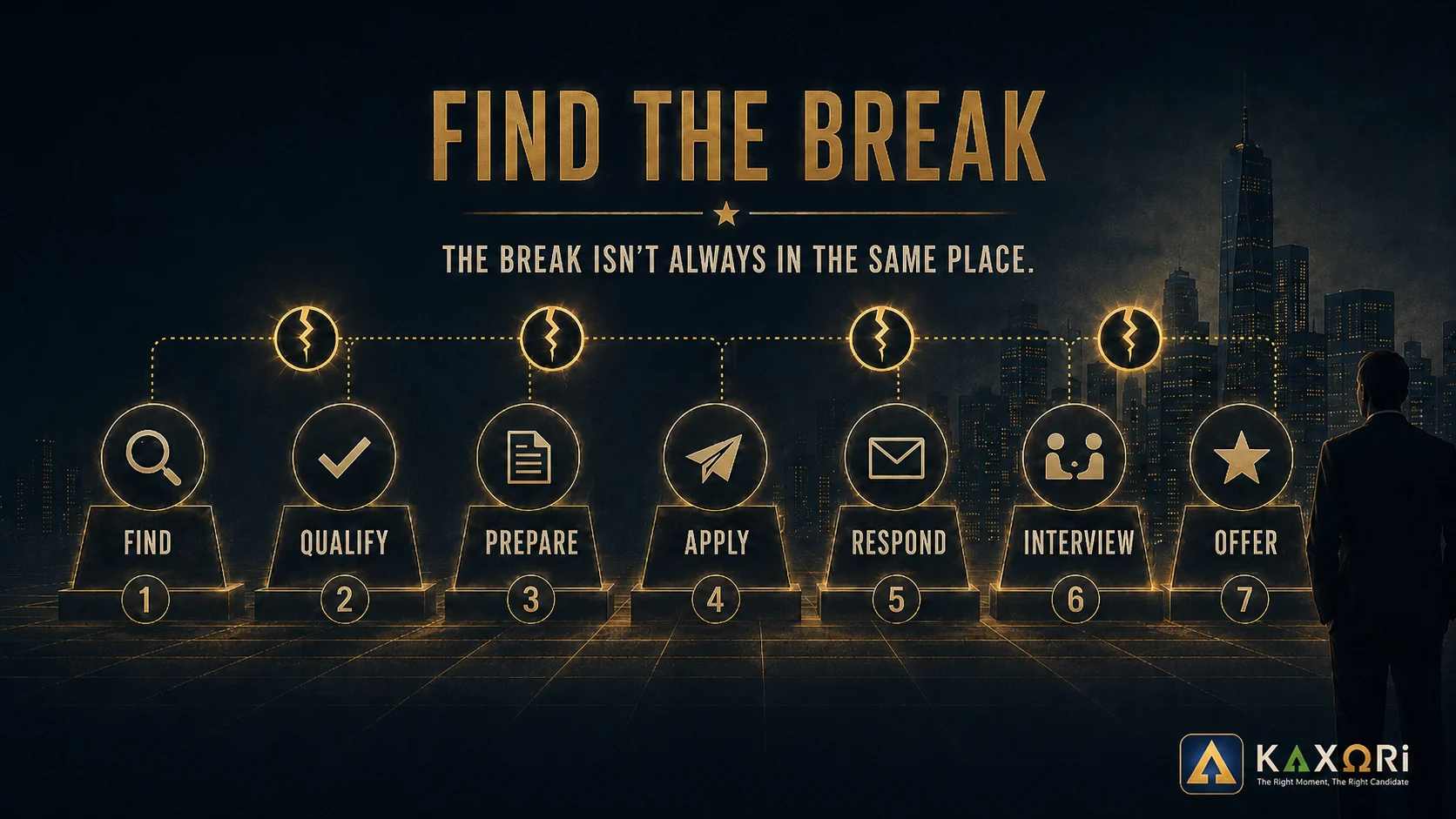
Lots of applications, almost no human responses
Look first at:
- whether the roles are genuinely good targets;
- real qualification gaps;
- résumé relevance;
- résumé evidence;
- job-specific language;
- the channels you are relying on.
Do not immediately redesign the entire résumé. Find the likely failure point first.
Recruiter screens, but few real interviews
Something in your application created enough interest for a conversation. Now ask what changes during that conversation. Possible issues include:
- role level;
- compensation;
- location;
- work authorization;
- true qualification gaps;
- unclear career positioning;
- a mismatch between what the résumé suggests and what you actually want.
That does not prove the résumé is perfect, but it suggests the next useful question may be deeper than formatting or an ATS score.
Interviews, but no offers
If employers are repeatedly interviewing you, your application is doing at least part of its job.
Shift more attention toward:
- interview preparation;
- examples and stories;
- how clearly you explain decisions and results;
- technical or case performance;
- role fit;
- references;
- follow-up;
- what changes between early and late rounds.
Harvard's interviewing guidance says employers use interviews to evaluate qualifications, fit, motivation, potential contribution, communication, and knowledge of the organization. Those are interview-stage questions, so do not keep trying to solve all of them with another résumé rewrite.
You cannot find enough good-fit jobs
That is a discovery problem before it is an application problem. You may need:
- broader job-title vocabulary;
- adjacent-role research;
- better saved searches;
- industry-specific job sources;
- company career pages;
- recruiters in your specialty;
- a stronger professional network.
You cannot improve the conversion of jobs that were never good targets.
Why there is no magic application-to-interview ratio
Be careful with internet benchmarks. One person may be applying for entry-level retail roles in a large city, while another is pursuing a senior regulatory position in a narrow industry. Someone else may need remote work, have a referral, or be changing careers. Those searches are not comparable.
NACE's professional recruiting standards emphasize role-specific qualifications and employer selection processes. That is another reason not to turn one online ratio into a universal promise.
Instead of asking, "What percentage of my applications should become interviews?", ask, "What is happening inside my search, and is the pattern improving?" That is a question you can act on.
Use your own job-search data
Once a week, review:
| Stage | What to track |
|---|---|
| Jobs found | How many were worth serious consideration? |
| Qualified targets | How many had a defensible fit? |
| Applications | Which résumé did you send? |
| Human responses | Which sources produced conversations? |
| Interviews | Where did you advance or stop? |
| Offers or final rounds | What changed late in the process? |

Then pick one thing to test, not five. For example:
Week 1: Keep the same target roles. Improve the top third of the résumé.
Week 2: Keep the résumé stable. Apply earlier to stronger-fit jobs.
Week 3: Keep the application process stable. Add targeted outreach around a small number of roles.
You will never turn a real job search into a perfect laboratory experiment, and you do not need to. You only need enough discipline to stop changing everything at once.
Where Kaxori fits
Kaxori works at the application-preparation stage of the funnel. Take one résumé and one real job description, then use Kaxori to examine fit, keyword gaps, credibility, and job-specific résumé alignment before you apply. Review every proposed change yourself.
Kaxori cannot tell you why a specific employer rejected you, see a company's private selection rules, or guarantee a callback, interview, ranking, or offer. What it can help you answer is narrower:
Before I send this application, is my real fit as clear as I can make it?
That is one stage of the funnel. What happens next gives you the next piece of information.
Before application 201
Stop for 20 minutes. Take your most recent applications and write down:
- the job;
- why it was a real target;
- where you found it;
- which résumé you sent;
- whether anyone responded;
- whether it became an interview;
- where the process stopped.
Then look for the break. If the target is wrong, fix the target. If your real experience is hard to see, improve the résumé. If one channel produces nothing, test another.
If you are getting interviews but not offers, work on the interview stage. If you do not know what is happening, start tracking.
The next application should teach you something, not just increase the count.
Frequently asked questions
How many applications should it take to get an interview?
There is no universal number. Results vary by role, seniority, geography, qualifications, market conditions, employer, competition, and application source. Look for patterns inside your own search rather than treating one benchmark as a promise.
Is my résumé the problem if I am getting no interviews?
It might be part of the problem, but silence alone does not prove that. Targeting, qualification gaps, résumé evidence, timing, competition, and application channels can all affect whether an application moves forward.
Should I keep applying while I fix my résumé?
You do not need to stop your entire search. But if the same pattern has produced little movement, pause long enough to review what you are targeting and what you are sending.
Should I apply if I do not meet every requirement?
Separate real requirements from areas where your experience may transfer. Never add a qualification you do not have. If you can explain a truthful, defensible connection between your experience and the role, the job may still be worth considering.
Does a high ATS score guarantee an interview?
No. A score is a review signal. It cannot control recruiter judgment, employer priorities, competition, interviews, or offers.
What should I track after I apply?
At minimum, record the job, company, source, application date, résumé version, contacts, responses, interviews, follow-up, and final outcome.
Sources
- Stanford Career Education, Job Search Action Plan. Accessed Aug. 24, 2026.
- Harvard FAS Mignone Center for Career Success, Harvard College Guide to Creating a Strong Resume. Accessed Aug. 24, 2026.
- Harvard FAS Mignone Center for Career Success, Interviewing. Accessed Aug. 24, 2026.
- UC Berkeley Career Engagement, Jobs. Accessed Aug. 24, 2026.
- National Association of Colleges and Employers, Professional Standards for Early Talent Recruiting & University Relations. Accessed Aug. 24, 2026.
Make sure the next application represents the experience you actually have.
Check your résumé against one real job in Kaxori. Then track what happens.
Check my résumé with Kaxori