
Dana almost skipped the job when she saw the title.
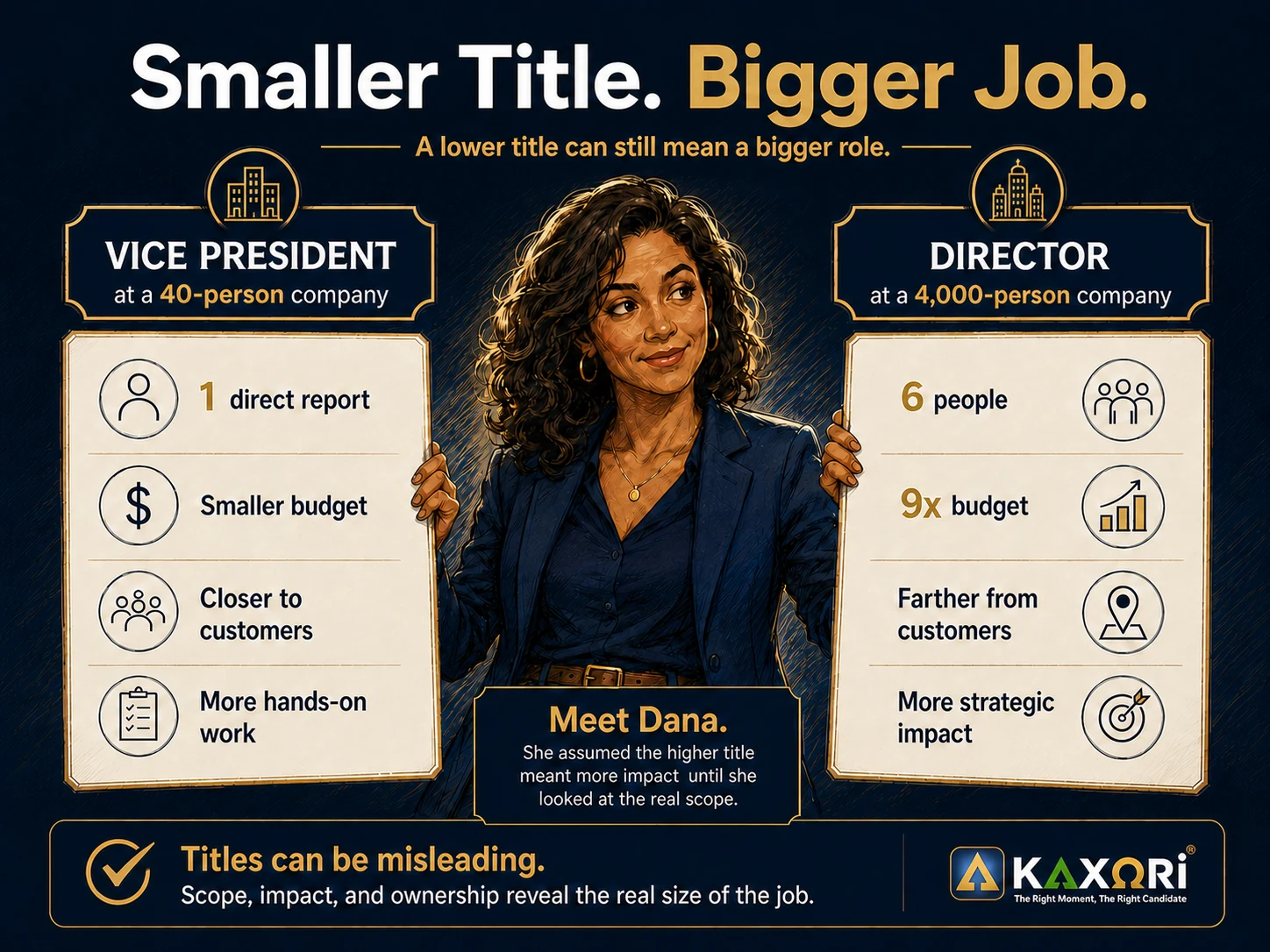
Her last title was Vice President at a 40-person company. This opening was Director at a company with about 4,000 employees.
On paper, the title looked smaller.
The work did not.
In this composite example, the Director role would lead six people instead of one and own a budget about nine times larger. It would also give Dana broader strategic impact inside a much larger company.
She wanted the job.
She could already hear the questions an employer would ask.
Why would a former Vice President want a Director role? Would she get bored? Would the pay work? Would she leave as soon as another Vice President job appeared?
Dana's problem was not that she had too much experience.
Her problem was that an employer could not yet see why this move made sense.
Dana is a composite teaching example created to show a common job-search situation. She is not presented as a specific Kaxori customer.
That is why overqualified can be a misleading shortcut.
The answer is not to make your career smaller.
The better move is to make the fit easier to understand.
What does “overqualified” mean for a job?
“Overqualified” usually means an employer thinks your background is bigger than the job needs. You can still apply when the work truly fits what you want. Keep every career fact accurate. Show the hands-on proof that matters here. Explain why this role makes sense for you now. Answer pay and retention questions directly.
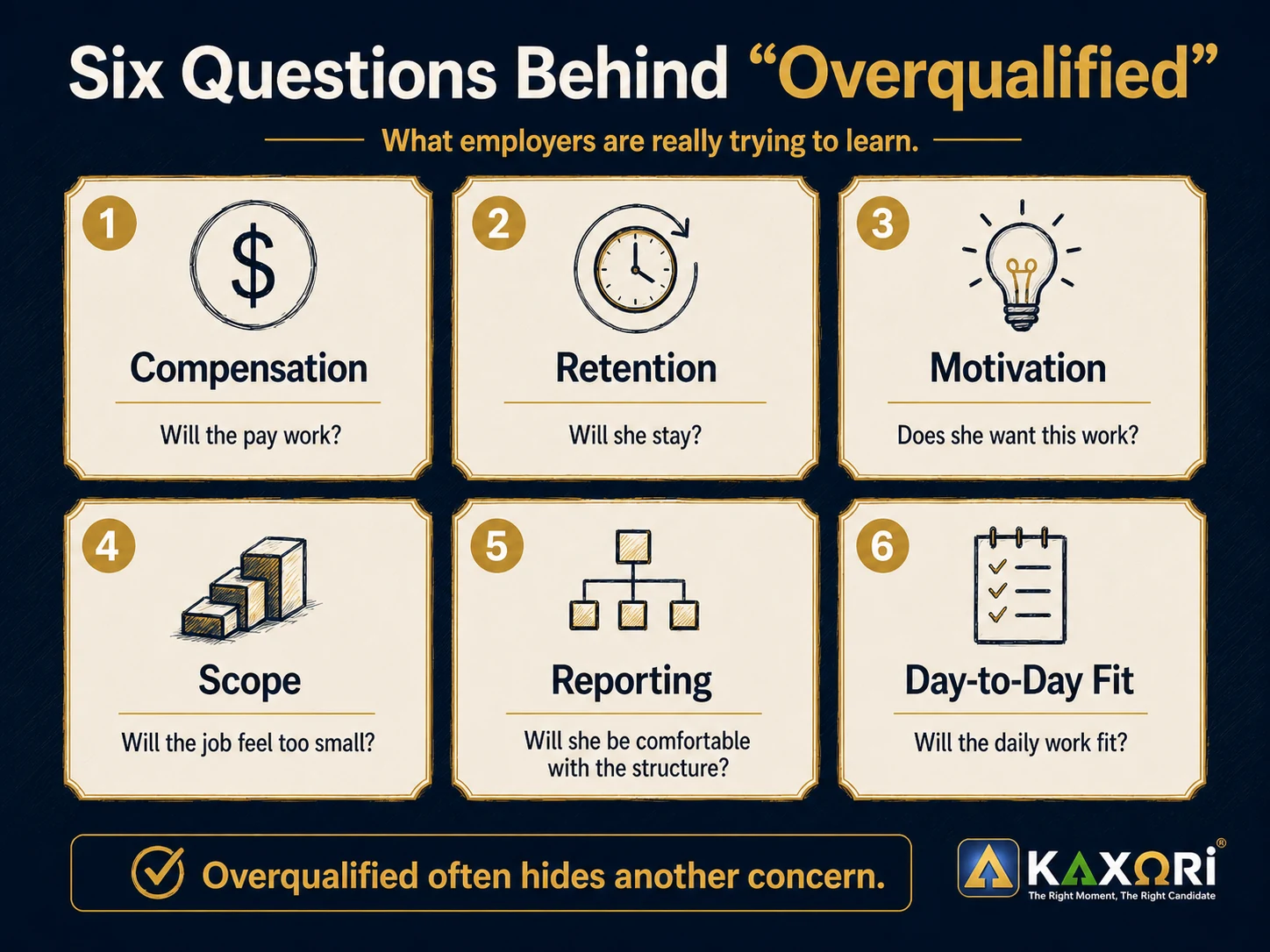
That label points to several concerns. Employers often ask whether the pay will work and whether the work will feel too small. They also ask whether you will leave when a more senior job appears.
What matters most
- First ask whether you truly want the work, pay range, scope, and reporting structure.
- Do not lower a real title or change dates to look less experienced.
- Focus the resume on the work that matters for this job.
- Explain why this move makes sense now. A clear reason reduces guesswork.
- Expect questions about pay, motivation, scope, and whether you will stay.
- If an interviewer says you seem overqualified, ask which concern is behind the label. Then answer the real concern.
- One rejection does not tell you why a hiring decision was made.
First decide whether the role fits you
Before you change a resume, make sure the job still makes sense for you.
This is the part many articles skip. They jump straight to “how to look less senior.” That can solve the wrong problem.
Ask yourself:
- Would I be happy doing the core work? Read the daily work. Do not apply only because the title is available.
- Can I accept the likely pay range? If the role pays far below what you need, the mismatch is real.
- Am I comfortable with the scope and reporting structure? If you managed a large team before, a job with no direct reports changes the work. Decide whether that works for you.
- Can I explain why I want this job without sounding temporary? “I just need something for now” will not build confidence.
A move makes sense for many reasons. You want less travel. You want to return to hands-on work. You want a different industry or a role closer to home. You care more about the mission, team, schedule, or type of problem than the title.
Those can all be real reasons.
The key is to know your reason before you ask an employer to believe it.
Dana's reason was clear. She wanted a larger operating scope, broader strategic impact, and the chance to lead a bigger team. The larger company made the Director role bigger in the ways that mattered to her.
That did not remove every employer concern.
It simply meant she had a real reason to keep going.
Check the job against the resume before you talk yourself out of it.
Use one real job and one real resume. Kaxori can surface alignment gaps so you can decide what needs a clearer explanation.
Why do employers worry about overqualified candidates?
Employers do not always reject the experience itself. They often use the label to test a different risk.
Research shows the picture is more mixed than the old stereotype suggests. A 2015 qualitative study interviewed 24 hiring managers across U.S. public and private organizations. Some managers said they would interview and hire candidates whose education or experience exceeded a job's requirements. The study also found that motivation matters when the mismatch is intentional. Review the DOI record. Free institutional record.
This was a small qualitative U.S. study, not a universal rule or a prediction about any one employer. It does show why “overqualified” should not be treated as an automatic no. An employer may be testing whether your expectations, motivation and preferred scope fit the actual job.
| Possible concern | What the employer wants to learn | What you can show |
|---|---|---|
| Compensation | Will this person accept the real pay range? | A direct, realistic answer about the role and range. |
| Retention | Will this person leave as soon as a larger job appears? | A credible reason this role fits your next chapter. |
| Scope | Will the work feel too small? | Interest in the actual work, not only the title. |
| Motivation | Why does this person want this job now? | A positive reason tied to the work, team, mission, market, or life stage. |
| Reporting structure | Will this person be comfortable reporting to someone with less tenure or a smaller title? | Respect for the role, manager, and decision rights. |
| Day-to-day attitude | Will this person treat the work as beneath them? | Hands-on proof, curiosity, and language that respects the job. |
That last concern deserves attention. Research on overqualification has examined how hiring practitioners think about expected attitudes and behavior, not only years of experience. Do not insist that you are “not too senior.” Show that you respect the work and understand what the job requires.
Dana could explain why she wanted the role. The employer still had to decide whether the move felt believable.
Use the Kaxori Four-Part Overqualification Fit Test
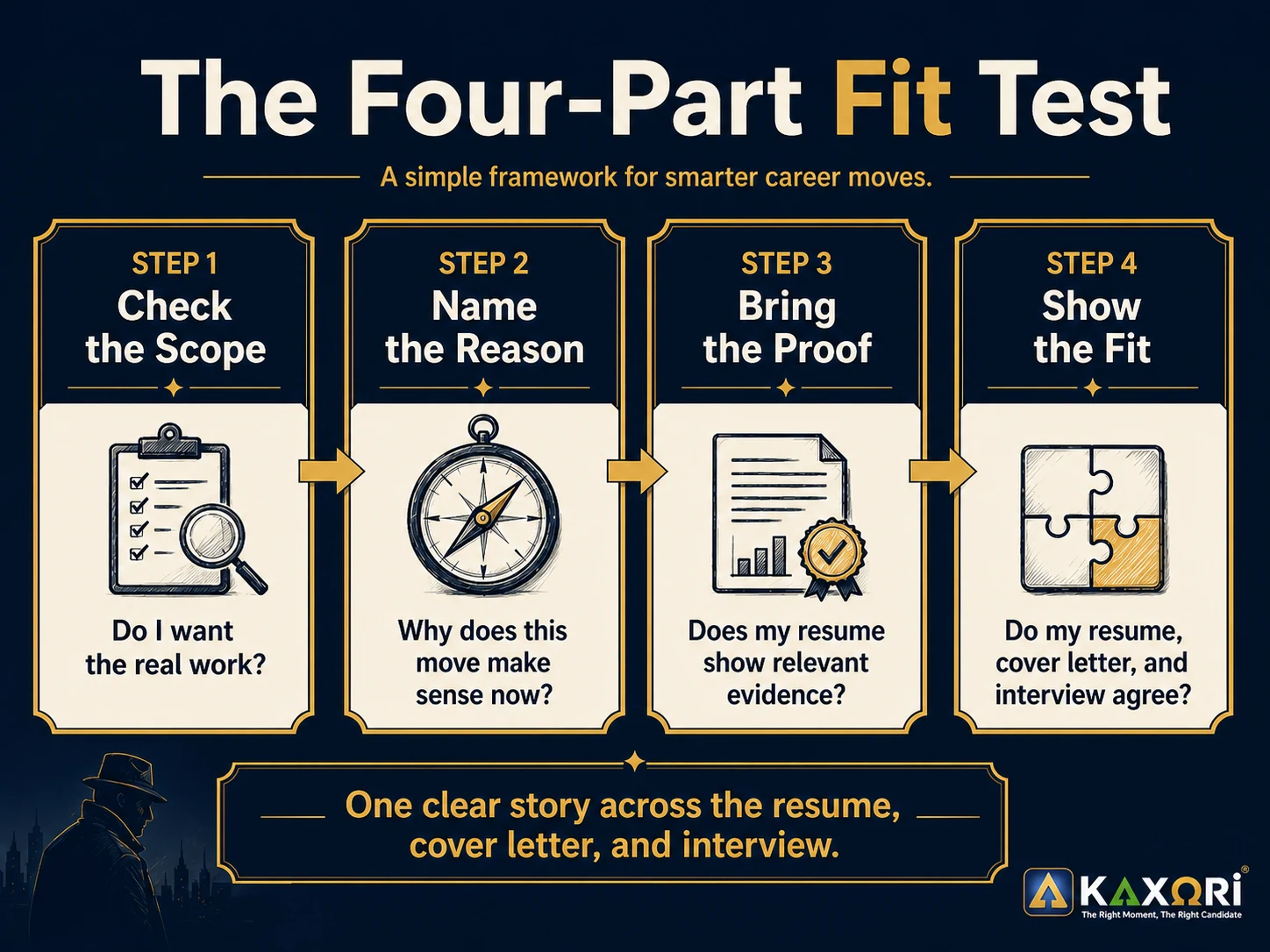
When the role truly fits, use one simple framework. It gives you one clear story that can hold up across the resume, cover letter, and interview.
Check the scope
Read the job as work, not as a title.
What would you own? What would you do each week? Who would you report to? What decisions would you make? What would you stop doing compared with your last role?
If the real work does not interest you, no resume trick will fix the fit.
Name the reason
Give the employer a reason that makes sense.
A strong reason is specific and positive.
Examples:
- “I want to return to hands-on product work.”
- “I am looking for less travel and more direct customer work.”
- “I want to move into this industry, and this role uses the parts of my background that transfer best.”
- “I have led large teams. At this stage, I want to spend more time building and less time managing layers.”
Do not invent a story. Use the truth.
Bring the proof
Show evidence that fits this job.
If the role is hands-on, do not let the resume read like a board biography. Bring forward the projects, tools, decisions, client work, systems, and results that prove you can still do the work.
Proof can include:
- Results you delivered
- Systems you used
- Projects you led
- Customers or teams you supported
- Problems you solved
- Budgets or scope you handled
- Work you personally built, wrote, analyzed, sold, fixed, or improved
The goal is not to erase senior experience. It is to make the right evidence easier to see.
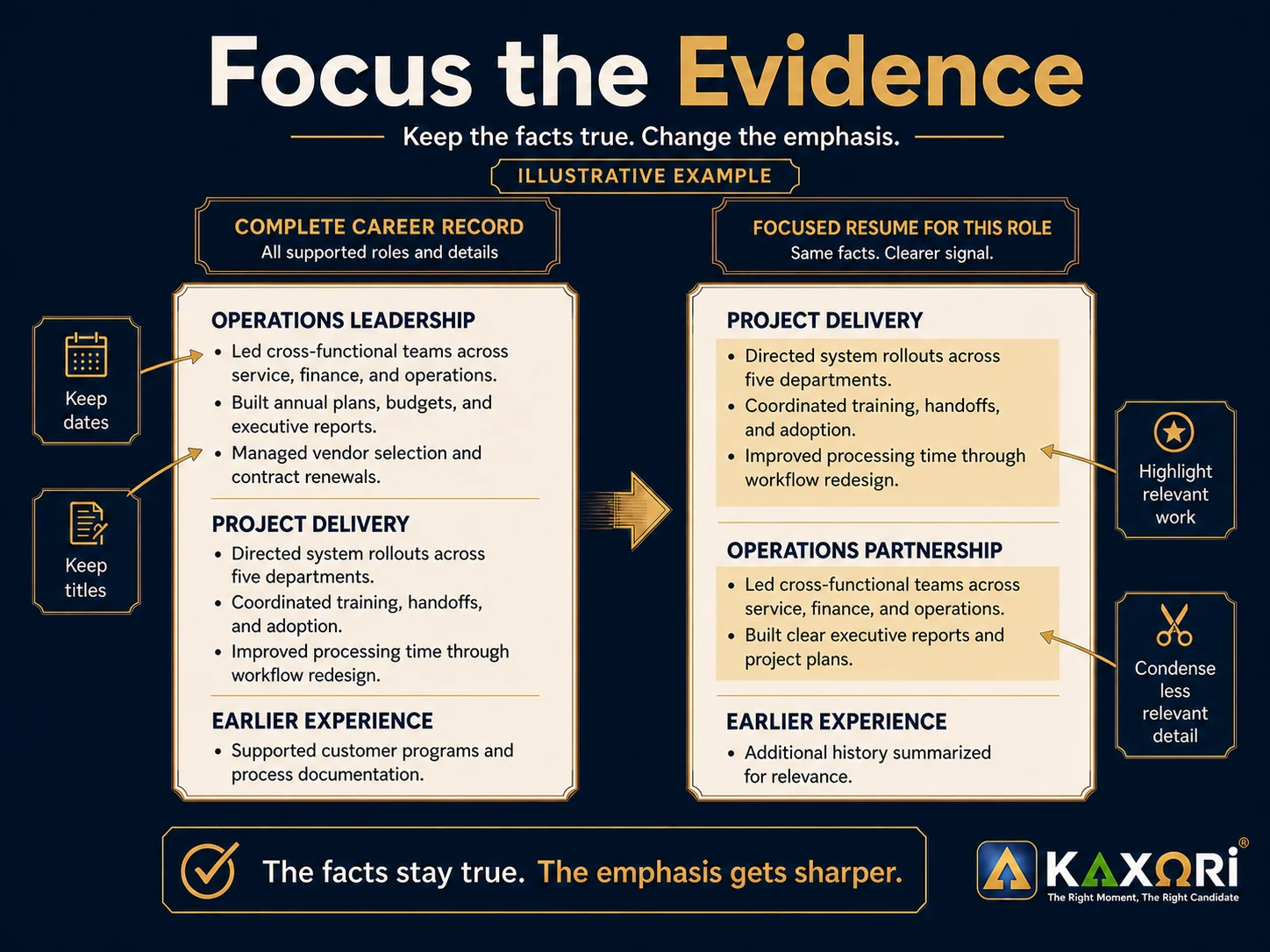
Dana's first draft led with seniority. Her stronger draft led with the work this Director role needed. The Vice President title stayed. The emphasis changed.
Show the fit
Make the same logic visible across the application.
Your resume, cover letter, and interview answer should tell the same basic story:
I understand this role. I want this work. My experience helps me do it. Here is why the move makes sense now.
That is stronger than trying to look smaller.
Dana did not need six clever answers for six possible concerns. She needed one clear story. Her resume showed relevant proof, her cover letter explained the move, and her interview answer could address the employer's real concern.
Turn the role logic into a stronger application.
When you are actively applying, use Kaxori to carry the same evidence and positioning into repeat resume tailoring, cover letters, and deeper optimization.
Should I make my resume look less senior?
No. Do not change what is true.
Do not lower a real title. Do not change dates. Do not invent a smaller scope. Do not create a false career story.
You can change emphasis.
That is normal tailoring.
A focused resume does these things:
- Give more space to the work that matches this job
- Compress older or less relevant leadership detail
- Move hands-on proof closer to the top
- Use a headline that points toward the target role
- Remove repeated duties that add length but not value
- Keep impressive achievements only when they help explain the fit
This is the distinction:
Your career record stays true. Your resume chooses which true evidence gets the most space.
That is not hiding your experience. It is editing for relevance.
Before you finish, check six things:
- Does the top of the resume point to the job I want now?
- Does it show relevant proof, not only senior titles?
- Does it include hands-on work when the target job is hands-on?
- Does it explain the move without sounding temporary?
- Can I defend every title, number, tool, and result?
- Does my cover letter add the “why now” that the resume cannot fully explain?
For a deeper explanation, read What Counts as Work Experience? and the Career Evidence Library guide.
Dana kept Vice President on the resume. She kept the dates and real scope. She changed the emphasis, not the facts.
Should I remove older experience from my resume?
There is no universal number of years that works for every candidate.
Older experience earns space when it helps explain why you fit this job today. Keep it when it shows industry depth, a required skill, leadership growth, technical knowledge, or a major result.
If old experience adds context but not much current value, compress it.
If it does not help the target story, cut it or compress it.
The test is relevance, not age alone.
How do I explain taking a lower-level job?
Do not apologize for the move.
Explain the logic.
A good explanation covers three things:
- What you want now
- Why this role fits that goal
- How your experience helps the employer
For example:
“I have spent several years leading in a smaller organization. This Director role operates at a much larger scale and gives me more responsibility for the work I want to own. I am comfortable with the title because the scope is what matters to me.”
Dana could use an answer like this in the composite example. It is a teaching example, not a script to copy.
Your real answer should sound like you.
Avoid reasons that make the role sound like an escape from work. Saying you want something “easy,” “less stressful,” or “below your level” can create a new concern.
How do I answer if the interviewer says I seem overqualified?
Do not argue with the label. Find out what it means.
If an interviewer says, “You seem overqualified for this role,” ask what concern sits behind the label.
A useful response is:
“I understand why my background raises that question. What part concerns you most: the scope, compensation, or whether I would stay?”
That question changes the conversation. Now you know what needs an answer.
If the concern is pay, discuss pay. If it is retention, explain why the role fits your goals. If it is scope, show that you understand the day-to-day work.
You cannot remove every concern. You can make the decision easier to evaluate.
For Dana, this is where the story and the strategy meet. She can answer the employer's real concern instead of defending herself against a vague label.
How do I convince an employer that I will stay?
You cannot prove the future.
Do not promise that you will “never leave.” That is not credible.
Instead, explain why the role fits your current direction.
Build your retention logic around points like these:
- The work itself is what you want to do
- The location or travel level fits your life
- The industry is where you want to build depth
- The mission or customer problem matters to you
- The role gives you the type of ownership you want
- You are choosing less people management and more direct work on purpose
The more specific the reason, the less the employer has to guess.
What about salary?
Be ready before the interview.
Know the posted range when one is available. Decide whether it works for you.
If the employer asks whether you will be comfortable with the range, answer the question directly. Do not use your old title or old compensation to dodge it.
You can say that you are evaluating the role based on the work, total package, and fit. But do not pretend compensation does not matter if it does.
A mismatch that cannot work financially is better discovered early.
Can “overqualified” be a sign of age discrimination?
Sometimes employers use the word to discuss a legitimate concern about scope, pay, or retention. The word alone does not prove discrimination.
U.S. federal law prohibits age discrimination in hiring against workers age 40 and older who are covered by the Age Discrimination in Employment Act. The U.S. Equal Employment Opportunity Commission lists hiring as one of the employment areas covered by the law. Read the EEOC overview.
Announcing an age-discrimination case against Exact Sciences, an EEOC regional attorney said federal courts have recognized a pattern. Terms like “too senior” or “overqualified” can act as euphemisms for age discrimination when they do not rest on objective job qualifications. Read the EEOC filing announcement.
In the later settlement announcement, the EEOC said a third-party recruiter rejected a 49-year-old applicant and called him overqualified. The recruiter also said the company wanted someone more junior who could stay for years. Exact Sciences denied violating the ADEA and settled the case. Read the EEOC settlement summary.
That does not mean every “overqualified” rejection is age discrimination.
One rejection usually does not tell you enough.
If you notice age-related comments or a repeated pattern, keep records of what was said and when. Review EEOC guidance. If you need advice about a specific situation, speak with a qualified employment professional.
This article is general job-search guidance. It is not legal advice.
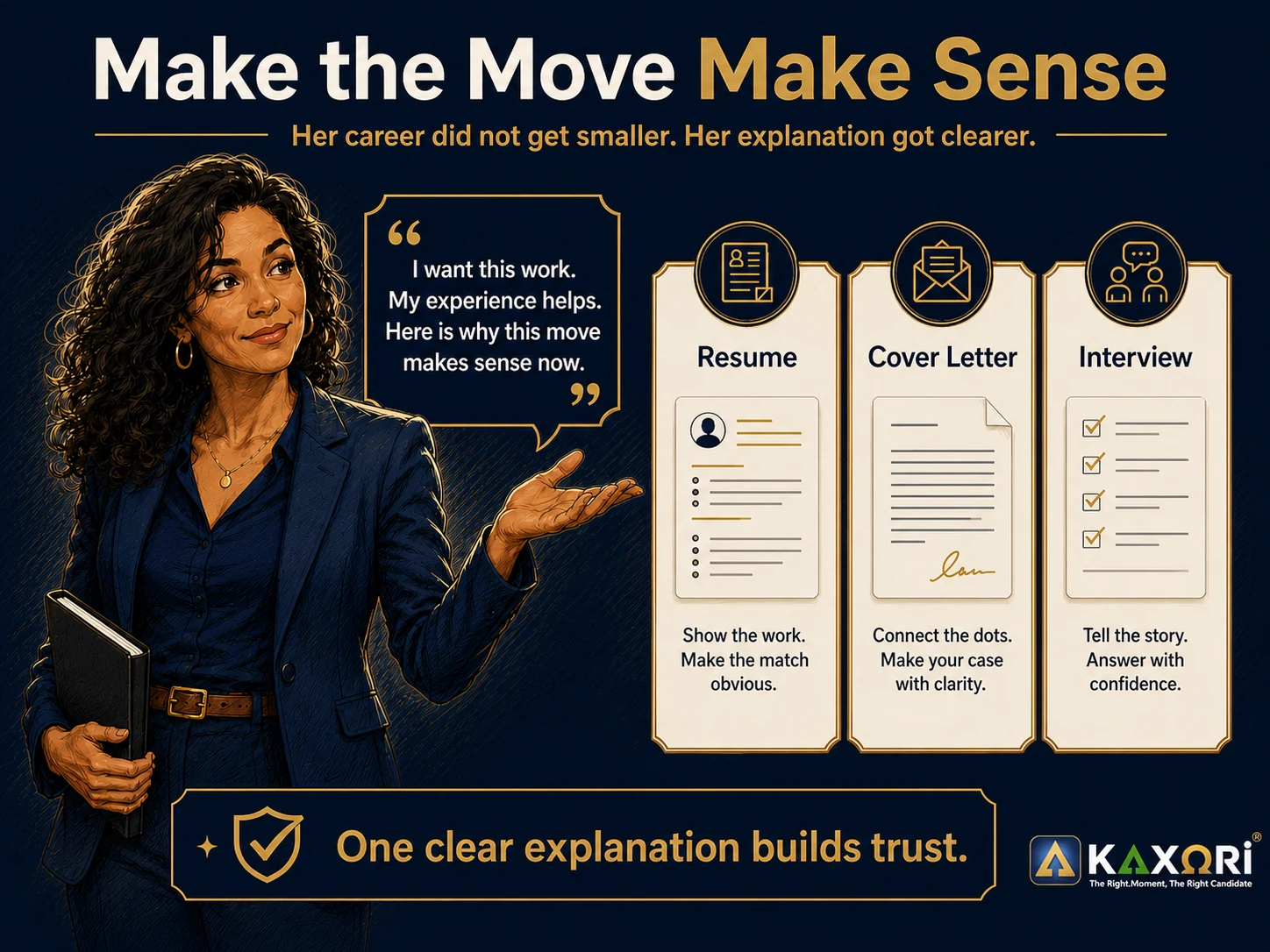
Dana did not shrink her career. She clarified the move.
The final version of Dana's story still says Vice President.
It still shows the real dates and the real scope of her experience.
What changed was the focus.
The resume puts the work that matters to this Director role closer to the top. The cover letter explains why the move makes sense now. Her interview answer does not beg the employer to ignore her experience. It explains why that experience is useful here.
We do not know whether Dana gets the job.
That is intentional.
A truthful job-search strategy cannot promise an interview or an offer. The goal is to remove avoidable doubt and make the real fit easier to see.
Dana's career did not get smaller.
Her explanation got clearer.
Before you apply: the 60-second overqualification check
Ask these four questions:
- Check the scope: Do I truly want the work and reporting structure?
- Name the reason: Can I explain why this move makes sense now?
- Bring the proof: Does my resume show relevant, hands-on evidence?
- Show the fit: Do my resume, cover letter, and interview story agree?
If one answer is weak, fix that part before you apply.
If you want a second read on resume-to-job alignment, Kaxori’s ATS Check can surface keyword gaps and other review signals. It is not a hiring prediction, and it does not tell you whether an employer will view you as overqualified.
If the role itself is wrong, do not force the application.
Frequently asked questions
What does overqualified mean for a job?
It usually means the employer thinks your experience, education, or past scope is greater than the job requires. The real concern often involves pay, retention, motivation, scope, or day-to-day fit.
Should I apply if I am overqualified?
Yes, when you truly want the work and can accept the role’s real scope and compensation. Research shows some hiring managers are willing to hire candidates whose experience exceeds the stated requirements. Your reason for wanting the role still matters.
Should I make my resume look less senior?
Not by changing facts. Keep titles, dates, and claims accurate. You can change emphasis by giving more space to relevant work and less space to older or unrelated detail.
Should I remove older experience from my resume?
Not automatically. Keep or compress older work when it supports the target job. Reduce detail when it does not help the employer understand your fit today.
How do I explain why I want a lower-level role?
Explain what you want now, why this role matches that goal, and how your experience helps. A specific positive reason is stronger than apologizing for your past level.
How should I answer salary concerns?
Know the likely range before you apply. If the range works for you, say so directly. If it does not, the role is not a practical fit.
How do I convince an employer I will stay?
You cannot guarantee the future. Give a credible reason the role fits your direction now. Focus on the work, scope, location, mission, schedule, or type of ownership you are intentionally choosing.
Does “overqualified” mean age discrimination?
Not by itself. The word can reflect legitimate fit concerns, but age discrimination in hiring is illegal under federal law for protected workers age 40 and older. If age-related comments or a pattern concern you, review EEOC guidance and document what happened.
Research behind this guide
- Overqualification, mismatched qualification, and hiring decisions: Perceptions of employers. Kulkarni, Lengnick-Hall, and Martinez, Personnel Review, 2015. The researchers interviewed 24 hiring managers. DOI · Free institutional record
- Age Discrimination. U.S. Equal Employment Opportunity Commission. Read the EEOC overview
- Exact Sciences age-discrimination filing and settlement. U.S. Equal Employment Opportunity Commission. Read the filing · Read the settlement
Next step
Do not shrink your career.
Take one target job and run the Four-Part Fit Test. Check the scope. Name the reason. Bring the proof. Show the fit.
Then review the resume beside the job description.
One ATS Check can help you see the alignment problem. If you are actively applying, Kaxori can carry the same evidence-backed approach into each application. Use it for repeat resume tailoring, cover letters, and deeper optimization.
Make the move make sense.
Bring one real job and one real resume. Keep the facts true, clarify the fit, and build the application around evidence you can defend.
Build Your Next ApplicationRelated Kaxori resources
- What an ATS Resume Score Means Before You Apply
- What Counts as Work Experience?
- Build a Career Evidence Library
Editorial boundary: Kaxori helps people say true things more clearly. Never add a title, qualification, date, responsibility, number, or result you cannot support.