
Why “experience” is not one universal category
People often use employment, work experience, and relevant experience as if they mean the same thing. They do not always.
The U.S. Bureau of Labor Statistics does not count volunteer work or unpaid internships as employment in its Current Population Survey. That is a statistical definition, not a rule for every résumé or hiring decision.
Federal qualification policy provides a useful contrast. The U.S. Office of Personnel Management states that comparable unpaid and volunteer work should be evaluated using the same qualification criteria as paid experience. Many USAJOBS announcements also tell applicants that paid and unpaid experience can build competencies, knowledge, and skills.
Those policies apply to federal hiring. They do not prove that every private employer will reach the same decision. They do show why the better question is not simply, “Was I paid?”
Ask instead:
Does this work demonstrate something the target employer needs, and can I support the claim?
That is where useful experience begins.
The four questions that turn work into proof
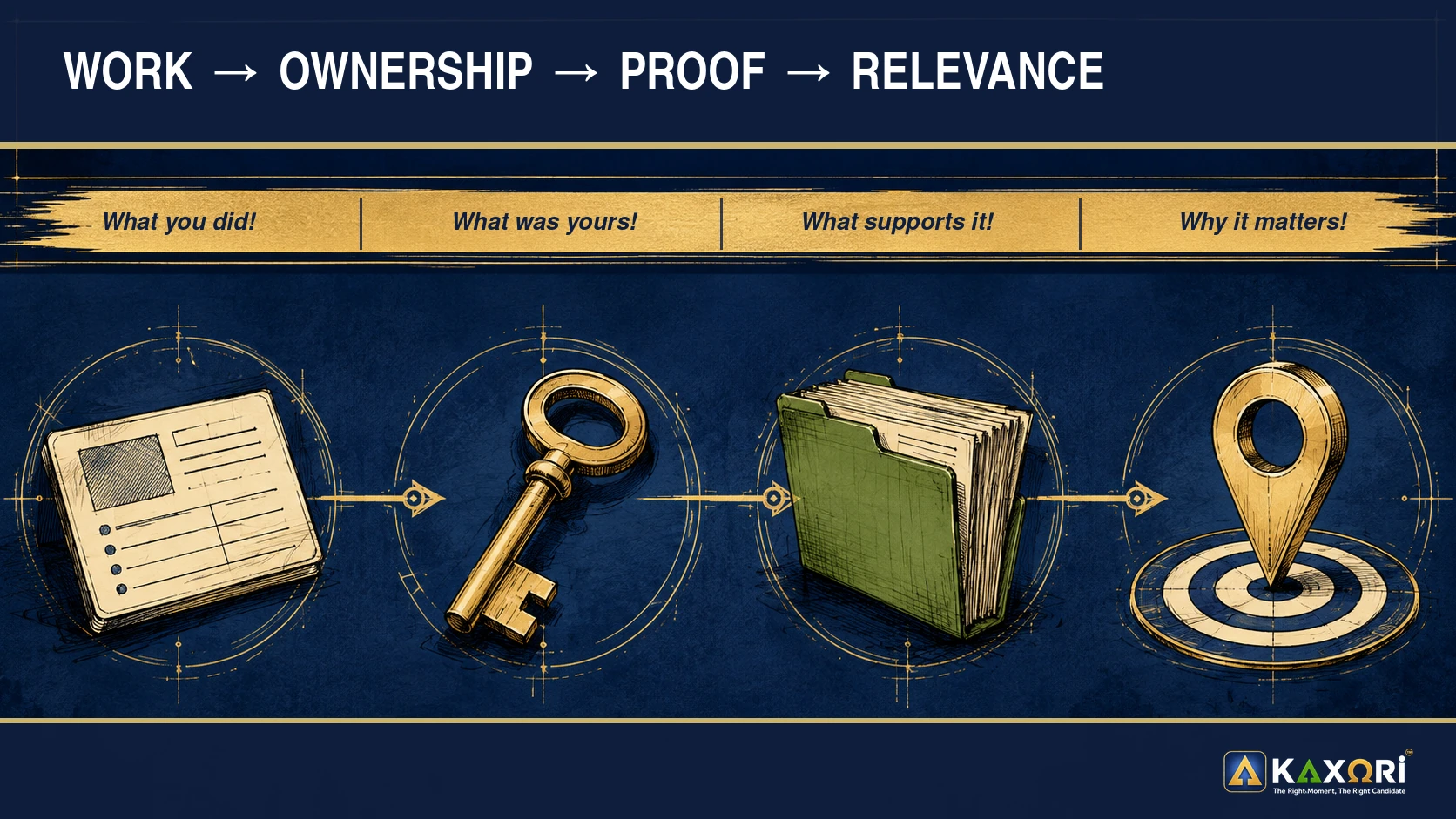
Use the same four questions for every job, contract, volunteer role, internship, or project.
1. Work: What did you actually do?
Name the visible work. Did you analyze data, create a campaign, build a website, coordinate an event, research a market, manage a budget, train people, improve a process, or deliver a product?
Avoid broad labels such as “helped with marketing” or “worked on a project.”
2. Ownership: What part was yours?
Separate your contribution from the team's work.
Did you lead the project, own one workstream, write the plan, conduct the research, build the model, manage the schedule, present the recommendation, or support someone else's decision?
This protects credibility. It also prevents a common mistake: taking credit for an entire result when you owned only one part.
3. Proof: What supports the claim?
Proof can include:
- A finished work sample.
- A client deliverable.
- A presentation or report.
- A project plan.
- A recommendation or documented feedback.
- A measurable change.
- The number of people, locations, records, events, or deliverables involved.
- The tools, systems, or methods you used.
Do not add a number because it sounds stronger. Use it only when you can defend what it measures and where it came from.
4. Relevance: Why does it matter to this job?
Relevant experience solves a problem connected to the target role.
A volunteer treasurer may have budgeting and reporting evidence. A freelancer may have client discovery and delivery evidence. A class project may demonstrate research and analysis. An independent project may demonstrate technical execution.
The label matters less than the connection you can prove.

Freelance and contract work
Freelance and contract work are real forms of work. The IRS treats independent contractors as self-employed workers for tax purposes, but tax classification is not the main résumé question. Your résumé needs to explain the service, scope, contribution, and relevant result.
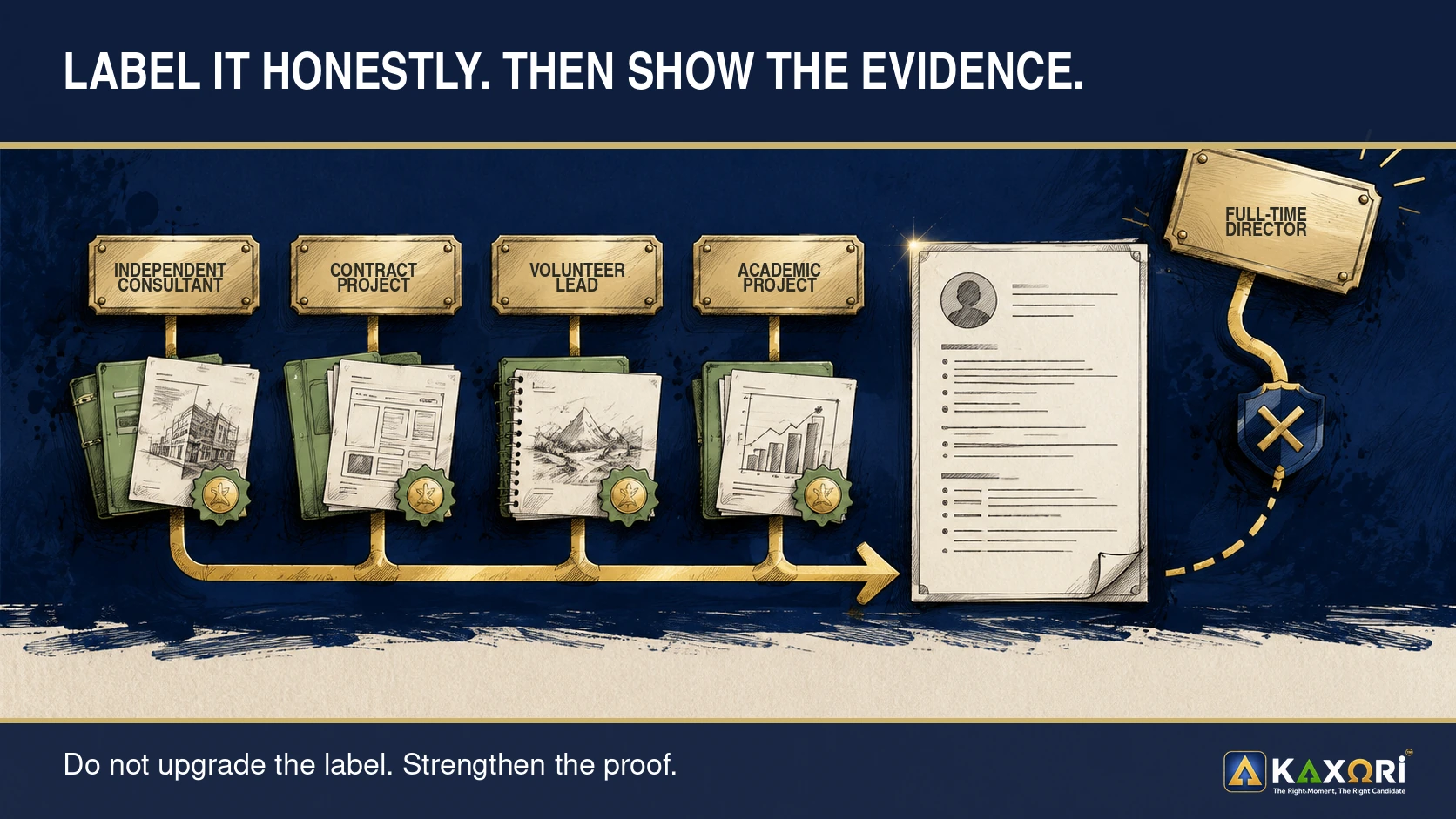
Use an accurate heading such as:
- Independent consultant
- Freelance designer
- Contract project manager
- Self-employed marketing strategist
- Client project: website redesign
Do not create an employer-employee relationship that did not exist. If confidentiality limits what you can name, describe the client truthfully, such as “regional health care provider,” without revealing protected information.
Example
Too vague:
Freelance marketing work for several companies.
Stronger:
Planned and delivered three email campaigns for two local service businesses, including audience segmentation, message development, launch coordination, and performance reporting.
This example is stronger because it shows the work and scope. Any candidate using a similar statement must confirm the number of campaigns, clients, tasks, and reporting responsibility.
Volunteer and community work
Volunteer work can demonstrate leadership, organization, communication, fundraising, operations, training, budgeting, or technical skill. Payment is not what makes those activities real.
Still, use the correct label. “Volunteer operations lead” is honest. “Operations director” may be misleading if the organization never gave you that title or level of authority.
Example
Too vague:
Helped a nonprofit with events.
Stronger:
Coordinated volunteer schedules, vendor communication, and attendee registration for four community events serving approximately 300 participants.
Only use the event and participant numbers if records support them. If the number is uncertain, remove it or verify it first.
University of Pennsylvania career guidance recommends describing experiences through actions and accomplishments. It specifically prompts job seekers to ask what they created, improved, led, analyzed, or accomplished. That approach works whether the setting was paid or unpaid.
Academic and independent projects
A project can demonstrate experience when it required meaningful work. The strongest projects usually have:
- A clear problem.
- A defined audience or user.
- Constraints.
- A process.
- A completed output.
- Feedback, testing, or another quality signal.
- A connection to the target job.
National Association of Colleges and Employers guidance describes assignments, presentations, research, volunteer work, leadership, and employment as settings where people develop skills and collect evidence of those skills.
A project does not need to be sold to a customer to demonstrate ability. But completing a tutorial exactly as written is weaker evidence than defining a problem, making decisions, and producing an original result.
Example
Too vague:
Completed a data analytics class project.
Stronger:
Analyzed 18 months of public transit data, built a dashboard showing peak-demand patterns, and presented three scheduling recommendations to the class review panel.
The project label must remain clear. Do not present classwork as paid client work.
Internships and applied training
An internship can provide experience because it places a person inside real work, expectations, relationships, and deliverables. NACE notes that internships can help people develop communication, reliability, ethical behavior, and other workplace skills.
Training alone is not the same as performing a job. Applied training becomes stronger evidence when you can show what you built, analyzed, practiced, tested, or delivered.
Compare these two statements:
Training only:
Completed a digital marketing certificate.
Training plus applied proof:
Completed a digital marketing certificate and built a campaign plan covering audience selection, channel mix, creative testing, budget allocation, and measurement.
The certificate supports the learning. The project shows how the learning was applied.
Where the experience belongs on a résumé
There is no single layout that fits every person. Choose the section that makes the experience clear without disguising what it was.
Possible sections include:
- Relevant experience
- Professional experience
- Consulting experience
- Freelance and contract work
- Volunteer leadership
- Selected projects
- Research experience
- Internships
Use a consistent structure:
Accurate role or project label | Organization or client description | Dates
Then describe the work, ownership, proof, and relevance.
The strongest material should be easy to find, but relevance does not give you permission to change the facts. Keep the title, relationship, dates, and scope accurate.
What AI cannot decide for you
AI can help organize notes, compare your evidence with a job description, identify unclear language, and propose revisions.
It cannot know whether:
- The work really happened.
- You owned the result.
- A number is accurate.
- A project was paid, unpaid, academic, or independent.
- A client approved disclosure.
- An employer will accept the experience as a formal qualification.
You remain responsible for verifying titles, dates, relationships, tools, deliverables, numbers, outcomes, and ownership.
Kaxori is designed to help make supported experience easier to recognize. It cannot turn unsupported claims into qualifications or predict an employer's private decision.
Build your experience proof
Choose one target job and list up to five experiences that may support it. Include traditional jobs, freelance work, contracts, volunteer roles, internships, and projects.
For each one, complete four lines:
- Work: I performed...
- Ownership: I personally owned...
- Proof: I can support this with...
- Relevance: This matters to the target job because...
Then make one decision:
- Use it because the evidence is relevant and supported.
- Verify it because an important detail is uncertain.
- Leave it out because the connection is weak or the claim cannot be supported.
That is a better starting point than asking AI to invent stronger language from an empty page.
Frequently asked questions (FAQ)
Does freelance work count as work experience?
Freelance work can demonstrate relevant experience when you accurately describe the service, client or audience, dates, scope, your contribution, and supporting evidence. An employer may still apply its own qualification rules.
Does contract work count as experience?
Contract work can support experience claims when the duties and evidence match the target role. Label the relationship accurately rather than implying you were a permanent employee.
Does volunteer work count as experience on a résumé?
Volunteer work can demonstrate skills, responsibility, and results. Some formal systems, including federal qualification policies, recognize comparable unpaid experience. Private employers may evaluate it differently, so show the relevance and keep the volunteer label clear.
Do personal projects count as experience?
They can demonstrate applied skill when the project has a real problem, decisions, a completed output, and evidence. Do not describe a personal or academic project as paid client work.
Can coursework count as experience?
Coursework can provide evidence when it includes applied projects, research, laboratories, presentations, or other relevant work. A course title alone is usually less informative than a clear description of what you produced and learned to do.
Can I combine paid and unpaid work under “Relevant experience”?
You can use a relevant-experience section when every entry is labeled accurately. Make the organization, relationship, role, and dates clear so the reader does not have to guess what was employment, consulting, volunteering, internship work, or a project.
Will an applicant tracking system count volunteer or project work?
Applicant tracking systems and employer configurations vary. A document may store or search text from several résumé sections, but no universal rule determines how every employer will treat volunteer or project experience. Focus on accurate, relevant, readable evidence rather than trying to predict a private system.
Final action
Your career is larger than your employment history.
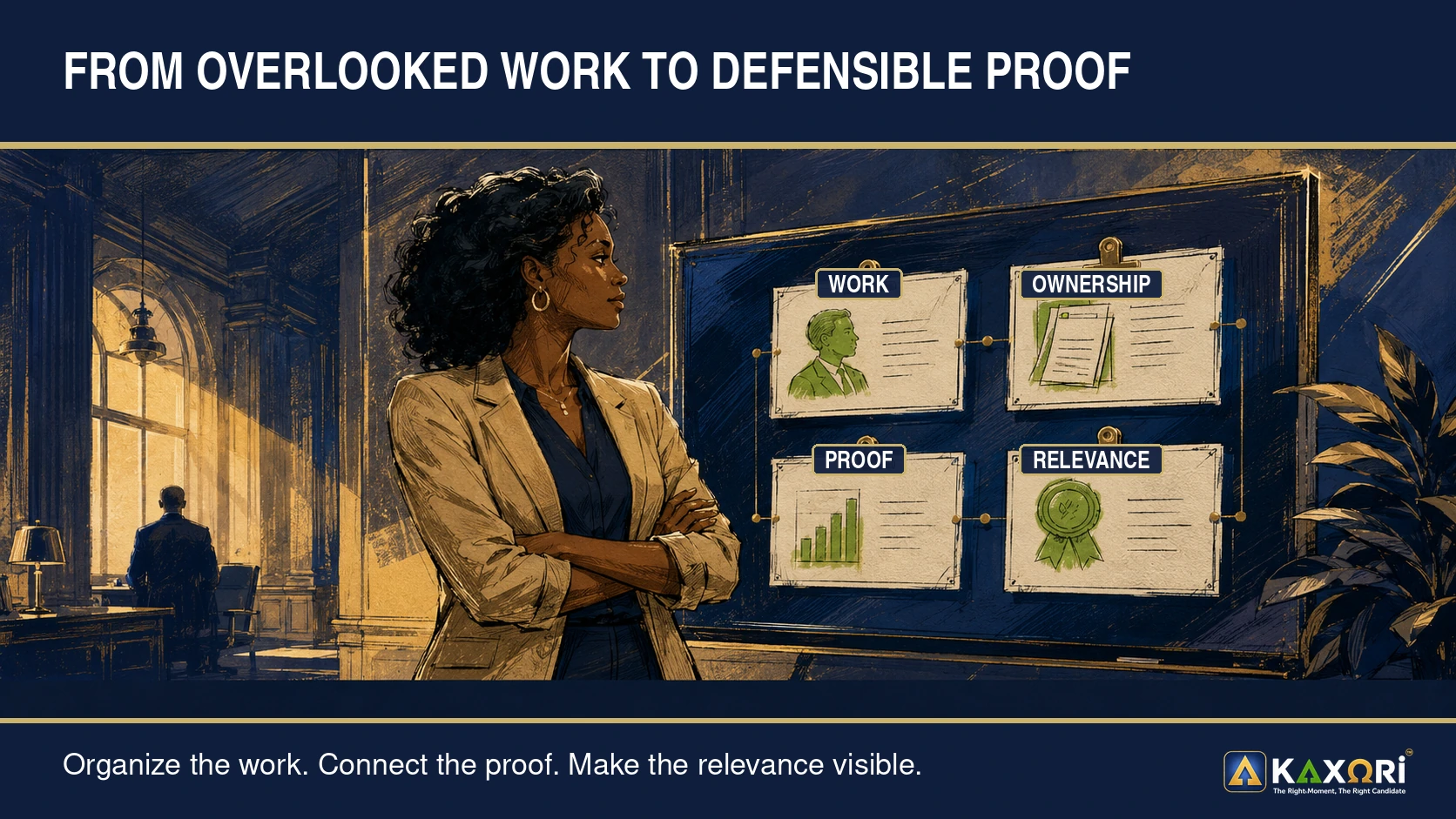
Look for work you completed, responsibility you carried, and proof you can defend. Label it honestly. Connect it to the job only when the relevance is real.
Then ask the question that matters:
Can another person understand what I did, what I owned, and why it matters?
Kaxori can help you compare that supported experience with one real job description. You make the final decision about every claim.
Make overlooked experience easier to recognize.
Compare supported experience with one real job description and make the final decision about every claim.
Check my experience against a real job with KaxoriSources and evidence notes
- U.S. Office of Personnel Management, General Schedule Qualification Policies. Supports the narrow statement that comparable unpaid and volunteer work can receive equal credit under federal qualification policy. It is not presented as a universal private-employer rule.
- U.S. Bureau of Labor Statistics, Current Population Survey concepts and definitions. Supports the distinction between statistical employment and unpaid or volunteer activity.
- Internal Revenue Service, Independent Contractor (Self-Employed) or Employee?. Supports the statement that independent contractors are generally self-employed and that worker classification depends on the full relationship. The article does not offer tax or legal advice.
- University of Pennsylvania Career Services, Write a Resume/CV. Supports action-and-accomplishment descriptions, specificity, scope, tools, outcomes, and job relevance.
- National Association of Colleges and Employers, The Value of Faculty Connecting Classroom Lessons to Career Success. Supports using assignments, projects, presentations, research, employment, volunteer work, and leadership roles to identify developed skills and evidence.
- National Association of Colleges and Employers, What Do Students Gain From Internships?. Supports the discussion of workplace skills developed through internships.