
At 51, Michael Reed was not winding down his career. He was trying to decide what the next 15 years should look like.
He had spent more than 25 years in marketing and business leadership. He had an undergraduate degree and an MBA. He had led teams, managed large budgets, launched products, and helped businesses grow.
For the past several years, Michael had served on the executive team of a large family-owned company. The business had operated for more than 120 years. Its brand mattered. So did its plant, equipment, customers, and history.
Then the family decided to sell.
Michael became an important part of the sale for the owners. He helped prepare the business for a buyer. He also helped explain the value of the brand and worked through questions that came up during the deal.
The buyer was a large European conglomerate.
After the deal closed, the new owner's plan became clear. It wanted the brand, the market position, and the plant assets. It did not plan to keep much of the organization that had been running the business.
The executive team was eliminated. So were the sales force, customer service, engineering, finance, marketing, and even HR. Michael's role as the company's marketing leader disappeared with them.
There was no performance problem. Michael had helped the prior owners complete the sale. The buyer simply had a different operating model.
At 51, he was back in the job market.
Michael understood the business logic. Acquirers combine functions. Leadership teams change. Companies look for savings. A good person can lose a good job for reasons that have little to do with performance.
What surprised him was the search that followed.
Michael thought he was a stronger executive at 51 than he had been at 41. He had more judgment and more proof. He also kept learning. In recent years, he added training in digital marketing, analytics, and artificial intelligence. He tested new AI tools instead of dismissing them.
He treated the search like a business project. He updated LinkedIn. He rebuilt his resume. He tracked openings, contacts, applications, and follow-ups. When a role looked right, he read the job description and adjusted the application before sending it.
The first 25 applications did not bother him. Neither did the first 50.
By 100, he started paying closer attention.
At 150, he was frustrated.
A few months later, his spreadsheet had passed 200 applications.
Some were stretch roles. Many were not. Plenty matched work Michael had already done. He had built growth plans, led teams, managed large budgets, and launched products. He had aligned sales and marketing, used data, adopted new technology, and led change.
The fit was not perfect every time. No candidate is a perfect match for 200 jobs. But the response still felt too small.
There were a few recruiter calls and some first interviews. Most applications went quiet.
Then Michael found a role that looked unusually close to his background. He spent almost an hour on the application. He adjusted the top of the resume and made sure the best proof was easy to find.
He submitted it shortly before noon.
At 12:39 p.m., the rejection email arrived.
Less than an hour.
Michael knew the timestamp did not prove anything. A knockout question could have ended the process. A recruiter could have reviewed it quickly. The company might have had another candidate far ahead. A screening system could have found something it did not like.
Still, after more than 200 applications, one question had become hard to ignore.
Michael opened his resume again. This time he was not looking for keywords. He was looking at the clues a stranger could see.
There was the MBA and its graduation year. There was a career history that went back more than two decades. Older jobs still had a lot of detail. Near the top was a phrase he had always thought was a strength:
25+ years of experience.
Michael was proud of those years. They represented teams built, products launched, mistakes survived, and results delivered.
But he started to wonder if the same sentence was sending another signal first.
Before someone understood what he could do, had he made it easy to estimate how old he was?
That led to the harder question.
Could the experience that made him qualified also make it easier to screen him out?
Michael wanted more than an opinion.
He wanted evidence.
The evidence is real. It is also messier than most articles make it sound.
What evidence do we actually have for senior-level age discrimination, and where does the research stop?
Age discrimination in hiring is real. But the strength of the evidence depends on two things: the job level and the study design.
Large U.S. field audits do show age-related callback differences in real hiring. Those audits mainly use administrative, office-support, retail, security, and similar jobs.
Evidence closer to executive and professional roles is thinner. It relies more on scenario studies, workforce data, enforcement actions, recruiter screening studies, and litigation.
What matters most
- Real employer behavior: U.S. field audits measure callbacks, but not VP or C-suite hiring.
- Professional judgments: Sales Director and Marketing Manager studies use hypothetical candidates, not real callbacks.
- Sector context: BLS and EEOC data show real displacement and age-related high-tech workforce concerns, but do not prove causation.
- Enforcement: iTutorGroup and JPL show age discrimination can reach automated hiring and high-skill technical organizations, but settlements are not randomized experiments.
- Executive evidence gap: Large U.S. senior-level age field audits remain underdeveloped in the literature reviewed for this article.
First, Michael's job loss is not unusual career disruption
Federal data show that experienced managers, professionals, and manufacturing workers lose long-held jobs in large numbers. This is displacement evidence. It is not proof of age discrimination. It matters because Michael returned to the market after an acquisition, not because of poor performance.
The Bureau of Labor Statistics counted 3.3 million long-tenured U.S. workers displaced during 2023-2025. 44.4% lost a position or shift that was abolished. Another 32.6% lost jobs when a company or plant closed or moved.
The group included 1.545 million workers from management, professional, and related occupations, including 916,000 in management, business, and financial operations. Manufacturing accounted for 642,000 displaced workers, with 447,000 in durable goods manufacturing.
Those numbers do not explain Michael's later rejections. They do establish the setting. Experienced people can be pushed back into the market by business decisions that have little to do with their performance.
Source: U.S. Bureau of Labor Statistics, Worker Displacement: 2023-2025, released Aug. 27, 2026. bls.gov Worker Displacement 2023-2025 news release

What can U.S. research honestly tell an executive about age discrimination?
As of September 2026, U.S. research shows that age can affect hiring. But our review of the leading U.S. age-audit literature did not find a large randomized field experiment that tested thousands of VP, C-suite, senior finance, senior engineering, or senior marketing applicants. That gap matters.
Field audits send fictitious applications to real employers and measure real callbacks. They work best in high-volume jobs where researchers can create believable resumes that differ on only a few variables.
Executive hiring is harder to test. Senior resumes vary in company size, P&L scope, industry, transactions, leadership history, and network-based recruiting. So we should not take an administrative-support study and pretend it tells us the exact penalty for a 51-year-old CMO.
We can still learn from the evidence if we label what each study actually measures.
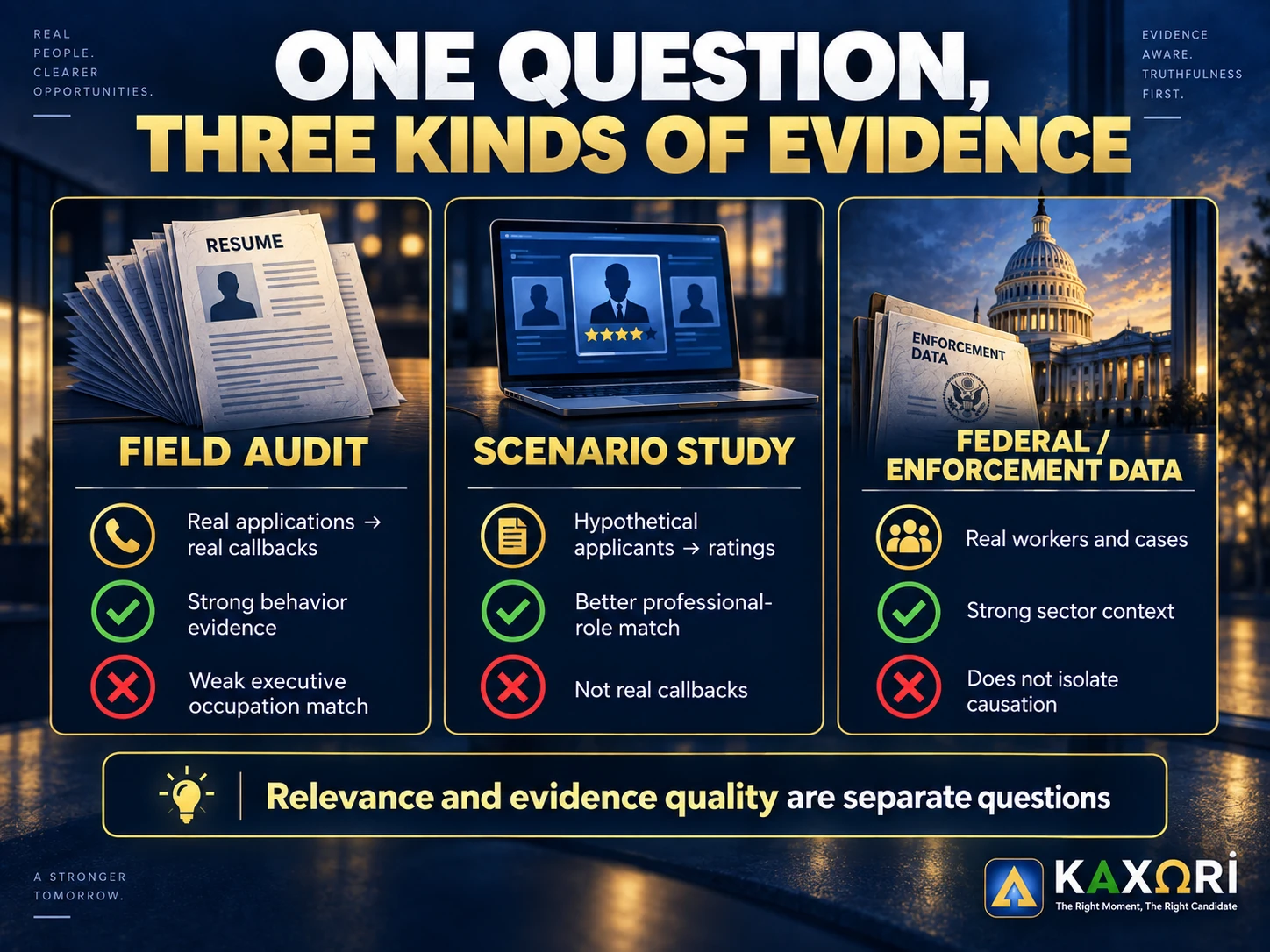
A quick evidence key
- Field auditReal applications sent to real employers; measures callback behavior.
- Scenario or vignette studyPeople evaluate hypothetical candidates; measures judgment, not real callbacks.
- Federal labor dataMeasures real workforce patterns; does not prove discrimination caused the pattern.
- EEOC enforcement or litigationDocuments allegations, settlements, and legal action; not the same as a randomized experiment.
Keeping those categories separate is the only honest way to talk about this research.
Real employer behavior: age 51-52 in a U.S. field audit
A U.S. resume audit found a lower callback rate for applicants age 51-52 than for applicants in their 30s and early 40s. That is real employer behavior. The limit is equally important: the study used experienced, college-educated women applying to administrative and office-support jobs, not senior executives.
Researchers Henry Farber, Chris Herbst, Dan Silverman, and Till von Wachter sent 8,488 applications to 2,122 U.S. job postings.
Their Table 5 reports the average any-callback rate by age:
| Applicant age | Any callback |
|---|---|
| 33-34 | 12.9% |
| 42-43 | 12.6% |
| 51-52 | 11.0% |
| 60-61 | 9.7% |
Evidence type: field audit. Occupations were administrative and office-support roles, and the applicants were women. These are not executive-hiring callback rates.
The full age pattern was hump-shaped. Younger applicants and older applicants both did worse than prime-age applicants.
Michael is 51, so the age band is relevant.
The occupation is not.
Study limitation: These were administrative and office-support roles, and the applicants were women. We should not translate the 11.0% callback rate into a prediction for a male VP in marketing, finance, engineering, or manufacturing.
What the study does establish is narrower:
In a real U.S. hiring market, employer callback behavior changed across age groups, and the decline was already visible by age 51-52.
Source: Farber, Herbst, Silverman, and von Wachter, NBER Working Paper 24605, Table 5. NBER Working Paper 24605
Professional-role studies are closer to Michael's jobs, but they measure judgment, not callbacks
Professional-role studies are closer to Kaxori users, but they use hypothetical candidates. They measure judgment, not real employer callbacks. That is a real limit, and it is worth knowing.
Sales Director: age can change judgments about adaptability
Perry and colleagues used a Sales Director scenario. Across two studies, candidates described as 60 years old were seen as the least motivated and adaptable. The comparison was with younger candidates and with candidates labeled by generation.
Age bias may not sound like, "This person is too old." It may show up as doubts about adaptability, drive, learning speed, or culture fit.
The limit is clear. The studies used graduate-student and online raters, not real employers making callback decisions.
Source: Perry et al., Work, Aging and Retirement, 2017. doi.org/10.1093/workar/waw029
Marketing Manager: "objective" decision-makers were not automatically bias-free
Lindner, Graser, and Nosek used a Marketing Manager scenario with a 31- or 54-year-old male applicant. The main finding was not a simple young-versus-old callback effect. Both the objectivity prime and the bias prime increased age discrimination compared with the control condition. In the objectivity condition, participants preferred the younger applicant over the equally qualified older applicant.
The lesson is about judgment, not real hiring behavior: seeing yourself as objective does not guarantee that age stereotypes disappear.
Source: Lindner, Graser, and Nosek, PLOS ONE, 2014. doi.org/10.1371/journal.pone.0084752
Source note: The San Jose State software-engineer thesis stays in the research ledger only. It is exploratory MTurk vignette research, not headline evidence.
What about engineering and high-tech professionals?
U.S. federal data show that age remains an equal-employment concern in high tech. That is sector context, not a randomized hiring experiment.
The EEOC's 2024 review covered 56 STEM occupations. Workers over 40 fell from 55.9% to 52.1% of the high-tech workforce between 2014 and 2022. The EEOC also found a higher share of age-related allegations in high-tech charges than in other sectors. Pay and genetic-information allegations were also more common.
There is also enforcement evidence. In 2020, the EEOC alleged that Jet Propulsion Laboratory systematically laid off workers over 40. It also alleged that JPL passed older workers over for rehire in favor of younger workers. JPL agreed to pay $10 million and provide injunctive relief to settle the case.
Neither source tells us the callback penalty for a 51-year-old VP of Engineering. They do show that age concerns reach high-skill technical organizations too.
- EEOC, High Tech, Low Inclusion, 2024. EEOC research on the high-tech sector and workforce
- EEOC, Jet Propulsion Laboratory settlement, June 11, 2020. EEOC announcement of the $10 million JPL settlement

So what can we honestly say about Michael?
We cannot prove that Michael's age caused any one rejection. We can say that U.S. research and enforcement evidence show age can affect employer response and professional judgments, and that age-related concerns exist in high-skill sectors too. We can also say the executive-level evidence is thinner than the headlines often suggest.
That distinction is the point.
Michael should not explain every rejection with age.
He also should not pretend age has no role in hiring.
The useful question is what he can control.
That brings him back to the resume.
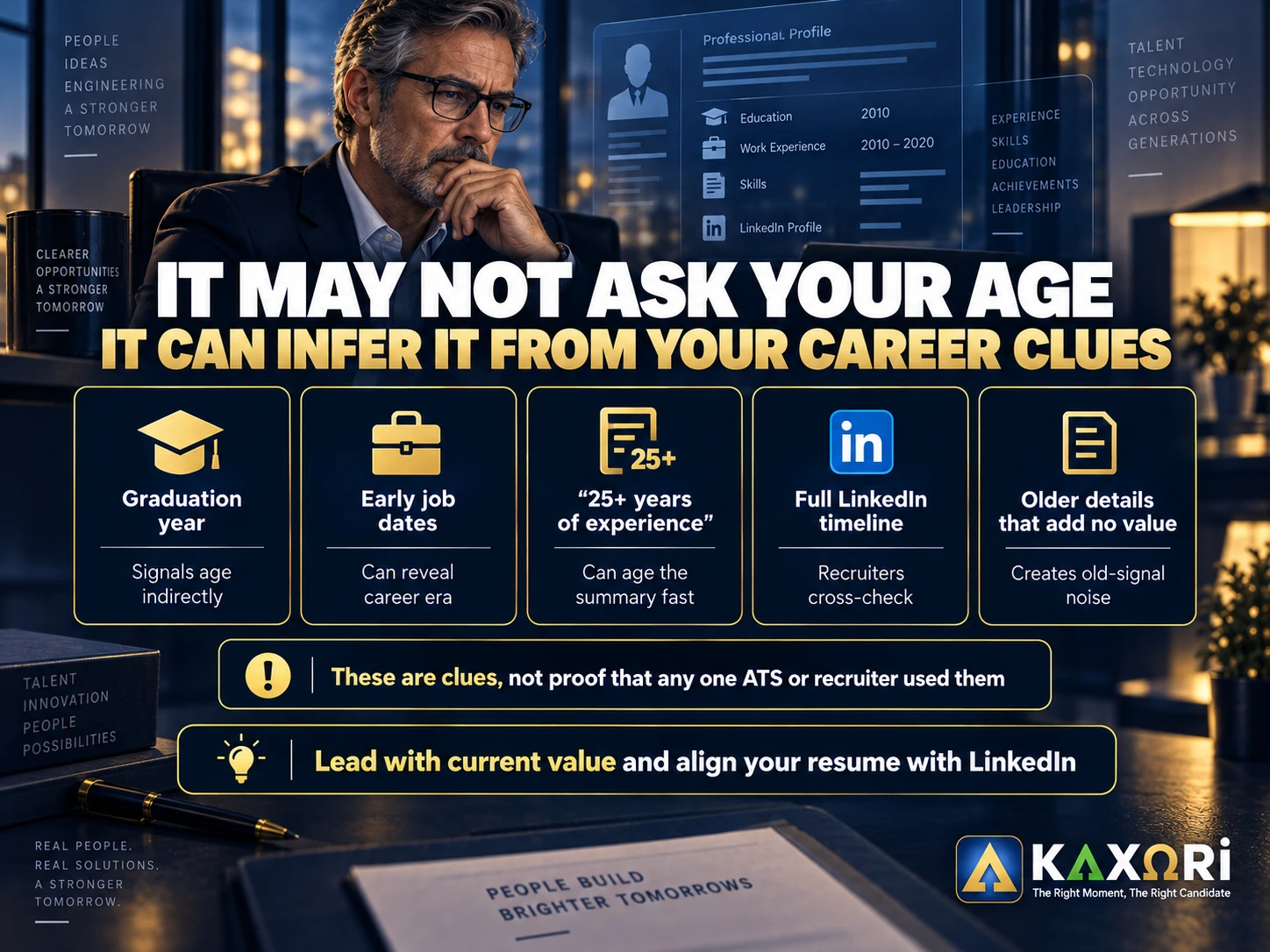
Can a resume signal age without listing a birth date?
Yes. A resume can make age easier to estimate without showing a birth date. Graduation years, early job dates, older credentials, and phrases such as "25+ years of experience" can all send age signals. That does not prove an ATS uses those signals. It means the signals are visible.
This was the part Michael could change.
He printed his resume and stopped reading it as a record of everything he had done. He read it like a stranger with limited time.
His MBA mattered.
The year he earned it often did not.
His early leadership roles mattered because they showed growth.
They did not need as much space as work he had done in the past five years.
His 25+ years of experience were real.
But the number itself said less about his current value than the proof behind it.
CareerOneStop, sponsored by the U.S. Department of Labor, says older workers may leave a graduation date off a resume because it can call attention to age. Its work-experience guidance says to focus on the jobs that add the most value. For a long career, that often means putting the most detail into roughly the past 12 to 15 years.
That is not permission to falsify dates on an application.
It is a reminder that a resume is a targeted document, not a complete autobiography.
Source: CareerOneStop Resume Guide: careeronestop.org Resume Guide
Don't erase the career. Change the signal.
Michael did not need to become a younger version of himself.
He needed the page to make his current value easier to understand.
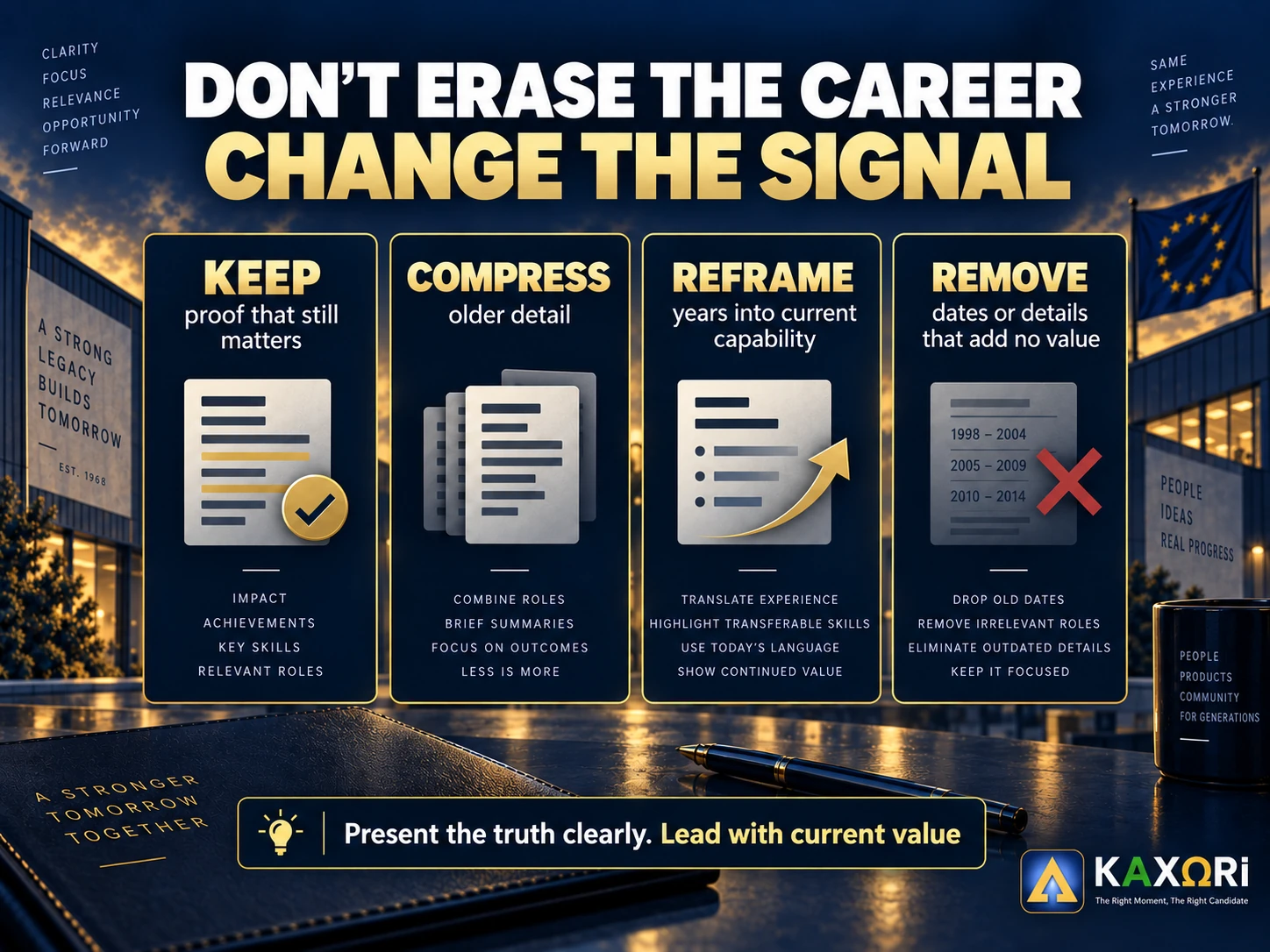
Keep
Keep older experience when it proves something important that newer work cannot.
A major transaction. A defining turnaround. Specialized industry knowledge. A product launch. A business transformation. An achievement that still matters to the role.
History earns space when it provides proof.
Compress
A position from 2002 may still belong on the resume.
It probably does not need six bullets.
Keep enough detail to show the career and the proof. Give more space to the work that best shows what you can do now.
Reframe
Instead of leading with:
25+ years of executive marketing experience
Michael could lead with:
Growth and marketing executive leading customer acquisition, product strategy, analytics, AI-enabled execution, and cross-functional growth.
Nothing about the career changed.
The first signal did.
Years measure time.
Evidence shows capability.
Employers also describe the same work in their own language. Matching the words an employer actually uses, without inventing anything, is its own skill.
Remove
Remove information that adds little value and is not required.
An old graduation year. A tool that has not mattered in a decade. Early-career detail that repeats stronger recent evidence. A phrase that uses length of career as a substitute for value.
Do not remove or change information to deceive an employer.
Keep the facts. Change the priority.
What should an experienced professional change before the next application?
Start by making the resume prove current fit instead of merely documenting career length. The best changes are usually not about looking younger. They are about showing recent capability, current tools, relevant evidence, and the parts of a long career that matter to this job.
Ask seven questions:
- Does my opening describe what I can do now, or mostly how long I have been doing it?
- Does recent, relevant work get more space than older history?
- Are graduation dates or old credentials present when they add no value and are not required?
- Do my skills show current technology, methods, and tools for this role?
- Have I kept old experience because it adds proof, or because I am afraid to leave anything out?
- Can a reader find the evidence that matches this job without digging through the entire career?
- Would I defend every date, title, metric, qualification, and claim in an interview?
That last question is the guardrail.
Age-proofing a resume should never require fiction.
Can automated hiring systems discriminate by age?
Yes, automated screening can be used in a discriminatory way. But a fast rejection does not prove age caused the decision. To make a claim about a specific hiring system, we need evidence about that system.
The EEOC's iTutorGroup case is unusually clear.
The agency alleged that the company's application software automatically rejected older applicants. Under the alleged rule, that meant women age 55 or older and men age 60 or older. More than 200 qualified U.S. applicants were rejected. The companies agreed to pay $365,000 and provide other relief to settle the case.
That is evidence that age rules can be built directly into automated hiring.
It does not mean every automated rejection works that way.
Source: EEOC. EEOC announcement of the iTutorGroup settlement
What does the Workday lawsuit tell job seekers?
The Workday litigation shows that algorithmic hiring discrimination is a serious legal question. It does not prove that Workday discriminated against every older applicant, and it does not explain Michael's rejection. The claims must remain allegations unless and until the litigation establishes otherwise.
In Mobley v. Workday, plaintiffs allege that AI-based screening and recommendation tools produced discriminatory effects, including based on age.
The federal court allowed age-discrimination claims to move forward and preliminarily certified an ADEA collective in 2025. The case is still ongoing.
Three rulings from 2026 show how it has moved since then:
- June 22, 2026. The court granted part of Workday's motion to dismiss and denied part of it.
- July 1, 2026. The court required the plaintiffs to file a clean amended complaint.
- July 28, 2026. The court denied the plaintiffs' motion for relief from a discovery order about customer data.
Each of those is a ruling about how the case proceeds. None of them is a finding that Workday discriminated against anyone.
Those procedural decisions matter.
They are not a final verdict.
Case record, reviewed September 2026: Civil Rights Litigation Clearinghouse record for Mobley v. Workday
What can Kaxori tell you, and what can't it tell you?
Kaxori can compare a resume with a specific job description. It can help surface alignment, keyword gaps, qualification issues, and proof that may be hard to see. Kaxori cannot tell whether a specific employer discriminated against you. It cannot identify a private hiring algorithm from a rejection email. And it cannot promise that changing a resume will produce an interview.
That limit matters.
Michael could not control whether an employer carried an age bias.
He could control whether his resume made his age easier to understand than his value.
So he changed the question.
Not:
How do I make myself look younger?
Instead:
What does this job need, where have I proved it, and can the reader find that proof quickly?
That is a stronger place to work from.
The career stays intact.
The signal gets clearer.
Before you submit the next application
Michael's story does not end with a made-up offer.
That would miss the point.
He still cannot know why some employers rejected him. Neither can any resume tool.
What he can do is stop sending a career archive. He can send a focused case for the job in front of him.
That is useful at 51.
It is useful at 41.
It is useful at 61.
Don't erase the career. Change the signal.
See what the job sees
Compare one real resume with one real job description.
Kaxori can help identify gaps, supported keywords, qualification questions, and relevant evidence that may be buried before you submit.
Run Your First ATS Check Kaxori provides application guidance, not hiring predictions. Always review every recommendation and verify every claim before submitting.Frequently Asked Questions
What does the best U.S. evidence show about age and hiring?
U.S. field studies show that age can affect callbacks. The best-known studies did not test VP or C-suite jobs. They focused on office-support, retail, security, and similar roles. Other studies use professional job scenarios and find age-related differences in how candidates are judged. So the evidence is real, but the job level and study type matter.
Does a rejection less than an hour after applying prove age discrimination?
No. A fast rejection may come from an automated rule, a knockout question, a ranking system, an existing candidate pipeline, or a quick human review. The timing alone does not tell you why you were rejected.
Is there a large U.S. field experiment on age discrimination in executive hiring?
As of September 2026, our review did not find a large U.S. field experiment that sent thousands of fake VP, C-suite, senior finance, senior engineering, or senior marketing applications to real openings and compared callbacks by age. Executive age bias is studied more often through surveys, scenario studies, lawsuits, and workforce data.
Should I remove my graduation year from my resume?
If the year is not required and does not help your case, you can often leave it off the resume. Keep the degree and school. If an application asks for the date, answer truthfully.
How many years of experience should I include?
There is no single cutoff. Give the most space to recent and relevant work. Keep older experience when it proves something important, and compress older detail that repeats newer evidence.
Can an ATS determine my age?
A resume can make your age easier to estimate. Graduation years, early job dates, and phrases like "25+ years of experience" can all be clues. That does not prove a specific ATS guessed your age or used it against you.
How do I age-proof my resume without lying?
Lead with what you can do now. Give more space to recent, relevant proof. Remove dates that add no value, compress older work, and show current skills. Keep every fact accurate. Never change dates, titles, employers, credentials, or qualifications to look younger.
About this story
Michael Reed is a composite teaching example created from recurring experiences described by experienced job seekers. He is not presented as a specific Kaxori customer. His job-search numbers and story details are illustrative. The research findings, government statistics, enforcement actions, and court proceedings cited in this article are independently sourced.
Research notes and evidence ledger
A. Real employer-behavior field evidence
- Farber, Herbst, Silverman & von Wachter. Whom Do Employers Want? The Role of Recent Employment and Unemployment Status and Age. NBER Working Paper 24605; published in Journal of Labor Economics 37(2), 2019. 8,488 applications to 2,122 U.S. postings. Administrative/office-support jobs; female applicants. Table 5 callback rates verified: 33-34 = 12.9%; 42-43 = 12.6%; 51-52 = 11.0%; 60-61 = 9.7%. NBER Working Paper 24605
- Neumark, Burn & Button. Is It Harder for Older Workers to Find Jobs? New and Improved Evidence from a Field Experiment. Journal of Political Economy 127(2), 2019. More than 40,000 applications. Strong U.S. field evidence, but occupations were administrative assistant/secretary, retail sales, janitor, and security guard. Keep as background, not headline executive evidence. NBER Working Paper 21669
B. Professional-role judgment and vignette evidence
- Perry et al. Talkin' 'Bout Your Generation: The Impact of Applicant Age and Generation on Hiring-Related Perceptions and Outcomes. Work, Aging and Retirement 3(2), 2017. Sales Director vignette; 60-year-old candidates perceived as least motivated and adaptable. Graduate-student and online raters, not real callbacks. doi.org/10.1093/workar/waw029
- Lindner, Graser & Nosek. Age-Based Hiring Discrimination as a Function of Equity Norms and Self-Perceived Objectivity. PLOS ONE 9(1), 2014. Marketing Manager, age 31 vs. 54. Online Project Implicit volunteers. Both the objectivity and bias primes increased age discrimination relative to control; the objectivity result is the article's teaching example. Not a field study. doi.org/10.1371/journal.pone.0084752
- Windsor, Rachel Su. The Moderating Effects of Gender and Occupation on Age Discrimination. San Jose State University M.S. thesis, 2020. Software engineer vs. nurse vignette using MTurk participants. Keep as exploratory footnote only, not main proof. San Jose State University thesis 5115
- Schellaert, Oostrom & Derous. Ageism on LinkedIn: Discrimination towards older applicants during LinkedIn screening. Computers in Human Behavior 162, 2025, Article 108430. DOI assigned online in 2024; volume publication is January 2025. Experimental screening study among 366 HR professionals. Strong adjacent recruiter evidence, but non-U.S. and not a large callback field experiment. doi.org/10.1016/j.chb.2024.108430
C. U.S. labor-market and sector evidence
- U.S. Bureau of Labor Statistics. Worker Displacement: 2023-2025. Released Aug. 27, 2026. 3.3 million long-tenured displaced workers; 1.545 million management/professional; 916,000 management/business/financial; 642,000 manufacturing. bls.gov Worker Displacement 2023-2025 news release
- EEOC. High Tech, Low Inclusion: Diversity in the High Tech Workforce and Sector, 2014-2022. Workers over 40 declined from 55.9% to 52.1% of the high-tech workforce; age allegations more common in high-tech-sector EEOC charges than in other sectors. EEOC research on the high-tech sector and workforce
- EEOC / Jet Propulsion Laboratory settlement, 2020. EEOC alleged systemic age discrimination in layoffs and rehire; JPL agreed to pay $10 million and provide injunctive relief. Enforcement evidence, not a randomized hiring experiment. EEOC announcement of the $10 million JPL settlement
- REGARDS U.S. cohort analysis. Older employed U.S. population with large management/professional and college-educated representation. Useful audience context; not callback evidence. REGARDS cohort analysis on PubMed Central
D. Resume and legal / automated hiring guidance
- CareerOneStop, U.S. Department of Labor. Resume Guide. careeronestop.org Resume Guide
- EEOC. Age Discrimination. ADEA protects applicants and employees age 40 and older. EEOC age discrimination overview
- EEOC iTutorGroup settlement. Automated age rules alleged; $365,000 settlement. EEOC announcement of the iTutorGroup settlement
- Civil Rights Litigation Clearinghouse. Mobley v. Workday, Inc. Current litigation record. Civil Rights Litigation Clearinghouse record for Mobley v. Workday
Research-gap wording
As of September 2026, our review of the leading U.S. age-discrimination field literature did not identify a large randomized resume-audit or correspondence study that sent thousands of fictitious VP, C-suite, senior finance, senior engineering, or senior marketing applications to real senior-level openings and measured callbacks by age. The largest U.S. age field experiments use lower-skill or administrative white-collar jobs. Evidence closer to senior work comes from scenario studies, recruiter screening research, federal workforce data, enforcement actions, surveys, and litigation.
Important: This is a literature-review statement, not a claim that no unpublished or obscure study can exist.