Read the contradiction before you judge the candidate.

Ethan Walker stopped at the third line of the posting. ENTRY LEVEL sat at the top. Three years of experience sat below it.
Then came six tools, project ownership, monthly reports, and training other people. Ethan had 18 months in a paid internship. He had also led campus promotions and completed a freelance campaign. His first thought was blunt: Entry level for whom?
Closing the tab would reject him before the employer could. Applying to every role like this would waste time. Worse, it could tempt him to turn related experience into claims he could not defend.
The useful question was not whether Ethan matched every line. It was whether he could do the role's main work and prove enough of that fit without changing the truth. He needed to sort the posting, test his proof, and make one clean choice: apply, stretch, or skip.
That decision is not only an early-career problem. Experienced professionals hit the same contradiction when a posting says junior, coordinator, or associate, then asks for ownership, tools, or years that do not match the label. The method below is the same either way.
Direct answer
Yes, you can apply when you do not meet every listed requirement. Apply when you meet the true must-haves and have direct proof of the main work. Choose stretch when your proof is related and the bridge is honest. Skip when you lack a required license, legal condition, core skill, or level of ownership and cannot close the gap without exaggerating.
Why the experience line feels final
Job descriptions compress several different ideas into one list. Some lines describe conditions of employment. Others describe the work. Some show what the employer prefers. A few may describe the strongest possible candidate rather than the only person who could succeed.
That does not mean you should dismiss the list. Employers decide whom they consider. Some application systems also ask direct screening questions about licenses, location, work authorization, education, or years of experience. An answer can affect whether the application moves forward.
It does mean you should read the job description as a set of decisions, not as one giant yes-or-no test.
What trusted labor data can tell you
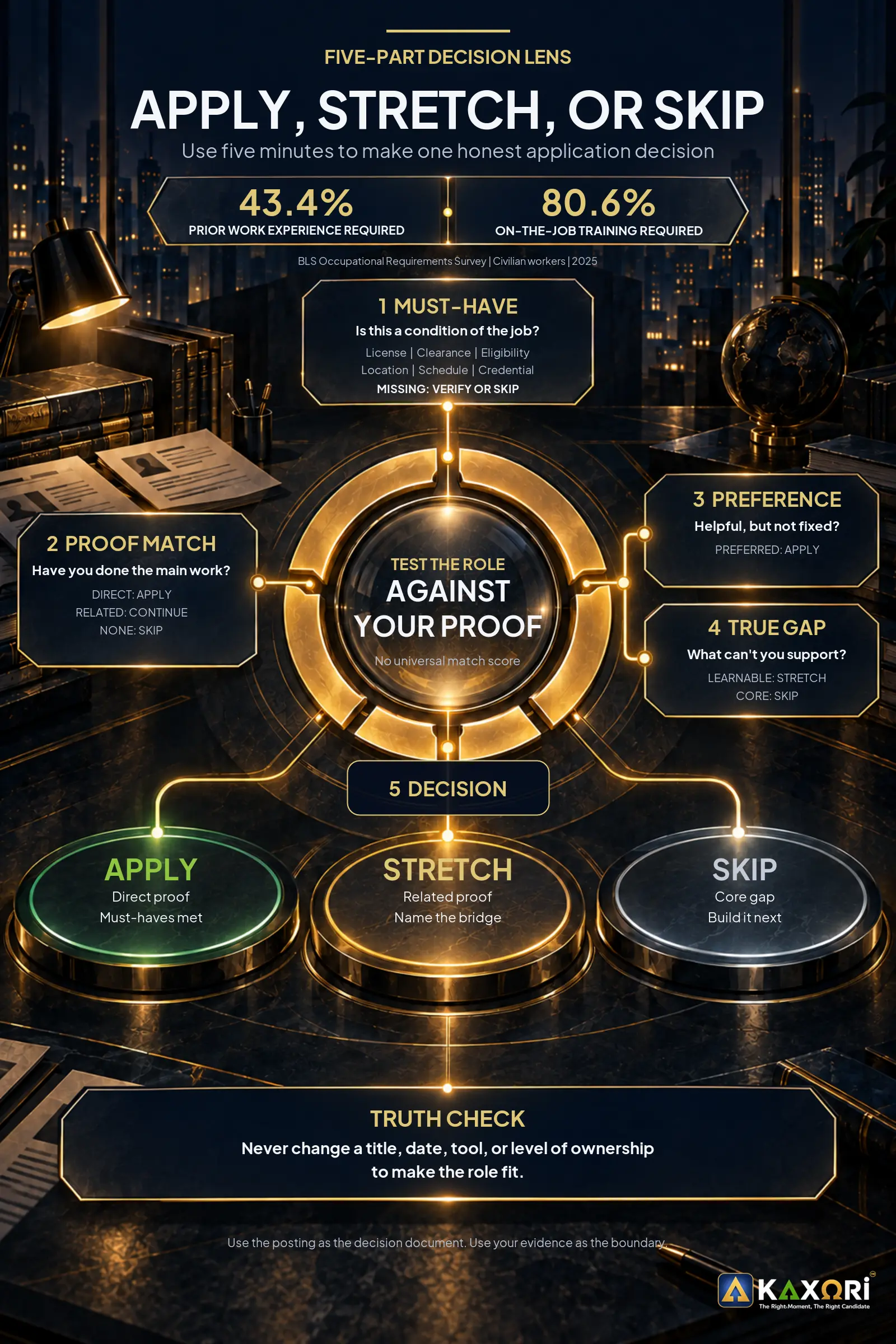
The U.S. Bureau of Labor Statistics Occupational Requirements Survey found that prior work experience was required for 43.4% of civilian workers in 2025. On-the-job training was required for 80.6%.
Fewer than half of civilian workers were in jobs where prior work experience was required. Four out of five were in jobs that required training after they were hired. Those figures do not tell you what one employer will do with one posting. They do show that an experience line is not a universal wall and that learning after hire remains a normal part of work.
BLS defines prior work experience as the amount of prior relevant work activity. That word matters: relevant. The strongest comparison is between the work the employer needs and the work you can prove, not just between two job titles.
For Ethan, that meant he could not turn 18 months into three years. He could count real work from his internship, campus role, and freelance project, as long as he kept each source clear. The Kaxori guide What Counts as Work Experience? Turn Overlooked Work Into Résumé Proof shows how to test and label those less obvious sources of experience.
Why there is no honest match percentage
You may have heard that you should apply when you meet a certain percentage of the requirements. There is no dependable percentage that works across jobs, employers, and industries.
Missing one required nursing license is not the same as missing one preferred software tool. Matching eight minor bullets does not cancel a gap in the job's central responsibility. Counting lines gives every requirement the same weight when they do not carry the same consequence.
There is evidence that employers are looking at skills. In the NACE Job Outlook 2026 survey, 70% of responding employers said they used skills-based hiring. Among those employers, 87% used it in interviews, 81% in job descriptions, and 65% in screening.
The survey had 183 employer respondents, mostly NACE members, and focused on early-career recruiting. It is not a count of every U.S. employer. Its useful point is simple: show proof of your skills. Do not expect a hiring trend to erase a stated must-have.
Not every line carries the same weight.

The five-part Apply, Stretch, or Skip test
Put the job description beside your résumé or evidence library. Sort the important requirements before you decide.
| Part | Question | What it means |
|---|---|---|
| 1. Must-have | Is this a condition of doing the job? | License, eligibility, clearance, location, schedule, or credential. Treat it as real unless another path is stated. |
| 2. Proof match | Have I done the main work? | Match duties, choices, tools, people, and results. Titles may differ when the work is related. |
| 3. Preference | Would this help but may not be fixed? | Preferred, desired, a plus, or familiarity. Other strengths may help. The employer decides. |
| 4. True gap | What important work can I not support? | Name the missing skill, ownership, scale, or knowledge. Do not hide it with keywords. |
| 5. Decision | Is this apply, stretch, or skip? | Apply with direct proof. Stretch with an honest bridge. Skip when the main fit cannot be defended. |
1. Mark the must-haves
Start with conditions you either have or do not have. A professional license is the clearest example. CareerOneStop's License Finder lets you check occupational licensing information by state. An employer cannot simply ignore a license the law requires.
Federal job announcements also require special care. USAJOBS states that applicants must meet the qualifications listed in the announcement to be considered. Do not carry flexible private-sector advice into a federal application with explicit eligibility and qualification rules.
Also check work location, schedule, travel, required documents, and any direct screening questions. If the role requires something you cannot truthfully confirm, stop and investigate before applying.
2. Find the proof match
Now move past the title. Break the role into its central duties. For each duty, identify work you have actually performed.
- What problem did you solve?
- What action did you take?
- Who depended on the work?
- What changed because of it?
The O*NET Job Duties search draws from more than 19,000 occupation-specific task statements. It can help you compare the work behind different titles. It cannot decide whether a particular employer considers you qualified.
When the proof is nontraditional (freelance, volunteer, internship, project, or career-break return work), run the same four questions from What Counts as Work Experience: work, ownership, proof, and relevance. Keep the label honest.
Claim less. Prove more.

3. Separate preferences from requirements
Read the employer's labels. Preferred, desired, helpful, and a plus usually signal an advantage rather than a stated condition. Required, must, and minimum deserve more caution.
Still, do not assume every employer uses those words with perfect consistency. Read the whole posting. Look at the duties, screening questions, application instructions, and required documents. When the posting gives a recruiter or hiring contact, ask a precise question instead of asking, "Am I qualified?"
A useful question sounds like this: "The role lists three years of CRM reporting. I have 18 months of direct reporting experience plus two years analyzing campaign performance in another platform. Is the three-year requirement fixed?"
4. Name the true gap
A true gap is not a missing keyword. It is work, authority, knowledge, or a condition you cannot support.
- The role owns a budget, but you have never managed one.
- The role supervises a team, but you have only coordinated peers.
- The job requires production-level coding, but you have completed only coursework.
- The position requires an active license or clearance you do not hold.
- The job needs fluent communication in a language you do not speak.
A true gap does not always mean never. It may mean not this role yet. That distinction can save you from a weak application and point you toward the experience you need next.
5. Decide: apply, stretch, or skip
Apply when you meet the must-haves and have direct proof of the main work. You may still miss a preference or a tool you can reasonably learn.
Stretch when your evidence is adjacent but credible. The application should explain the bridge clearly. It should not make the employer build the connection alone.
Skip when the role depends on a qualification, responsibility, or skill you cannot support. Also skip when your only way to look qualified is to change a title, inflate ownership, extend dates, or claim a tool you have not used.
Build the honest bridge.

Skip when:
- You do not meet a required license, clearance, or legal condition.
- The role depends on core ownership you have never held, such as managing people, budgets, or production systems.
- A screening question would require a false "yes."
- The only way to appear qualified is to invent or inflate experience.
Ethan's decision
Ethan returned to the junior marketing coordinator posting. It asked for three years of experience. The main work included email campaigns, CRM reporting, vendor coordination, and monthly performance summaries.
He had 18 months in a paid internship, one year leading email and event promotion for a student group, and a freelance project with campaign reporting. He had used a different CRM.
Ethan's five-part assessment
- Must-have: No license, clearance, legal, or location barrier appeared.
- Proof match: Ethan had done three of the four main duties in real settings.
- Preference: The employer preferred one CRM. Ethan knew a related platform.
- True gap: He had less paid time than requested and had not used the exact tool.
- Decision: Stretch. His bridge was real, but he had to show where each part came from.
Three years of marketing experience with advanced CRM reporting and vendor management.
That sentence would turn Ethan's mixed experience into a cleaner claim than his facts supported. It also called his CRM skill advanced without proof.
Built and reported on email campaigns across a paid internship, campus leadership role, and freelance project. Coordinated vendors and used CRM data to prepare monthly performance summaries.
This version did not hide where the experience came from. It showed the work and left the employer free to decide whether the bridge was strong enough.
Make one clean decision.

How the test works for career changers and returners
Career changers and people returning to work can use the same five-part test. Their strongest proof may come from an earlier role, another industry, contract work, volunteer leadership, or a recent project.
A career break or different title is not automatically a true gap. The real question is whether the person can support the role's main work and meet its stated conditions. Keep the timeline honest. Show the relevant work. Do not invent continuity that was not there.
Experienced professionals can face the opposite problem when their background appears larger than the role. In that case, read Overqualified for a Job? How to Show Why the Role Still Makes Sense. Under-experience and overqualification are different risks, but both require a truthful fit story.
When to skip instead
Change Ethan's role. Suppose it owns a large marketing budget, manages five people, and sets company strategy. Ethan has helped with campaigns. He has never owned a budget, managed employees, or set strategy.
Matching the software would not fix that gap. The missing issue is ownership. That is a skip decision, or a sign to target a role one step closer to his current proof.
Ethan stopped asking whether he could check enough boxes. He started asking whether he could defend the work that mattered most.
What your résumé needs to do next
Once you decide the job is defensible, your résumé has a focused job. It should make the strongest relevant evidence easy to find.
- Use the employer's accurate language when it describes work you really did.
- Move the strongest proof closer to the top by using the Prioritize, Move, Prove, Trim method from One Résumé. One Job. What Good Tailoring Actually Changes.
- Show scope, decisions, people served, and outcomes where you can verify them.
- Keep the source of the experience honest, including internships, contract work, volunteering, projects, career breaks, or employment.
- Remove less relevant detail that hides the match.
Do not add a skill just because the posting asks for it. Use Match, Translate, and Gap from Your Résumé Needs the Right Keywords, Not More Keywords to keep direct matches, translate related work truthfully, and leave real gaps honest.
Do not rename participation as ownership. Do not let an AI tool fill a gap with a sentence that only sounds likely. Use The Five-Second Résumé Credibility Test before you send the résumé. AI can compare and organize the facts you provide. It cannot verify work you never gave it.
If you need a cleaner place to store the proof behind a stretch, build that evidence before you rewrite. Your Résumé Isn't Your Career Memory. Here's What to Save Instead explains what belongs in a career evidence file.
Before you apply: a 60-second check
Ask these five questions:
- Must-have: Is there a license, eligibility, clearance, location, or screening condition I cannot meet?
- Proof: Can I name the main duties and point to real work for most of them?
- Bridge: If this is a stretch, can I explain the bridge in one clear paragraph without inventing titles or dates?
- Gap: What true gap remains, and am I willing to leave it honest?
- Decision: Apply, stretch, or skip?
If one answer is weak, fix that part before you apply. If the role itself is wrong, do not force the application.
Take the five-part decision lens with you.
Where Kaxori fits
Kaxori helps you compare one résumé with one real job description. An ATS Check can help surface job-specific language, missing terms, relevant evidence, and areas that need review before you apply.
Kaxori cannot see an employer's private hiring rules. It cannot decide whether a requirement will be waived. It cannot create experience, verify facts it was not given, or guarantee a response, interview, ranking, or offer.
The final decision stays with you and the employer. Kaxori's role is to help you make your truthful case easier to see.
Frequently asked questions
Should I apply if I am one or two years short of the experience requirement?
Possibly. Do not decide from the number alone. Check whether you meet the must-haves and whether your proof covers the main work. A smaller time gap with strong, related proof may be a fair stretch. The employer still decides whether it is enough.
What if the experience is labeled required?
Treat the wording seriously. Review the duties, screening questions, and instructions. If the application asks you to confirm a minimum you do not meet, answer truthfully. Federal announcements and regulated jobs often apply requirements more strictly.
Should I apply without the listed degree?
Check whether the degree is required by law, regulation, policy, or the employer's stated rules. Then look for any accepted education or experience equivalency in the posting. Do not assume experience replaces a degree unless the employer allows that path.
Why do entry-level jobs ask for several years of experience?
Entry level does not always mean no experience. Employers may count internships, projects, part-time work, or related experience, but postings differ. Experienced professionals can also see junior labels paired with senior-sounding duties. Read the work and the stated minimums instead of relying on the label alone.
Can an applicant tracking system reject me for missing a requirement?
Employer systems and screening rules vary. Some applications use direct questions about licenses, authorization, location, education, or experience. A keyword score cannot tell you how one employer's private system will make a decision.
What percentage of the job requirements should I meet?
There is no reliable universal percentage. Weight the requirements by consequence. One missing legal or professional requirement can matter more than several preferred qualifications.
How can I show related experience without exaggerating?
Name the work, where you performed it, what you owned, and what happened. Use the employer's terminology only when it accurately describes your experience. Keep internships, freelance work, volunteer work, coursework, career breaks, and employment labeled honestly.
When is skip the smart move?
Skip when a must-have is missing, when core ownership is absent, when a screening question would force a false answer, or when the only way to look qualified is invention. A skip can also point you to a nearer role that builds the missing proof.
Make one clean decision
Take one job description and mark its must-haves, proof matches, preferences, and true gaps. Then choose: apply, stretch, or skip.
If you apply, lead with proof. If you stretch, explain the bridge. If you skip, use the gap to choose what to build next. Like Ethan, you do not need false confidence. You need a decision you can defend.
Make the fit easier to see.
Use the ATS Check as a second read on language, evidence, and gaps. Keep every fact yours.
Sources
- U.S. Bureau of Labor Statistics, Occupational Requirements Survey: Civilian Workers. 2025 estimates.
- U.S. Bureau of Labor Statistics, Occupational Requirements Survey definitions. Definition of prior work experience.
- O*NET OnLine, Job Duties Custom List. U.S. Department of Labor sponsored.
- CareerOneStop, License Finder. U.S. Department of Labor sponsored.
- USAJOBS, How to understand job-announcement requirements. Federal applicant guidance.
- National Association of Colleges and Employers, Employer Use of Skills-Based Hiring Practices Grows. Job Outlook 2026 survey.
Editorial source note
This article uses U.S. government labor data, federal hiring guidance, a U.S. Department of Labor sponsored database, and a survey from a college recruiting association. National data cannot predict how one employer will read one posting. The NACE findings describe the employers that answered its survey. No cited source supports a universal match percentage or a guaranteed hiring result.